Types of Cypress Oil: Four Oils That Share a Name
Search for cypress oil and the bottles do not all agree. One smells like a pine grove, another like warm honeyed wood, another like a Japanese bathhouse. They are different plants, different plant parts, sometimes different continents, all sharing a word. A little sorting makes shopping much easier.
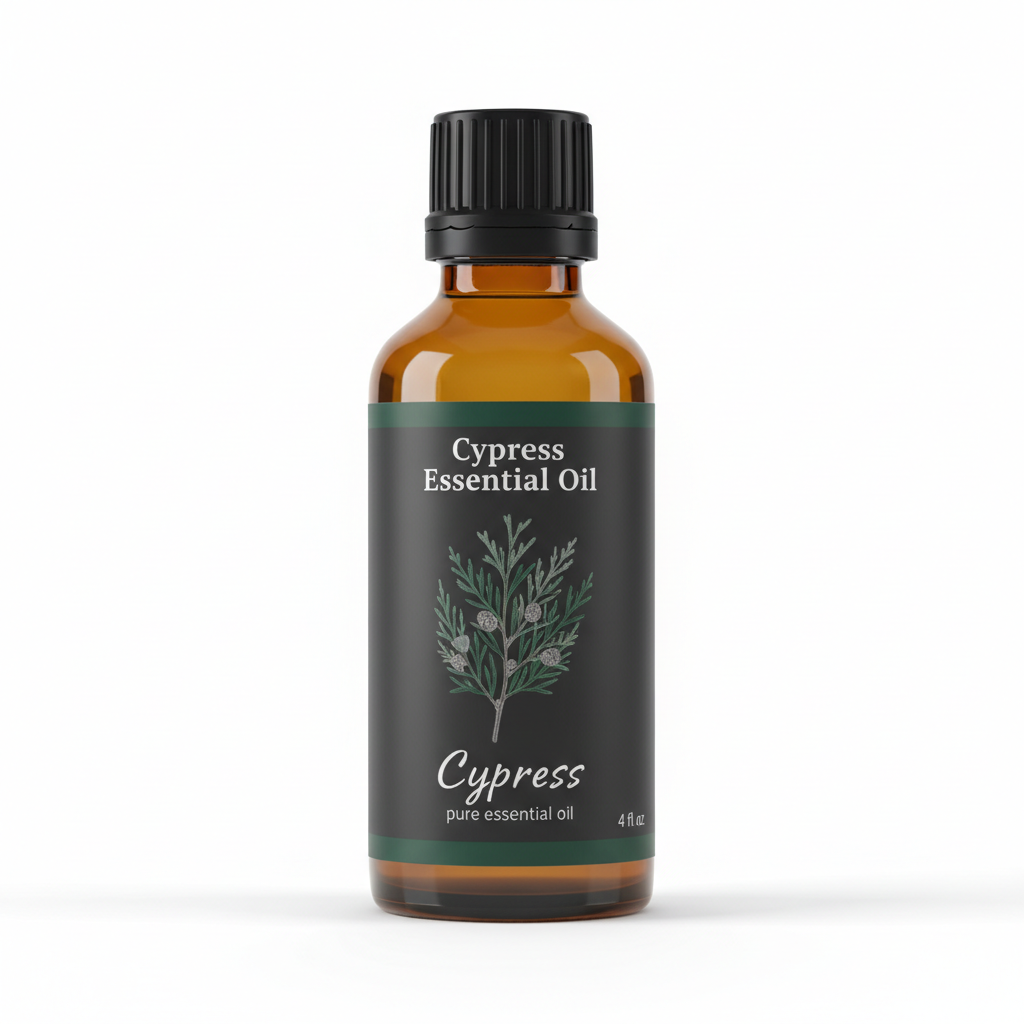
Cypress Essential Oil
Our own Cypress Essential Oil, in sizes from 0.5 oz to bulk.
From $10.99
Shop Now →Start with the Latin name
"Cypress" on a label is a common name, and common names are loose. The Latin name is what tells you what is in the bottle. For the classic oil, look for Cupressus sempervirens, the tall, narrow Mediterranean cypress. That is the one we sell, steam-distilled from the green growth of the tree. If you want the full picture of it first, our guide to cypress essential oil is the place to start.
The field, one by one
Mediterranean cypress
In one published analysis, the oil was led by alpha-pinene (about 49%) and delta-3-carene (about 22%), with smaller amounts of limonene and terpinolene. The result is a scent that opens green and dry, then settles into something resinous and a little smoky. It blends easily with citrus and other conifer oils.
Blue cypress
Blue cypress is Callitris intratropica, an Australian tree, and its oil is distilled from wood. A conference abstract on native Australian Callitris oils reports guaiol at about 17% to 21% and dihydrocolumellarin at about 12% to 20% in it. Those are heavier, woodier molecules than the pinene-rich needle oil, which fits a warmer, rounder scent. Our blue versus Mediterranean cypress piece goes into the detail.
Hinoki
Hinoki is Chamaecyparis obtusa, a Japanese tree from another genus. A study of its wood oil from Taiwan found a different cast of compounds, led by alpha-terpineol (about 19%), tau-muurolol and borneol, rather than pinene. It is the one to look for if you imagine the scent of fresh-cut bath wood. We cover it in hinoki and Japanese cypress oil.
The mix-up: Cyperus rotundus
Cypriol or "cypress rotundus" is not a tree at all. It is the rhizome oil of a grass-like plant, Cyperus rotundus. In one analysis of its rhizome oil, alpha-cyperone led at about 38%. Despite the similar name, it belongs to a separate world of smoky, earthy perfumery, and our article on cypress rotundus oil sorts out the confusion.
Why the confusion is so common
Part of the muddle is simply history. The word cypress has been used for a long time in many languages for tall, dark, evergreen trees, and people borrowed the name for plants that looked or smelled a bit similar. Sellers inherit the habit, and a bottle that says "cypress" can mean quite different things depending on who wrote the label. This is why we put so much weight on the Latin name. It is the one piece of text on a label that has an agreed meaning.
Learning the four by nose
If you get the chance to smell more than one, do it on blotter strips, labelled in pencil, with a breath of fresh air between each. You'll notice that the Mediterranean oil reads green and dry, the blue cypress feels rounder and more wood-like, the hinoki feels like a clean wooden bath, and the cypriol feels earthy and smoky and somehow older than the rest. The differences are not subtle once you have them side by side, and the exercise is worth doing even if you only plan to use one of them.
How to choose
- Want a clean, green, dry evergreen? Mediterranean cypress.
- Want warm, soft wood? Look into blue cypress, and read the label for the species.
- Want bath-wood freshness? Hinoki.
- Want smoky root and earth? Cypriol, from a perfumery supplier.
We sell the Mediterranean oil only, so the others will need another shop. A sensible dilution for ours on skin is 0.5% to 2% in a carrier oil, with a patch test first. It is an external, cosmetic oil, and since the other oils on this list have their own composition, check each one's own safety information before using it.
It is also worth keeping your bottles clearly marked. Four oils with similar names will look alike on a shelf, so a strip of tape with the Latin name and the opening date saves guessing. A tidy label is a small bit of care that keeps your blends predictable.
If you are only just starting out, a gentle plan is to learn the Mediterranean oil first, because its scent is the one most people picture when they hear the word cypress. Once you know it well, the others will make sense as variations: warmer, woodier, more floral or more earthy. Having one oil in your nose as a reference makes every later comparison easier, and it keeps you from buying a bottle just because the name sounds familiar.
The easiest rule is also the most reliable one: if it does not name the plant, ask. A good seller will be glad you did.
Cypress Essential Oil
Cypress Essential Oil from our own shop, in sizes from 0.5 oz to bulk.
From $10.99
Shop Now →Sources & Further Reading
- Selim SA et al. Chemical composition, antimicrobial and antibiofilm activity of the essential oil and methanol extract of the Mediterranean cypress (Cupressus sempervirens L.). BMC Complement Altern Med 2014. PubMed 24890383
- Oprava A et al. Chemical composition and biological activity of the essential oils from native Australian Callitris species. 59th International Congress of the Society for Medicinal Plant and Natural Product Research, 2010 (abstract). Southern Cross University research portal
- Chien et al. Chemical composition and anti-inflammatory activity of Chamaecyparis obtusa f. formosana wood essential oil from Taiwan. Nat Prod Commun 2014. PubMed 25026733
- Hu et al. Chemical Composition, Antioxidant, DNA Damage Protective, Cytotoxic and Antibacterial Activities of Cyperus rotundus Rhizomes Essential Oil against Foodborne Pathogens. Sci Rep 2017. PubMed 28338066