Cypress Rotundus Oil: What the Name Really Means
If a listing, a recipe or a supplier sheet says "cypress rotundus oil," it has probably welded together two real Latin names. Cupressus sempervirens is the Mediterranean cypress, and it is the tree behind the oil we sell. Cyperus rotundus is a different plant altogether, a sedge whose underground rhizomes are distilled into an oil with its own character. We do not sell the second one, and we could not find "cypress rotundus" listed as an oil in any source we read.
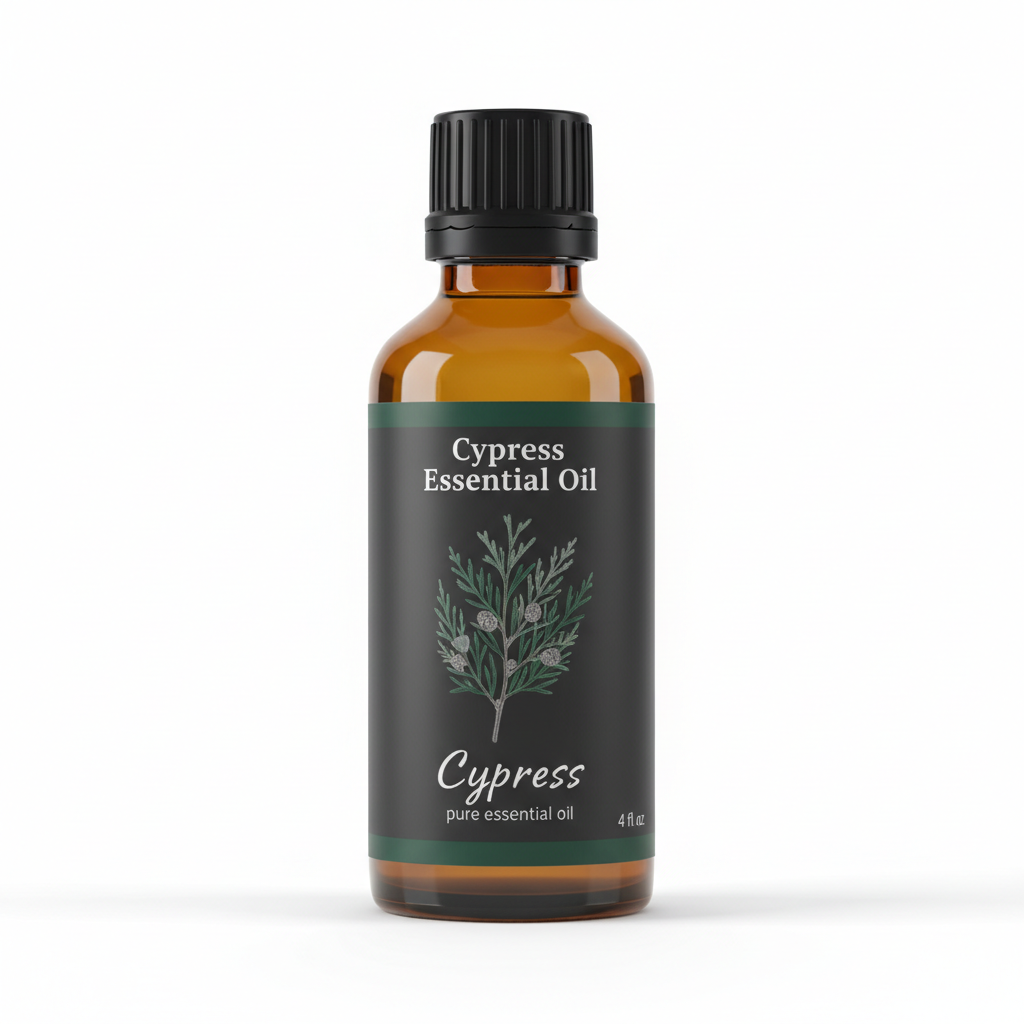
Cypress Essential Oil
Our own Cypress Essential Oil, in sizes from 0.5 oz to bulk.
From $10.99
Shop Now →Two words, two plants
"Cypress" is a common name, and "rotundus" is a species epithet that means round. Neither identifies a plant on its own. The Latin binomial does: Cupressus sempervirens is a conifer, and the published analyses of Cyperus rotundus oil that we found all distilled its rhizomes. We cannot tell you how the merged phrase first appeared. Our best guess, and it is a guess, is that two Latin names starting with similar letters got blended into one.
The practical lesson is a good habit for any oil: read the Latin name, not the nickname, and ask which part of the plant was distilled.
What the chemistry shows
Analyses of the two oils read like different languages. In one published analysis of a Mediterranean cypress oil, alpha-pinene led at about 49 percent, followed by delta-3-carene at about 22 percent. In a rhizome oil from China, the leaders were alpha-cyperone (about 38 percent), cyperene and alpha-selinene. Those are different molecules entirely, and they do not turn up among the leaders of the cypress sample.
The picture is not perfectly tidy, and we would rather you see that than a simplified rule. Two Cupressus samples can differ sharply: an analysis of aerial parts from Giza, Egypt found cedrol at about 74 percent with alpha-pinene near 5 percent, far from the first sample. Robert Tisserand notes that cypress oil is quite varied in its composition, depending on how much leaf and cone is distilled. And two Cyperus rotundus samples from neighboring sites in South Africa had different lead compounds from each other, one of them with alpha-pinene and beta-pinene both near 11 percent. So a single shared compound on a chart does not prove a shared plant. Identity rests on the whole profile and on the Latin name together. Each figure here is one sample, from one place, by one lab, so read them as a guide to the kind of oil, not a purchasing spec.
The paperwork check
A good listing names the Latin binomial, gives a batch or lot, and offers an analysis that fits the name. On our side, the Certificate of Analysis we publish for one batch names Cupressus sempervirens and lists density, refractive index and optical rotation. It does not include GC-MS figures. If you need compound percentages for a lot, ask us in writing through the contact page before ordering. Our walkthrough of our batch report explains each line, and how to spot a genuine cypress oil covers questions to put to any seller. Our page on how cypress oil is made describes the steam distillation.
Why this kind of mix-up happens
Oil names are a bit like nicknames for people. They get shortened, mispronounced and passed along until the original is hard to recognize. A seller copies a name from a spreadsheet, a blogger copies it from the seller, and soon a phrase appears that no botanist ever wrote. It is rarely anyone's bad intention. It is usually just habit, and that is why a good habit on your side, checking the Latin name every time, matters so much.
If you have the wrong bottle
- It says only "cypress rotundus": ask the seller for the Latin name and plant part in writing. If they cannot say, treat it as unidentified and leave it off your skin.
- It says Cyperus: you have a rhizome oil, a legitimate material of its own, though not a stand-in for cypress. Our substitutes guide talks about swaps.
- It says Cupressus sempervirens: that is the Mediterranean cypress, the same species we sell. For other named cypress oils such as blue cypress or hinoki, read the types of cypress oil.
A small habit worth keeping
Whenever you buy any oil, take a photo of the label and the Latin name before you start using it. Save it with a note about the date and where it came from. If a question comes up later, from a friend, a customer or a clinician, you will have the answer in a moment and will not have to guess from memory.
A word on using Cyperus oil
We do not offer guidance for Cyperus rotundus oil. Our 0.5% to 2% dilution guidance applies to the cypress we sell, and should not be borrowed for another plant. The laboratory work we read on the rhizome oil, covering antioxidant, DNA and antibacterial tests, was done in vitro, which tells you little about its use on skin or in a diffuser. For a rhizome oil you plan to use on skin, consult a safety reference such as Tisserand and Young's Essential Oil Safety, and for medical questions a pharmacist or physician.
If you are still unsure after reading a listing, a polite email to the seller usually clears it up. A seller who is happy to name the plant and the part used is a good sign. A seller who goes quiet is also telling you something.
The rule of thumb is short: ignore the nickname, read the Latin name, and ask for paperwork that matches it.
Cypress Essential Oil
Cypress Essential Oil from our own shop, in sizes from 0.5 oz to bulk.
From $10.99
Shop Now →Sources & Further Reading
- Selim SA et al., 2014. Chemical composition, antimicrobial and antibiofilm activity of the essential oil and methanol extract of the Mediterranean cypress (Cupressus sempervirens L.). BMC Complementary and Alternative Medicine 14. PubMed 24890383
- Ibrahim TA et al., 2017. Chemical composition and antimicrobial activities of essential oils of some coniferous plants cultivated in Egypt. Iranian Journal of Pharmaceutical Research 16(1):328-337. PMC5423258
- Hu QP et al., 2017. Chemical composition, antioxidant, DNA damage protective, cytotoxic and antibacterial activities of Cyperus rotundus rhizomes essential oil. Scientific Reports 7. PubMed 28338066
- Lawal OA, Oyedeji AO, 2009. Chemical composition of the essential oils of Cyperus rotundus L. from South Africa. Molecules 14(8):2909-2917. PubMed 19701133
- Robert Tisserand, Tisserand Institute. Cypress oil as a deodorant and a problem with citing books as references. tisserandinstitute.org/cypress-oil-as-a-deodorant