How to Read a Cypress Oil Label Before You Order
"Pure" is the cheapest word on any oil label. It costs nothing to print and tells you nothing you can check. The things that do tell you something are less glamorous: a Latin name, a lot number, a plant part, and papers that match the bottle. Here is how we would read a cypress label, and what we put on ours.
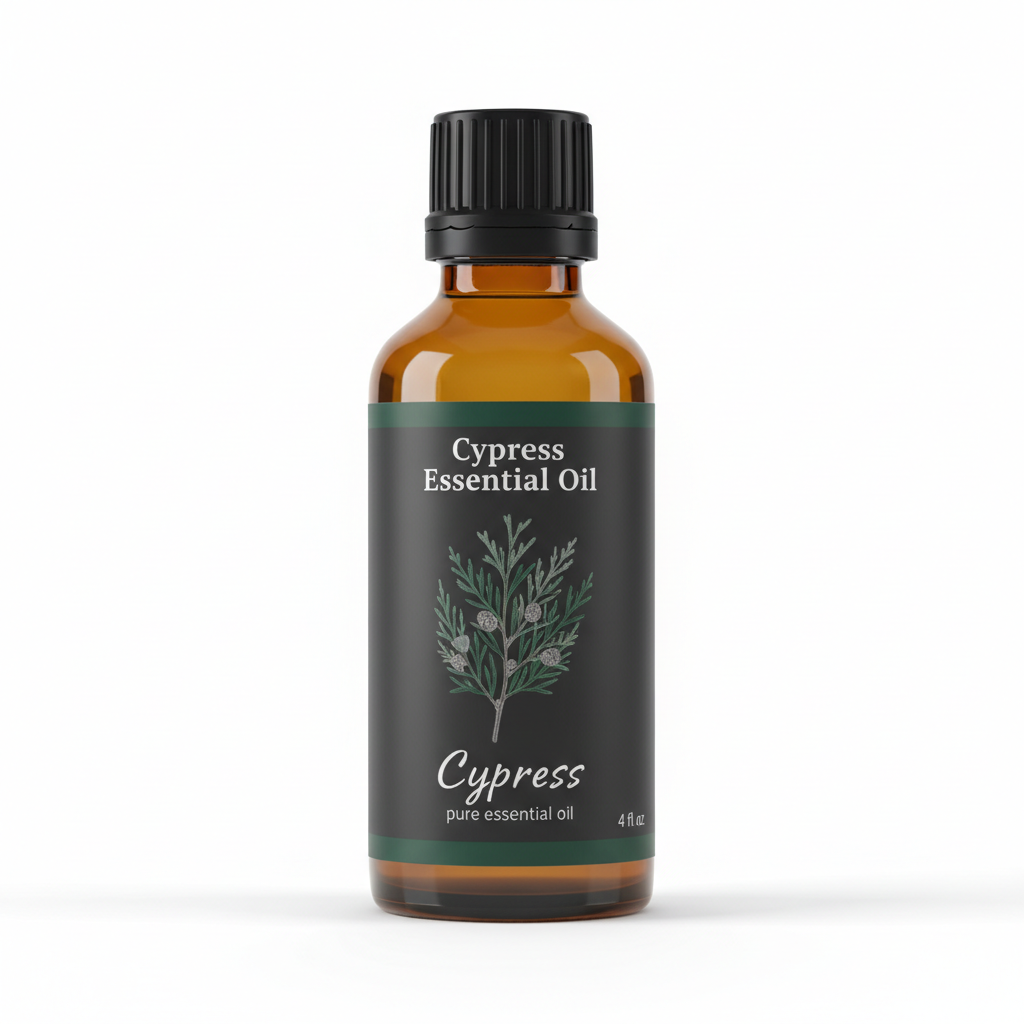
Cypress Essential Oil
Our own Cypress Essential Oil, in sizes from 0.5 oz to bulk.
From $10.99
Shop Now →Start with the botanical name
"Cypress" is shared by several different trees, so the Latin name is the first filter. You want Cupressus sempervirens, the Mediterranean cypress. Hinoki (Chamaecyparis obtusa) and blue cypress (Callitris intratropica) are different oils with different chemistry. A seller who knows what they distilled has no reason to leave the name off. Our guide to cypress types shows the differences.
Do the same with the rest of the label, line by line. A lot number, a size, an opening date, a storage note: each one is a small sign that someone paid attention. The labels worth trusting are often a little dull, with no poetry on them at all. When a label gets very poetic and very short on facts, we recommend slowing down.
Lot number and freshness
A lot number lets a document be matched to the bottle on your shelf, and a date lets you judge age, which matters for a conifer oil. Our bottles are amber glass and carry a lot number. Treat any best-by date as a ceiling rather than a promise. The Tisserand Institute's general advice is to keep oils cool, dark and sealed, and conifers are among those that change sooner.
A practical trick is to write the date you open the bottle on the label with a marker. It takes five seconds and gives you a rough age to go by, and it is particularly useful when you have several bottles on a shelf and no memory of which came first. Keep the cap tight, and the bottle somewhere cool and dark, and you'll have a much easier time judging when it is time to replace it.
What a batch report can tell you
Different tests answer different questions. Density, refractive index and optical rotation are quick physical measurements; together they can catch crude dilution or an oil from the wrong family. The Certificate of Analysis we publish for one batch (batch CYPQGCCSUSC005A) lists a relative density of 0.864 at 20 C against a standard range of 0.860 to 0.880, a refractive index of 1.469 against 1.460 to 1.480, and an optical rotation of +16.08 degrees against +9.00 to +27.00. All three sit inside their ranges.
Physical measures do not show composition, and that is where GC-MS comes in. A 2026 study of fourteen pine oils from one market tested them against the European Pharmacopoeia monograph, including GC-MS, and none complied. That was pine, but it is a good reminder of why composition data matters. If you need a GC-MS report for a lot of our cypress, ask us in writing through the contact page before ordering.
Expect natural variation
Do not expect every cypress oil to match one profile. One published analysis found alpha-pinene at 48.6% and delta-3-carene at 22.1%; another, on aerial parts from Egypt, found cedrol at 74% with alpha-pinene at 4.6%. Plant part, place and season all matter, and a good report is read as "consistent with cypress", not "identical to last time". Our walk-through of our certificate shows how to read one.
Use your nose last, but do use it
After the paperwork, the bottle itself has the final word. Open it and smell from a hand's width away, not right up against the opening. A cypress oil should smell like a green, dry, resinous evergreen, with a clean opening and a woody finish. If the smell is oddly sweet, flat, harsh or sour, trust that impression and ask the seller about it. Put a drop on a blotter strip and come back after ten minutes and again after an hour, and you'll notice how the scent develops. A real plant oil moves and changes on the strip, while a flat one tends to stay in one place.
A short label routine
- Latin name written out in full.
- A lot number that matches a document.
- Dark glass and a tight cap.
- A way to ask questions, and an answer when you do.
Print that list or keep it on your phone. It works for any oil label you meet, and it takes about a minute to run through.
Price as a clue
A very low price for a single-species conifer oil is worth a question, because the oil is a small fraction of the plant that goes into the still. Our cost guide explains why.
Keep in mind that a label is only as useful as your willingness to question it. Hold it up against what the product page says, what the document says and what your nose says. When all three agree, you can relax. When one of them is out of step, send a short message and ask. Most sellers, including us, would much prefer a question before an order to a surprise after it.
Read the label, ask for the paper, and let the oil confirm what the page promised.
Cypress Essential Oil
Cypress Essential Oil from our own shop, in sizes from 0.5 oz to bulk.
From $10.99
Shop Now →Sources & Further Reading
- Senturk et al. 2026, Molecules 31(4): pine turpentine oils on the Turkish market tested against the European Pharmacopoeia monograph
- Selim et al. 2014, BMC Complementary and Alternative Medicine 14: composition of Cupressus sempervirens oil
- Ibrahim et al. 2017, Iranian Journal of Pharmaceutical Research 16(1): essential oils of coniferous plants cultivated in Egypt
- Tisserand Institute: Keep essential oils cool