Cypress Oil COA Explained: Reading Each Line
A Certificate of Analysis is a small piece of paper with a lot of authority attached to it. Most people glance at the word "Complies," feel reassured and move on. It is more rewarding to read the thing properly, and ours is short enough to do it in a few minutes. Here is the one-page certificate we publish, line by line, available as a PDF.
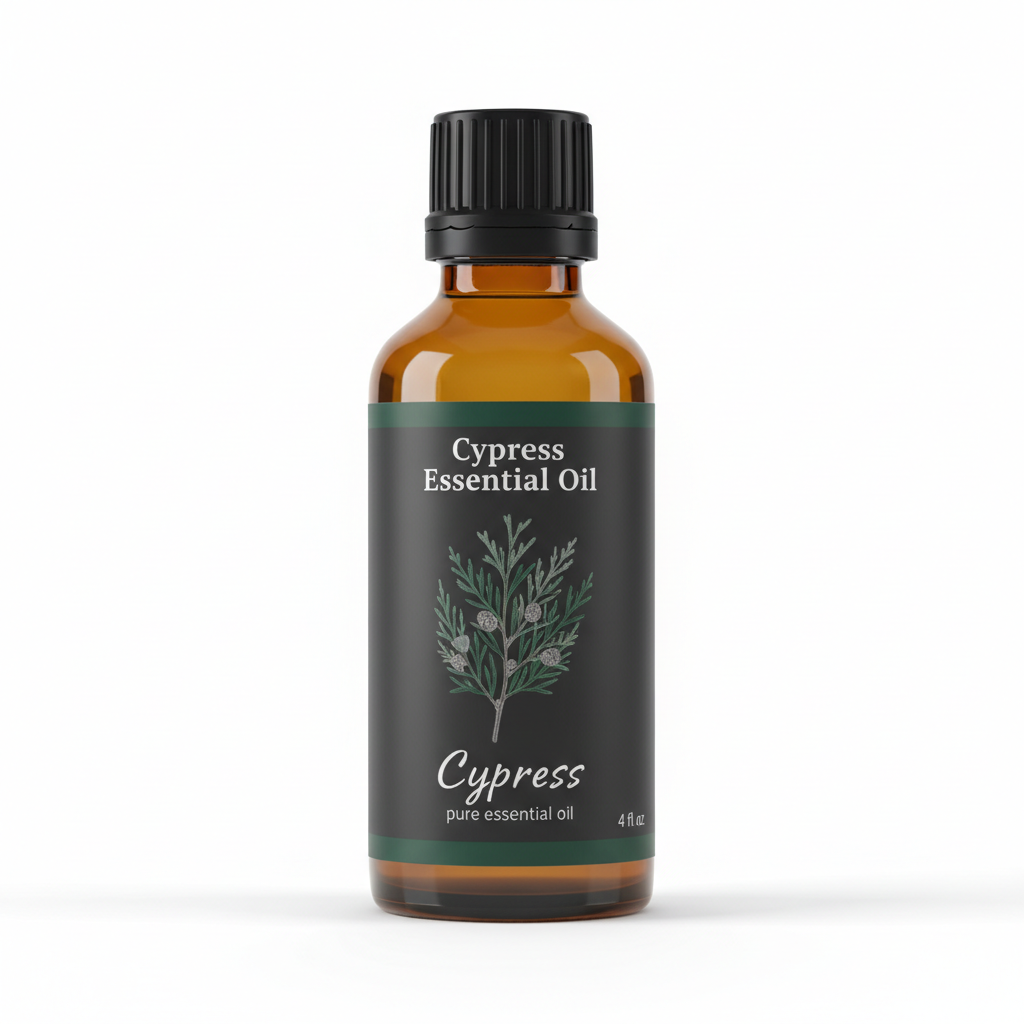
Cypress Essential Oil
Our own Cypress Essential Oil, in sizes from 0.5 oz to bulk.
From $10.99
Shop Now →The identity block: what the paper is about
The first thing to check on any certificate is that it names a product and a batch. Ours is for Cypress Essential Oil, batch CYPQGCCSUSC005A, botanical name Cupressus sempervirens, with a best-by date of 04/30/2028. The batch number is the anchor, since it is the string that ties the paper to a physical lot. Because "cypress" is a common name that covers several trees, the botanical name is how a seller commits to a particular plant. This one is the Mediterranean cypress.
The best-by date is worth a brief note. Oils rich in alpha-pinene react with oxygen over time, and Hana Tisserand of the Tisserand Institute notes that oils oxidize faster with heat, light and air. A date like this assumes a closed bottle stored cool and dark, and a bottle you open often will age faster. Our storage guide shows how to slow that down.
The measurements
| Parameter | Result for this batch | Standard on the certificate |
|---|---|---|
| Appearance | Complies | Clear liquid |
| Smell | Complies | Pine-like, citrus, earthy |
| Relative density at 20 C | 0.864 | 0.860 to 0.880 |
| Refractive index at 20 C | 1.469 | 1.460 to 1.480 |
| Optical rotation at 20 C | +16.08 degrees | +9.00 to +27.00 degrees |
Appearance and smell
These are the human checks. An analyst looks at the oil for clarity, sediment or odd color, and smells it against the expected profile. They are quick and useful as a sanity check, and neither is chemistry.
Relative density: 0.864
This compares the oil's weight with the same volume of water. At 0.864, a milliliter of this batch weighs about 0.86 g, which is why cypress oil floats. It lands inside the 0.860 to 0.880 band on the certificate, at the lower end. A band exists because natural oils vary from batch to batch, so a reading toward one edge is ordinary. Density is also handy for your own arithmetic: it is the number we use to turn drops and milliliters into grams for the recipes on this site.
Refractive index: 1.469
This is how strongly light bends as it enters the oil, read on a small instrument called a refractometer. Every liquid has a characteristic value shaped by the molecules it contains, and temperature affects it, which is why the certificate states 20 C. The batch reads 1.469, comfortably inside its band.
Optical rotation: +16.08 degrees
Many of the molecules in essential oils come in mirror-image forms, and in a natural oil one form usually outweighs the other. Shine polarized light through the oil and it twists by an amount that is characteristic of the mix. Alpha-pinene, the leading molecule in published cypress analyses, is one of those mirror-image compounds. A reading of +16.08 degrees sits well within the printed +9.00 to +27.00 band.
What the conclusion says, and what it leaves for a different report
The certificate concludes that all tested parameters comply with pharmacopoeia standards for genuine Cypress Essential Oil (Cupressus sempervirens). That is a statement about the five measurements above, for the one batch named on it. Together they describe a clear liquid with the density, refractive index and optical rotation expected of this oil. An international standard for cypress oil exists too (ISO 20809:2017), which is a useful reference for the species.
What this certificate does not do is break the oil down into its individual molecules. That is the job of a gas chromatography report (GC-MS), which lists compounds such as alpha-pinene, delta-3-carene and cedrol with percentages. Different published analyses of cypress oil show quite different pictures, as our piece on the molecules behind cypress oil explains, so a compound table is genuinely informative for the buyer who needs it, such as a perfumer, a soap maker or a formulator. If that is you, ask us in writing through our contact page before ordering, and tell us which size you are considering. Wholesale buyers can use the wholesale page to talk it through.
A few honest tips for a first-time reader
If a certificate is new to you, do not feel you need to understand every number. Start by finding the product name and the batch number, then check that they match what you are holding. Next, look at each result beside its printed range, since a number means little without its range. If everything sits inside, the paper has told you what it can. If something is missing that you need for your own project, that is not a failure on your part. It simply means it is time to ask.
We would rather you ask us a question than guess. A short note through the contact page, naming what you are making, is the best way to find out whether our paperwork covers your needs.
How to read any certificate
- Match the batch number to your bottle.
- Check the botanical name against what you expected to buy.
- Note which measurements are listed, and which are not.
- Ask for anything the certificate leaves out, in writing, before relying on it.
Our buyer's guide has the broader checklist. Reading one page carefully takes only a few minutes, and it will serve you for every oil you buy afterward.
Whichever oil you are reading about, a certificate is a starting point for a good question, and a seller who welcomes the question is usually a good sign.
Cypress Essential Oil
Cypress Essential Oil from our own shop, in sizes from 0.5 oz to bulk.
From $10.99
Shop Now →Sources & Further Reading
- Certificate of Analysis, Cypress Essential Oil, batch CYPQGCCSUSC005A. cypressessentialoil-coa.pdf
- ISO 20809:2017, Essential oil of cypress (Cupressus sempervirens L.). genorma.com listing
- Tisserand H. Keep essential oils cool! Tisserand Institute. tisserandinstitute.org