Cypress Oil Substitutes: What to Reach For
Run out of cypress mid-blend and the question is not really "what is the same?" but "what was it doing?" Cypress can be a fresh green lift, a dry smoky middle, or a bridge between bright top notes and a woody base. Most stand-ins manage one of those jobs well and miss the others.
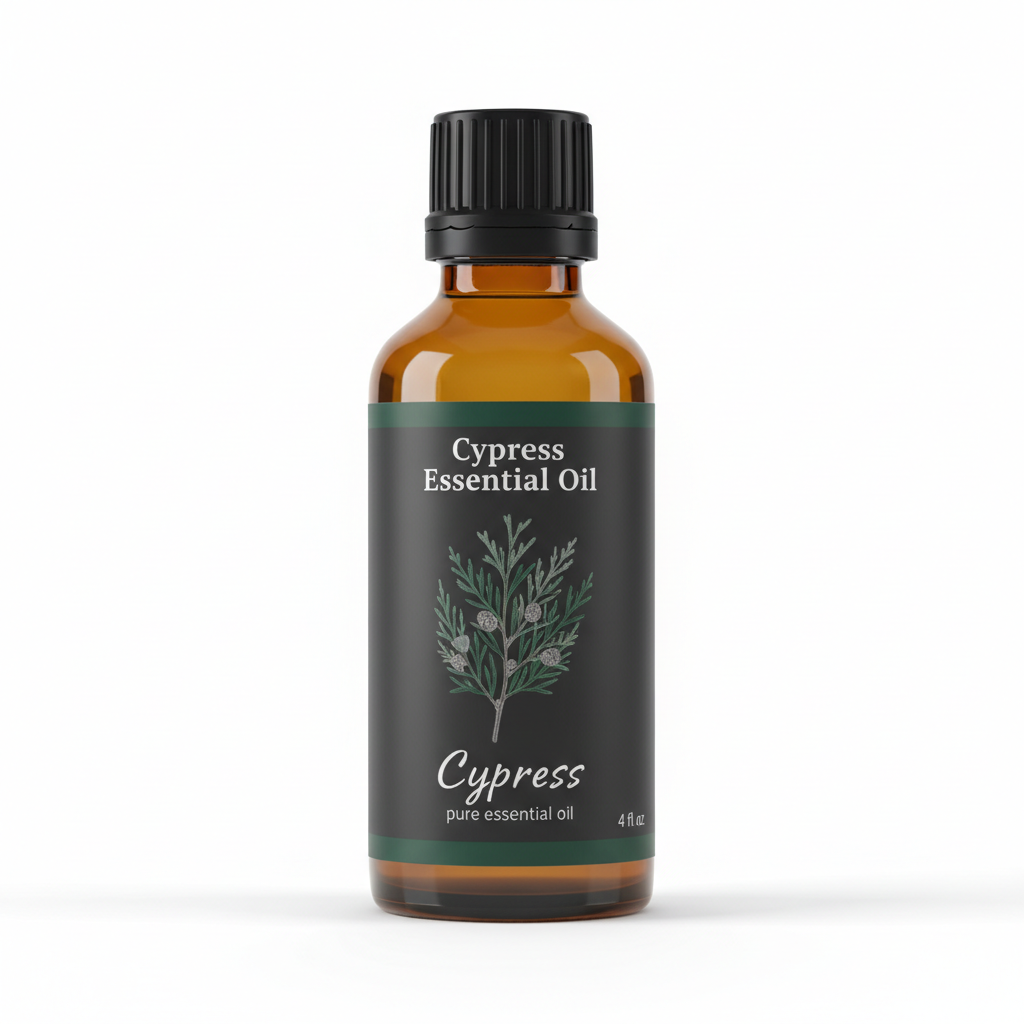
Cypress Essential Oil
Our own Cypress Essential Oil, in sizes from 0.5 oz to bulk.
From $10.99
Shop Now →Know your cypress first
Even cypress itself is not one fixed smell. We describe ours as fresh and smoky-green, drier and more refined than common pine oils, a top-to-middle note. Published analyses of Cupressus sempervirens oil show how much the material can move: one sample was led by alpha-pinene at 48.6% with delta-3-carene at 22.1%, another, from aerial parts grown in Egypt, was 74% cedrol. Robert Tisserand writes that cypress oil is quite varied, depending on how much leaf and cone is distilled. The practical advice that follows is simple: put your cypress and a candidate on separate blotters and smell them side by side.
For the green, fresh top: pine and fir
These are the nearest relatives. A 2026 study of Scots pine oil names alpha-pinene as its major compound, so pine shares cypress’s pinene backbone. A 2026 analysis of Moroccan fir (Abies marocana) was led by limonene at 38.5%, with alpha-pinene at 21.2%, which suggests fir can read brighter and more citrus-leaning. That is one fir from one place, so treat it as an illustration. Reasoning from it, pine is the closer match on structure, and fir is the choice when you want more sparkle. Neither quite reproduces the dry, smoky quality that makes cypress distinctive. Our pine and fir comparison sets them side by side.
For the pinene with a twist: juniper berry
A 2025 analysis of juniper berry oil identified 81 compounds with alpha-pinene at 22%. It is a pinene-bearing oil with a peppery, gin-like personality, and we list juniper among the oils cypress blends well with, which tells you it is a partner more than a double. Juniper is worth trying when the recipe wants an evergreen with a little more bite. Cypress vs juniper berry goes into it.
For the dry base: cedarwood
Cedarwood covers the woody half. A 2026 review of the wood oils from trees called cedar reports that Virginia cedarwood is rich in cedrenes, cedrol and thujopsene, while the true cedars lean toward himachalenes and atlantones. Those are heavier materials than the light molecules that dominate many cypress oils, so cedarwood supplies the dry, pencil-shaving depth but not the fresh opening. Our cypress vs cedarwood post covers how they complement each other.
The pair that gets closest
If you need to replace both the lift and the dryness, the data point to two oils: a pinene-rich needle oil for the top and a cedarwood for the base. Start with equal drops and adjust by nose, since that combination is a formulation idea, not a fixed recipe. The cypress pairing guide shows how those partners behave around cypress itself.
How to run a fair side-by-side
Set up three blotters: one for your cypress, one for the stand-in, and one that you will leave blank as a rest for your nose. Label them in pencil. Smell the cypress, wait a minute, smell the candidate, and then do it again in the opposite order. Come back in ten minutes and again in an hour. A substitute that matches at the start often drifts apart later, and the later stage is where your finished blend will spend most of its time.
Names that mislead
Two look-alikes are best avoided. Blue cypress is a different tree, Callitris intratropica, a wood oil whose leading components are guaiol and related compounds, not pinene; see blue vs Mediterranean cypress. "Cypress rotundus" blends the names of two plants and points toward Cyperus rotundus, a sedge whose rhizome oil is a different material altogether; that mix-up is explained here.
It also helps to adjust one thing at a time. If you swap an oil and change the drop count as well, you will never know which change did the work. Keep the other ingredients exactly the same, swap only the cypress, and write down what you notice. Small notes now make the next recipe quicker.
Swapping in a skin product
A dilution figure belongs to one oil, not to a scent family. Our 0.5% to 2% guidance is for our cypress oil; it does not transfer to pine, fir, juniper berry or cedarwood, which each have their own limits in IFRA standards and in references such as Tisserand and Young’s Essential Oil Safety. Conifer oils also oxidize faster than most, so an old, long-open bottle is a poor choice for skin. Similarity in scent is never a statement about safety around children, pets or pregnancy; for those questions, ask a pediatrician, a veterinarian or your own doctor.
When a recipe is for sale or has to smell the same next time, a swap makes it a new formula, and it is usually better to wait for the real thing. We sell cypress only, so for the stand-ins, a craft or supply shop is the place to look; if you are a maker who wants cypress in hand first, wholesale offers sample bottles.
When it is fine to just wait
Sometimes the honest answer is that nothing else will do. If your whole recipe was built around the dry, smoky-green quality of cypress, a stand-in will give you a different recipe, not a copy. That is not a bad thing, but call it by a new name and enjoy it for what it is.
Know the job, smell side by side, and let your nose pick the winner.
Cypress Essential Oil
Cypress Essential Oil from our own shop, in sizes from 0.5 oz to bulk.
From $10.99
Shop Now →Sources & Further Reading
- Selim et al. 2014, BMC Complementary and Alternative Medicine 14:179 (PMID 24890383)
- Ibrahim et al. 2017, Iranian Journal of Pharmaceutical Research 16(1):328
- Robert Tisserand, Cypress oil as a deodorant and a problem with citing books as references
- Pachura-Hanusek et al. 2026, Molecules (PMID 42197322), Pinus sylvestris essential oil
- El Bakkali et al. 2026, Scientific Reports (PMID 41629471), Abies marocana essential oil
- Sytykiewicz et al. 2025, Molecules (PMID 40509304), Acorus calamus and Juniperus communis oils
- Setzer and Satyal 2026, Plants 15(4):659 (PMID 41754364), cedarwood oils