Cypress vs Cedarwood Oil: Which Woody Scent Fits?
Both of these oils get called "woody," and that one word hides a real difference. Cedarwood comes from wood. Cypress, as we sell it, comes from the green growth of the tree. That single fact explains why one smells like a cedar chest and the other like a windbreak on a cool morning.
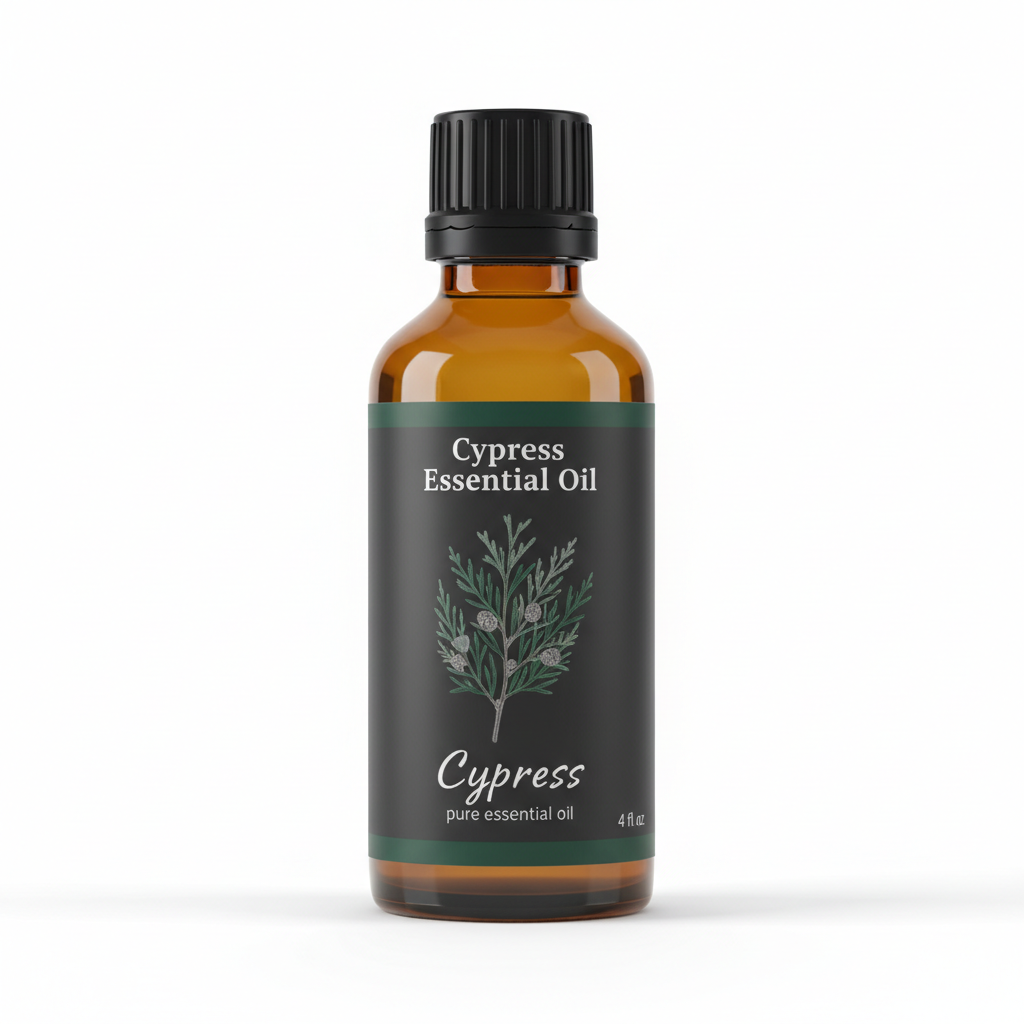
Cypress Essential Oil
Our own Cypress Essential Oil, in sizes from 0.5 oz to bulk.
From $10.99
Shop Now →One name, several trees
Before comparing, it helps to know that "cedarwood" is not a single oil. A 2026 review of cedarwood oils by Setzer and Satyal sorts them by tree: Virginia cedarwood, which is really a juniper (Juniperus virginiana), is rich in cedrenes, cedrol and thujopsene, while the true cedars (Cedrus) are marked by different families of molecules called himachalenes and atlantones. So when one writer calls cedarwood sweet and balsamic and another calls it sharp and pencil-like, they are probably smelling different trees.
Cypress is simpler. We sell a single oil, Cupressus sempervirens, the tall, narrow Mediterranean cypress, steam-distilled from its green growth. That is the whole story, which makes it the easier of the two to shop for.
Why green growth and wood smell different
Green foliage tends to give up light, bright aroma molecules, and cypress is a good example. In one published analysis of C. sempervirens oil, alpha-pinene made up about 49% and delta-3-carene about 22%. Alpha-pinene is the crisp, resinous, needle-like smell you know from conifer forests, and carene adds a dry edge. These lighter molecules lift off quickly, so cypress opens with a clean green freshness and then settles into something dry and faintly smoky.
Wood oils lean on heavier molecules that evaporate slowly. That is why cedarwood sticks around on a blotter or a scent strip for so long and why perfumers treat it as a base. Cypress works the other way round. We think of it as a top-to-middle material, the part of a blend that gives the scent its shape in the first half hour.
One caution against over-simplifying: cypress is not always the light one. Composition varies by material and place, and an Egyptian study of cypress aerial parts found cedrol, the same woody molecule that cedarwoods are known for, as the main compound at about 74%. Tisserand's own writing notes that cypress oil is quite varied, depending partly on how much leaf and how much cone goes into the still. It is a good reason to judge any bottle by nose first and by label second.
Try them on a blotter
The fastest education is to smell them side by side. Put a drop of each on separate strips, label them in pencil, and sniff straight away, then after ten minutes, then after an hour. You will notice the cypress doing most of its talking early, bright and green, while the cedarwood speaks up later and stays on the strip long after. Come back the next morning and you may find the cedarwood still there, a faint pencil-shavings memory, while the cypress has quietly gone.
Choosing between them
- For a bright, clean room: cypress. It reads as air and shade, with no sweetness.
- For a cozy, closed-in feeling: cedarwood, which brings warmth and weight.
- For a grooming-style or woodland accord: both, because one supplies lift and the other staying power.
If you want to try them together, a sensible starting point is two drops of cypress to one of cedarwood in a diffuser, then adjust by nose. That ratio is our suggestion from how the two behave, not a rule. Our guide to forest diffuser blends goes further, and cypress in perfumery shows where each sits in an accord.
We sell cypress only, so a cedarwood will need to come from another supplier. When you buy one, look for the Latin name so you know whether you are getting a juniper or a true cedar. For cypress on your skin, we recommend diluting to 0.5% to 2% in a carrier oil and patch testing first, and the same habit is a good one for any woody oil. Our scent profile is a good next read if you are still deciding what you want your room to smell like.
Where each one feels at home
Think of cypress as the open window and cedarwood as the wooden drawer. Cypress feels right in an entryway, a bathroom with the window cracked, or a bright morning room. Cedarwood feels right in a closet, a study or a fireside corner. When a room needs both, a few drops of each in the same diffuser can feel like a walk that starts in the trees and ends at a cabin door. Neither has to win.
A tip for blending the two
When you try them together, let the cypress go in first, smell it, and then add the cedarwood a drop at a time. Cedarwood is easy to overdo, and once it takes over, it is hard to coax the cypress back into the picture. Wait a minute between additions and let your nose reset.
Put the two bottles side by side and you will probably stop asking which is better. One is the frame, the other is the floor, and plenty of good blends use both.
Cypress Essential Oil
Cypress Essential Oil from our own shop, in sizes from 0.5 oz to bulk.
From $10.99
Shop Now →Sources & Further Reading
- Setzer WN, Satyal P. Cedarwood Oils: The Wood Essential Oil Compositions from Trees Known as "Cedar". Plants 2026;15(4):659. PubMed 41754364
- Selim SA et al. Chemical composition, antimicrobial and antibiofilm activity of the essential oil and methanol extract of the Mediterranean cypress (Cupressus sempervirens L.). BMC Complement Altern Med 2014;14. PubMed 24890383
- Ibrahim et al. Chemical composition and antimicrobial activities of essential oils of some coniferous plants cultivated in Egypt. Iran J Pharm Res 2017;16(1):328. PMC5423258
- Tisserand Institute. Cypress oil as a deodorant. tisserandinstitute.org