Cypress vs Juniper Berry Oil: Shade or Sparkle?
Pour a gin and tonic, crack open a bottle of cypress oil, and you are smelling two evergreens that share a lot more than you would guess. Juniper berries are the signature of gin. Cypress is the tall dark tree beside the Tuscan road. Their oils overlap in the nose, but they pull a blend in different directions.
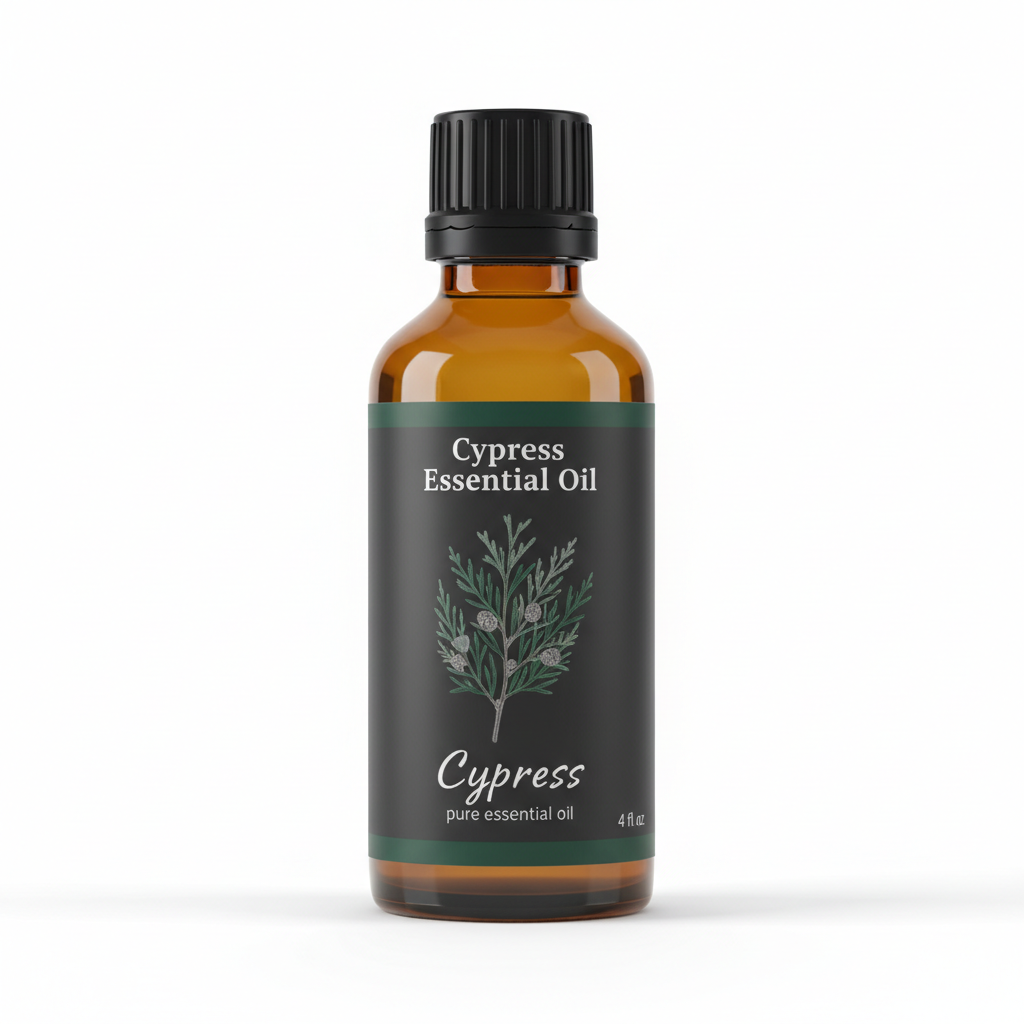
Cypress Essential Oil
Our own Cypress Essential Oil, in sizes from 0.5 oz to bulk.
From $10.99
Shop Now →The shared backbone
Both oils are built on alpha-pinene, the molecule behind that cool, resinous, fresh-cut-conifer smell. In one published analysis of Cupressus sempervirens oil, alpha-pinene was the leading compound at about 49%, with delta-3-carene next at around 22%. In a 2025 analysis of juniper oil from the cone-berries of Juniperus communis, alpha-pinene was also the main component, at about 22% among 81 compounds identified. That second number is a useful reminder that juniper berry oil is a crowd of molecules, and the pinene is only the front man.
Those supporting molecules are where the personalities split. Juniper berry brings a peppery, slightly fruity sparkle, which is the gin note people recognize. Cypress, with its carene and woody backing, reads drier, greener and more austere, with a hint of smoke. Put a drop of each on separate strips and they start close together, then part ways after a minute.
A word of caution on numbers: compositions move with harvest, place and distillation. Tisserand has made the same point about cypress, noting that it is quite varied depending partly on the leaf-to-cone proportion. Treat any percentage as a snapshot of one sample.
A simple sniff test
Put a drop of each oil on its own blotter strip, or a cotton pad if you have no strips, and label them in pencil so they do not get swapped. Smell both right away, then again after five minutes, then again after an hour. You'll notice the first sniff is where they sound most alike, and the later sniffs are where they part ways: the juniper strip keeps a bright, peppery lift, while the cypress strip settles into something drier and woody-green. Jot three words beside each strip. Those notes are easier to trust than any description, including ours.
Where each earns its place
Think of juniper berry as the sparkle and cypress as the shade. Juniper lifts a blend and brightens it, then tends to fade sooner. Cypress sits in the middle of a blend and gives it a spine, keeping sweeter or brighter oils from turning sugary. That is why cypress fits a quiet study, a hallway, or a grooming-style accord, while juniper suits a lively kitchen or a gin-inspired room scent.
- Reaching for structure: cypress.
- Reaching for sparkle and a little fruit: juniper berry.
- Wanting an evergreen blend with both depth and lift: use both, and let cypress be the larger share.
It helps to think about how long people stay in a room. A hallway or a study is a place where a scent lingers around you for hours, and a steady, dry backbone wears well there. A kitchen on a busy weekend morning can take something livelier, because nobody sits still long enough to tire of it. We recommend matching the oil to the length of the visit, not to the label on the bottle.
As a starting point, we would try three parts cypress to two parts juniper berry in a diffuser blend and adjust by nose. That is a suggestion drawn from how the two behave, not a measured recipe. For more partners, our guide to what blends well with cypress covers the field.
Reading the juniper label
If you are buying the juniper from another supplier, check the Latin name and the plant part. Juniper plants yield more than one oil, and an oil from the berries and an oil from other parts of the plant will not smell the same. A label that says only "juniper" leaves that open, so it is worth asking before you buy. We use the same standard for ours: the cypress we sell is Cupressus sempervirens, steam-distilled from the green growth of the tree, and we sell no juniper, so for that gin note you will want a second shop.
Both oils are rich in pinene, which reacts with air over time, so keep either bottle tightly capped and out of the light. Our note on storing cypress oil applies equally well to juniper. For skin, we recommend diluting cypress to 0.5% to 2% in a carrier oil and patch testing first. Both oils are for external, cosmetic use only, and our cypress substitutes guide goes deeper on which oils can stand in for it.
Keeping the pair on one shelf
If you do end up with both, give each its own spot and write the opening date on the bottle in marker. Two evergreen oils in similar brown glass are easy to confuse when the light is dim, and a wrong cap on a wrong bottle carries scent from one to the other. A small habit that saves a lot of muddled blends is to smell the cap, not just the bottle, before you start.
One last observation: both oils make an excellent teacher. If you are learning to blend, start with just these two and change the ratio a drop at a time. Four drops of one and two of the other will smell different from three and three, and watching that shift on a strip is the quickest education in how oils interact that we can think of.
If you only have room for one bottle, ask which you reach for more often: the sunny hillside or the shaded grove. The answer usually settles it.
Cypress Essential Oil
Cypress Essential Oil from our own shop, in sizes from 0.5 oz to bulk.
From $10.99
Shop Now →Sources & Further Reading
- Selim SA et al. Chemical composition, antimicrobial and antibiofilm activity of the essential oil and methanol extract of the Mediterranean cypress (Cupressus sempervirens L.). BMC Complement Altern Med 2014. PubMed 24890383
- Sytykiewicz H et al. Chemical Composition, Anti-Tyrosinase and Antioxidant Potential of Essential Oils from Acorus calamus (L.) and Juniperus communis (L.). Molecules 2025. PubMed 40509304
- Tisserand Institute. Cypress oil as a deodorant. tisserandinstitute.org