Cypress vs Tea Tree Oil: Which Belongs on Your Shelf?
Tea tree is the famous one. Cypress is the quiet one. If you have both on a shelf, they are not rivals for the same job, and the fastest way to see that is to smell them one after the other: tea tree is sharp and solvent-bright, and cypress is a cool, green grove.
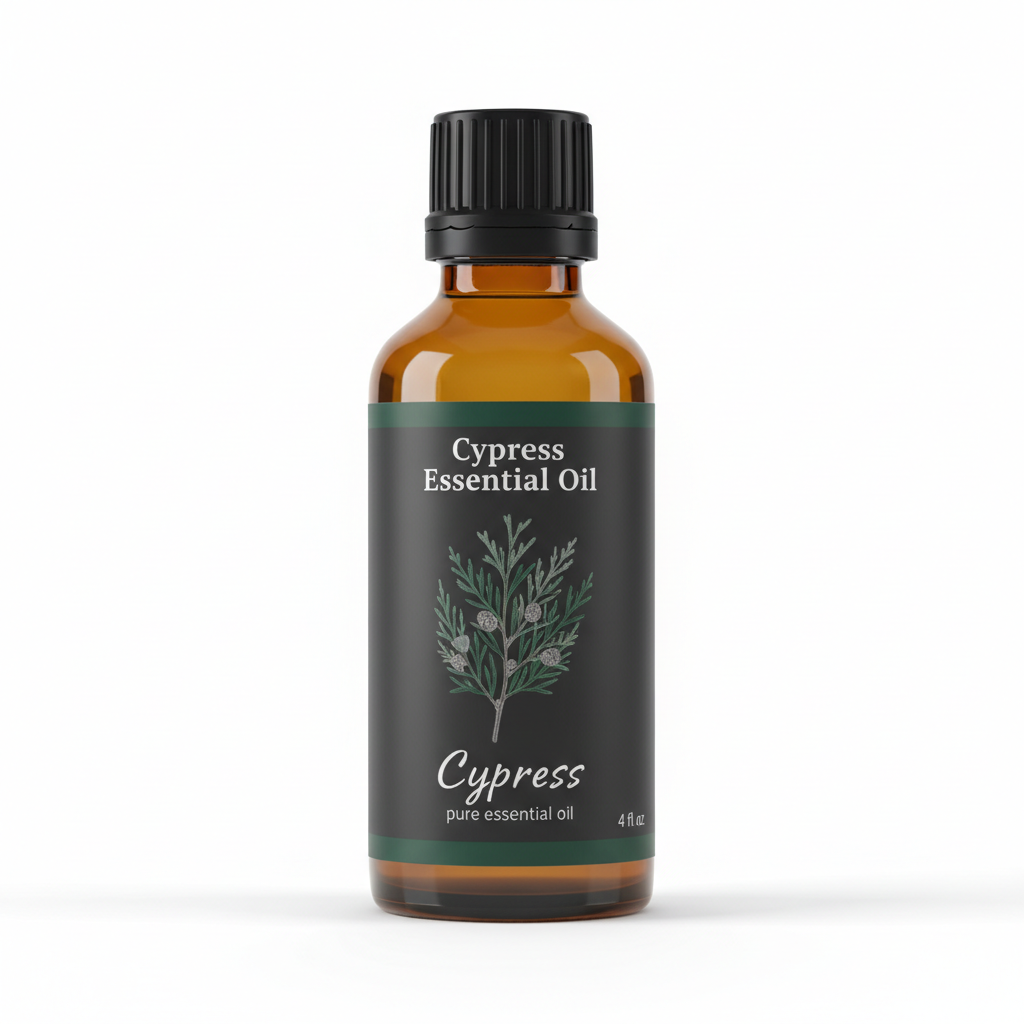
Cypress Essential Oil
Our own Cypress Essential Oil, in sizes from 0.5 oz to bulk.
From $10.99
Shop Now →Two very different recipes
Tea tree oil (Melaleuca alternifolia) leans on a single standout compound. In a 2022 analysis of tea tree oil, terpinen-4-ol was dominant at about 40%, followed by gamma-terpinene, 1,8-cineole and p-cymene. That mix is a big part of why it smells so crisp, medicinal-adjacent and camphoraceous.
Cypress is a conifer oil, and its scent comes from the resinous, green side of chemistry. In one analysis of Cupressus sempervirens oil, alpha-pinene led at about 49%, with delta-3-carene at about 22%. Composition varies with the plant material used, but the character is steady: dry, woody-green and a little smoky. We describe ours as fresh and smoky-green, finishing resinous.
Put them side by side
The cleanest way to learn the difference is to open both bottles within the same minute. Hold each one a hand's width below your nose, not right against it, and breathe in gently. Tea tree arrives fast and sharp, and it can make your nose feel scrubbed. Cypress comes in slower, a little drier, with a green, woody quality that reminds many people of walking along a hedge in the afternoon. Wait a minute between sniffs and take a breath of fresh air in between, or the second oil will smell like an echo of the first.
Choosing by what you want from the room
Put aside what you have read about uses, because there is a simpler way to decide. Ask what the scent is for.
- If you want something that smells like a forest, cypress is the natural pick. It blends happily with citrus, juniper, lavender and frankincense.
- If you want a brisk, sharp, clean-smelling note, tea tree is the one most people reach for, though it tends to dominate a blend and has few easy partners.
Another way to choose is to picture the whole room. Tea tree has a loud, singular personality, so it sits at the front of a blend and the other oils end up arranged around it. Cypress is a more cooperative voice. It will happily take a supporting role under citrus, or sit in the middle of a woody blend and hold the rest together. As people who care a lot about how a single oil behaves, we recommend deciding first whether you want the scent to be the main act or the backdrop.
Our guides to cypress blends and the comparison with cedarwood show where cypress sits among its woody neighbors. For a look at how cypress fits a face-and-body routine as a scent, see cypress oil for skin.
Shelf manners
If both bottles live in the same cupboard, give them a little distance. Strong-smelling oils can leave a ghost of themselves on a cap, a dropper or a blotter, and that ghost shows up in whatever you smell next. Wipe the threads of each bottle clean after use, keep a separate blotter for each, and put the date you opened each one on its label. It is a thirty-second routine that keeps the cypress tasting like cypress.
Patch testing is worth a minute
Both are concentrated botanical oils, so it is worth knowing how dermatologists view them. A 2016 review of tea tree oil found it has caused more published allergic reactions than any other essential oil since the first cases in 1991, with positive patch tests in routine testing ranging from 0.1% to 3.5%. The review also noted that oxidized oil is a part of that picture. We would not read that as a reason to avoid it, only as a reason to patch test and keep oils fresh.
Cypress deserves the same habits. Our guidance is to dilute to 0.5% to 2% in a carrier oil, patch test first, keep it away from eyes, children and pets, and never take it internally. Storage matters too: Hana Tisserand has noted that conifer oils oxidize faster than heavier oils and can reach the end of their usable life in about two years even when refrigerated, which is a good reason to keep the cap tight and the bottle cool. Our storage guide has the rest.
We sell cypress only, so a tea tree oil will need to come from another shop. And neither oil is a medicine, and neither replaces advice from a doctor or dermatologist if you have a skin concern.
If you cannot decide, a small test helps. Put a drop of each on a separate cotton pad, set both on saucers in different corners of the same room, and walk in and out over an afternoon. You'll notice which one you walk toward and which one you walk away from. The one you keep going back to is usually your answer.
Think of them as two cupboard residents with different manners, one that announces itself and one that sets the scene. Most people end up wanting the second more often than they expected.
If you are curious about the quiet one, a single small bottle and a cotton pad on a shelf is all it takes to find out whether it suits your space.
Cypress Essential Oil
Cypress Essential Oil from our own shop, in sizes from 0.5 oz to bulk.
From $10.99
Shop Now →Sources & Further Reading
- Chemical and Biological Characterization of Melaleuca alternifolia Essential Oil. 2022. PubMed 35214891
- Tea tree oil: contact allergy and chemical composition. Contact Dermatitis 2016. PubMed 27173437
- Selim SA et al. Chemical composition, antimicrobial and antibiofilm activity of the essential oil and methanol extract of the Mediterranean cypress (Cupressus sempervirens L.). BMC Complement Altern Med 2014. PubMed 24890383
- Tisserand Institute. Keep essential oils cool. tisserandinstitute.org