French or Mediterranean Cypress Oil: Does Origin Matter?
"French cypress" has a ring to it, the way "Italian leather" does. It suggests a better bottle. The tree, though, does not care about borders: Cupressus sempervirens has been planted around the Mediterranean for centuries, and what ends up in the oil depends on far more than the country on the label.
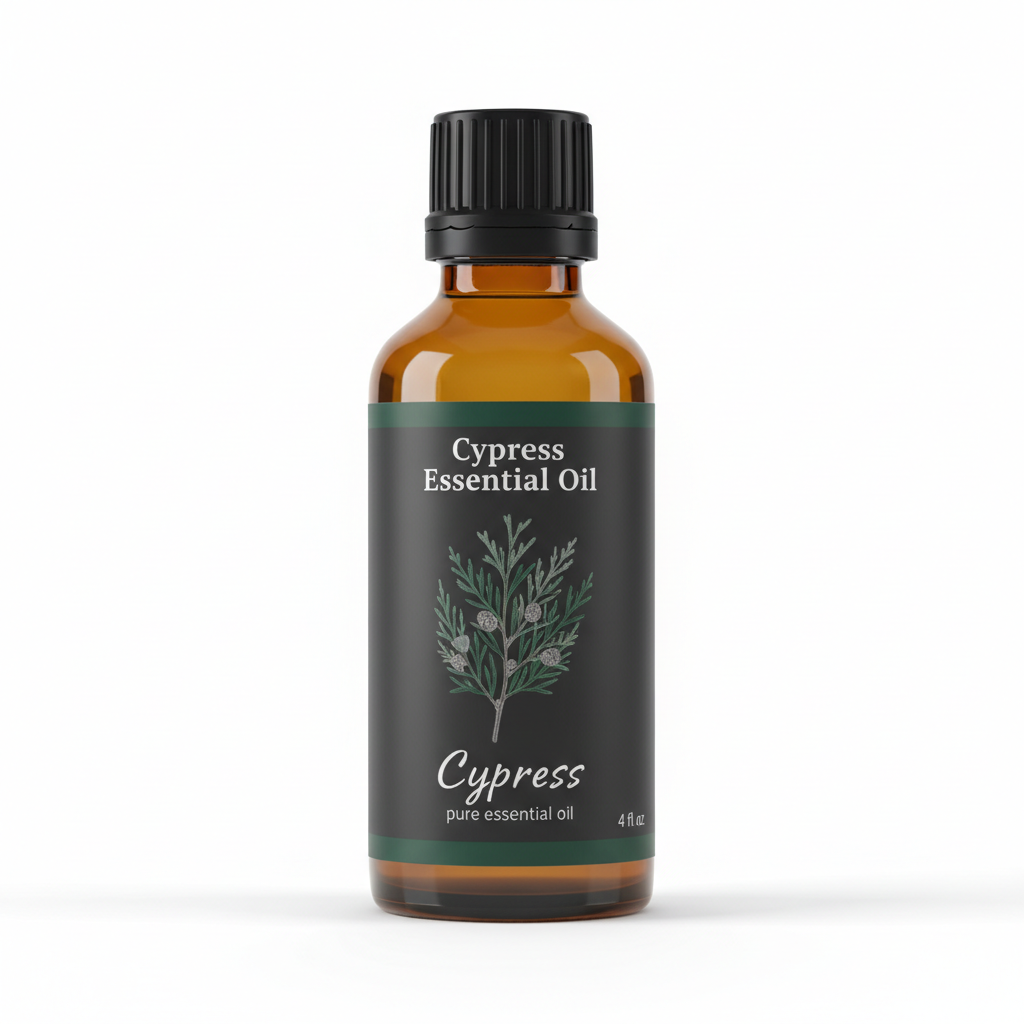
Cypress Essential Oil
Our own Cypress Essential Oil, in sizes from 0.5 oz to bulk.
From $10.99
Shop Now →One species, many chemistries
Published analyses of cypress oil show how much the numbers move. One analysis of C. sempervirens oil found alpha-pinene at about 49% and delta-3-carene at about 22%. A Tunisian study of oils from three regions (Bizerte, Ben-Arous and Nabeul) found alpha-pinene between 30% and 37%, so even within one country the figures differed. And an Egyptian study of cypress aerial parts from a Giza garden found something quite different: cedrol, a woody sesquiterpene alcohol, as the main compound at about 74%, with alpha-pinene at only about 5%.
Those are different samples, different plant material and different methods, so they are not a clean test of French against anything. But together they make a plain point. The same species can produce oils that lean green and piney or deep and woody, depending on what was cut and how. Robert Tisserand has written that cypress oil is quite varied, depending partly on the proportion of leaf and cone in the material.
Think of how people talk about wine regions. A name on a bottle starts a conversation, but nobody who loves wine stops there, because a hillside, a year and a producer all change what is in the glass. Cypress oil is much the same. Sellers like a tidy origin story because it is short, and a short story fits on a label. The tree itself has a longer one, with each cutting shaped by sun, wind, soil and the weather of that particular season.
What a country name does and does not tell you
A country on a label is a place of harvest or bottling. It is a useful start, since climate, soil and season all shape a tree, but it cannot tell you the plant parts used, how fresh the material was, or how the distillation was run. That is why we would rather you look at the nose and the paperwork than at the flag.
For ours, we say it plainly: we sell one cypress oil, Cupressus sempervirens, harvested around the Mediterranean and steam-distilled. The Certificate of Analysis we publish for one batch lists density, refractive index and optical rotation. If you need a constituent profile such as GC-MS for your own formulation, ask us in writing through the contact page before ordering.
If you ever get to compare two cypress oils from different places, do it slowly. Put a drop of each on a blotter strip and label them. Smell right away, then again after ten minutes and after an hour. You'll notice differences in how green, how dry and how resinous each one feels as it evolves, and you may find that two oils from the same country smell less alike than two from different ones. Write down what you notice, because that note is worth more than any flag on a label.
How to shop for origin without being fooled
- Look for the Latin name. Cupressus sempervirens tells you more than any country.
- Ask for the plant part and distillation method. Needles, twigs and cones can all go in, and the balance changes the oil.
- Be wary of tidy origin stories. A fixed chemical gap between two countries is not something the published literature supports.
- Trust your nose. Fresh, green, dry and a little smoky is what most people expect from this tree.
A better question than "where"
Instead of asking where the oil is from, try asking what exactly went into the still and how it was handled. Those two questions pull out much more than a postcode does. A seller who can talk about the plant material, the method and the paperwork for a particular lot is a seller who knows the product, and that is the kind of conversation we would encourage any buyer to have, with us or anyone else.
If you are comparing bottles, our guide on what to check before you buy cypress oil goes through the label in detail, and our piece on cypress oil labels covers the other words you will meet. For how the oil is made, see needles, twigs and steam.
A practical tip if you are comparing several bottles at once: smell them in the same order each time, and rest your nose between them by breathing in the crook of your elbow or a cup of ground coffee. It sounds fussy, but it stops the first oil from colouring your opinion of the second. Keep the strips in a small row on a clean plate, and revisit them over an afternoon. The oil you keep going back to is usually the one worth buying.
It is also worth noticing how a scent behaves in a real room, not just on a strip. A drop on a pad on a shelf will tell you whether the oil fills a space politely or crowds it, and that is a much better test of origin than any claim on a page.
In the end, a good cypress oil is one you have read about, smelled and can ask questions about. Origin is a chapter in that story, and rarely the whole book.
Cypress Essential Oil
Cypress Essential Oil from our own shop, in sizes from 0.5 oz to bulk.
From $10.99
Shop Now →Sources & Further Reading
- Selim SA et al. Chemical composition, antimicrobial and antibiofilm activity of the essential oil and methanol extract of the Mediterranean cypress (Cupressus sempervirens L.). BMC Complement Altern Med 2014. PubMed 24890383
- Sriti J et al. Antioxidant, antibacterial and insecticidal activities of cypress (Cupressus sempervirens L.) essential oil. Int J Environ Health Res 2024. PubMed 37115147
- Ibrahim et al. Chemical composition and antimicrobial activities of essential oils of some coniferous plants cultivated in Egypt. Iran J Pharm Res 2017;16(1):328. PMC5423258
- Tisserand Institute. Cypress oil as a deodorant. tisserandinstitute.org