Forest Diffuser Blends: Cypress as the Heart
Walk into any shop with a "forest" candle and you know the trick: pile on the evergreens and hope. In a diffuser it rarely works. Put cypress, fir, pine, spruce and juniper in one reservoir and they stop smelling like different trees and start smelling like one loud, generic pine note. The better approach is to treat a forest blend like a small piece of music, with a low note, a middle and a little light on top.
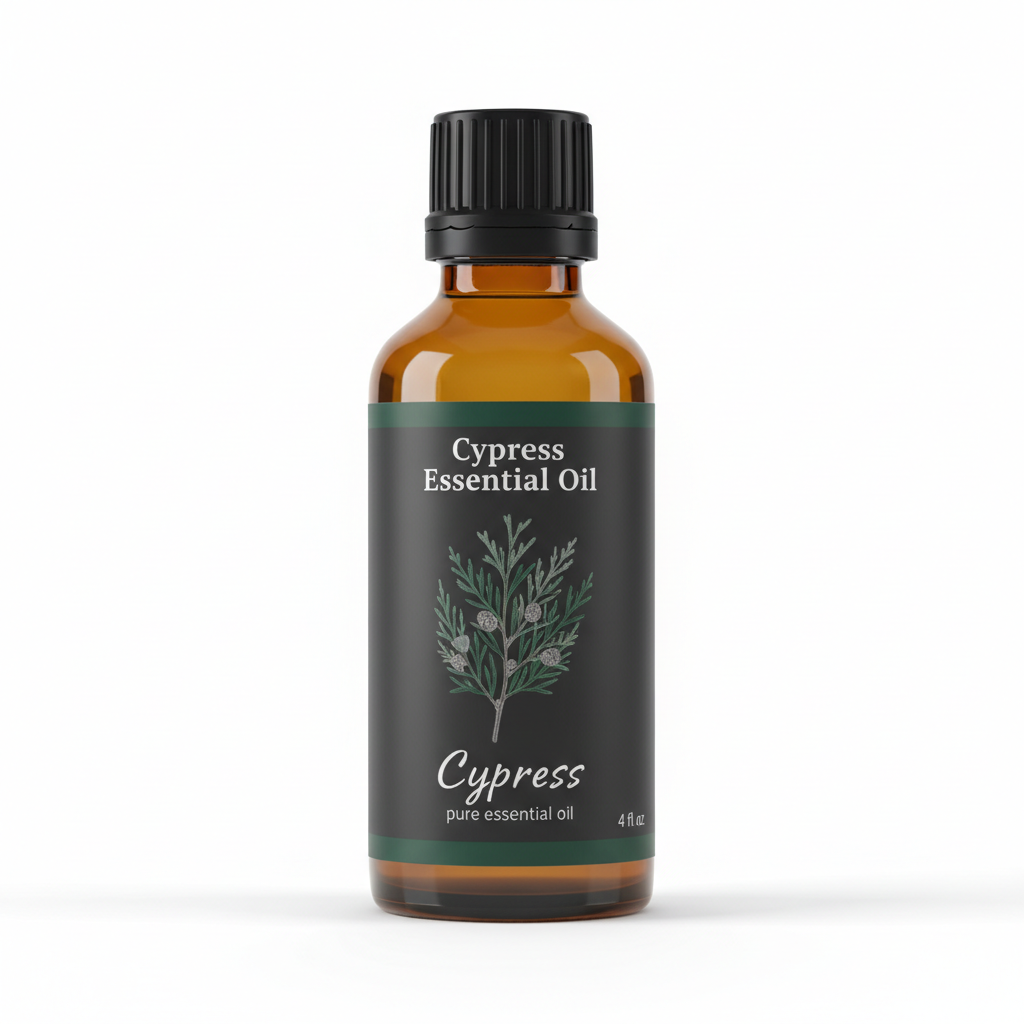
Cypress Essential Oil
Our own Cypress Essential Oil, in sizes from 0.5 oz to bulk.
From $10.99
Shop Now →Why the needle oils blur together
Most conifer oils share a backbone of pinene. In published analyses, alpha-pinene is the leading compound in a Mediterranean cypress oil (about 49 percent in one sample, with delta-3-carene next at about 22 percent), it is a major component in juniper berry oil, and it ranks near the top in fir needle oil too. That family resemblance is why they get along. It is also why stacking four of them adds volume without adding detail.
The other half of the answer is to bring in a different kind of material. Cedarwood oils are built on heavier sesquiterpene compounds: in a recent review of the group, Virginia cedarwood is described as rich in cedrenes, cedrol and thujopsene. Those molecules are slow to evaporate, so a wood oil lingers under the lighter needles like a floor under a room. Our cypress sits between them. We describe it as fresh and smoky-green, drier and more refined than common pine oils, finishing resinous, so it makes a very good middle voice.
The rule we work from
One wood or earthy oil as the floor. Cypress as the heart. At most one or two other needle or berry oils above it. Then, if you like, a single accent. That is our own reasoning from how the oils are built, not a laboratory result, and it is easy to test on your own nose. We sell the cypress, so the cedarwood, fir, juniper, patchouli and citrus below are things to collect from an aromatherapy supplier.
Five blends, in drops for a 100 ml reservoir
Six drops in total is a modest, comfortable amount for a standard small diffuser. Scale up for a bigger tank, and follow your diffuser's own manual.
| Blend | Drops | What you get |
|---|---|---|
| Old Growth | 3 cypress, 2 cedarwood, 1 fir | Dry green heart over a woody floor, with one drop of fir for lift |
| Snowline | 3 cypress, 2 fir, 1 pine | All needles, crisp and bright, no wood underneath |
| Gin Hour | 4 cypress, 2 juniper berry | Two oils only, so the berry's fruity edge shows through the dryness |
| Smolder | 3 cypress, 2 cedarwood, 1 patchouli | Earthy and low, closer to a hearth than a hillside |
| Clearing | 3 cypress, 2 fir, 1 sweet orange | A conifer blend with some sun on it, for anyone who finds pure needles austere |
If you like Old Growth, our guide to cypress and cedarwood explains why the pairing works. The deeper comparison of cypress, pine and fir helps with Snowline and Clearing. And for more seasonal ideas, our fifteen diffuser blends branch out beyond forests.
How to judge a blend as it develops
A blend does not smell the same at minute one and minute thirty. Before you fill a reservoir, put the drops on a blotter strip, or a cotton pad, and wave it gently. You'll notice the lighter oils speak first, and the wood or earth comes forward as the strip sits. Smell it again after ten minutes and after an hour. If the blend still pleases you at the hour mark, it will probably wear well in the room, and if it turns flat, the usual fix is to add one drop of the heavier oil, not another needle oil.
Making them behave
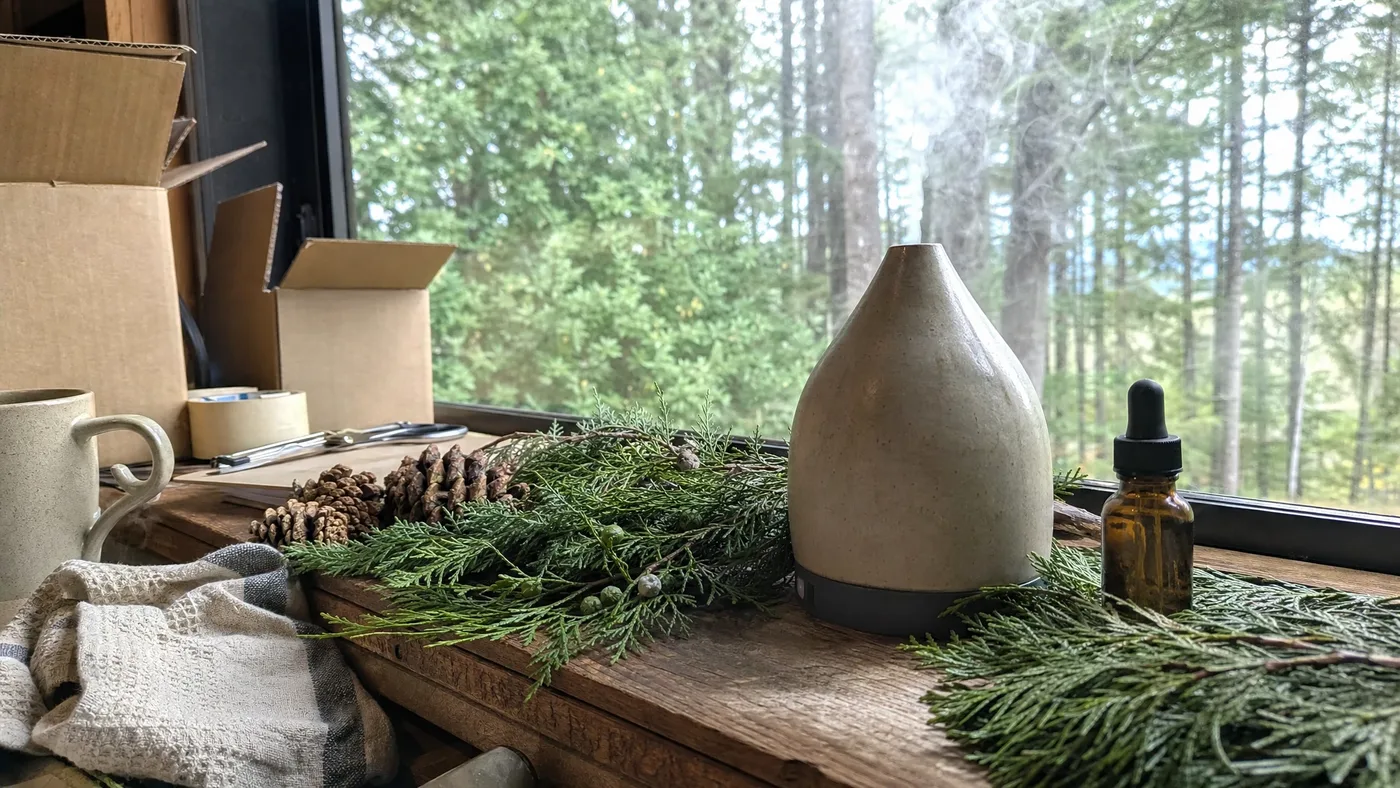
Fill the reservoir with room-temperature water, add the drops, and swirl gently so the oil spreads out before you switch on. Run the diffuser in intervals, around half an hour on and then a break, in a room with some airflow. A chamber study of ultrasonic diffusers (Schwartz-Narbonne and colleagues, 2021) measured fine particles rising during use, which is a good reminder to open a window now and then. Rinse the tank between blends so a leftover note does not muddy the next one.
Keep a small notebook by the diffuser. Write the recipe, the date and one line about what you noticed. Two weeks later you will be glad you did, because blends that seemed fantastic in the moment are hard to rebuild from memory, and the version you forgot to write down is usually the one you want again.
If you share your home with cats or birds, diffuse in a room they can leave, or skip it while they are in the room. Anyone who is pregnant, nursing or managing a health condition should check with their clinician before making diffusing a routine, and our Harvest page advises avoiding cypress oil in pregnancy as a precaution. Keep every bottle out of reach of children, and do not take the oils internally.
The needle oils are the most delicate bottles on the shelf. Conifer oils oxidize faster than woods or resins, and the Tisserand Institute notes that conifers should be used within about two years even if refrigerated, so cap bottles tightly after each use and smell before you blend. Fresh oil gives the clean forest notes you are after. Wood oils such as cedarwood will keep their character longer.
Start with Old Growth on a cool evening, then change one drop at a time until the room smells like the woods you have in your head.
Cypress Essential Oil
Cypress Essential Oil from our own shop, in sizes from 0.5 oz to bulk.
From $10.99
Shop Now →Sources & Further Reading
- Selim SA et al., 2014. Mediterranean cypress (Cupressus sempervirens L.) oil composition. BMC Complementary and Alternative Medicine 14. PubMed 24890383
- Sytykiewicz H, 2025. Juniperus communis cone-berry oil composition. Molecules. PubMed 40509304
- El Bakkali et al., 2026. Abies marocana essential oil composition. Scientific Reports. PubMed 41629471
- Setzer WN, Satyal P, 2026. Cedarwood essential oils review. Plants 15(4):659. PubMed 41754364
- Schwartz-Narbonne H, Du B, Siegel JA, 2021. Particle emissions from ultrasonic essential oil diffusers. Indoor Air 31(6):1982-1992. PubMed 33905580
- Hana Tisserand, Tisserand Institute. Keep essential oils cool. tisserandinstitute.org/learn-more/keep-essential-oils-cool