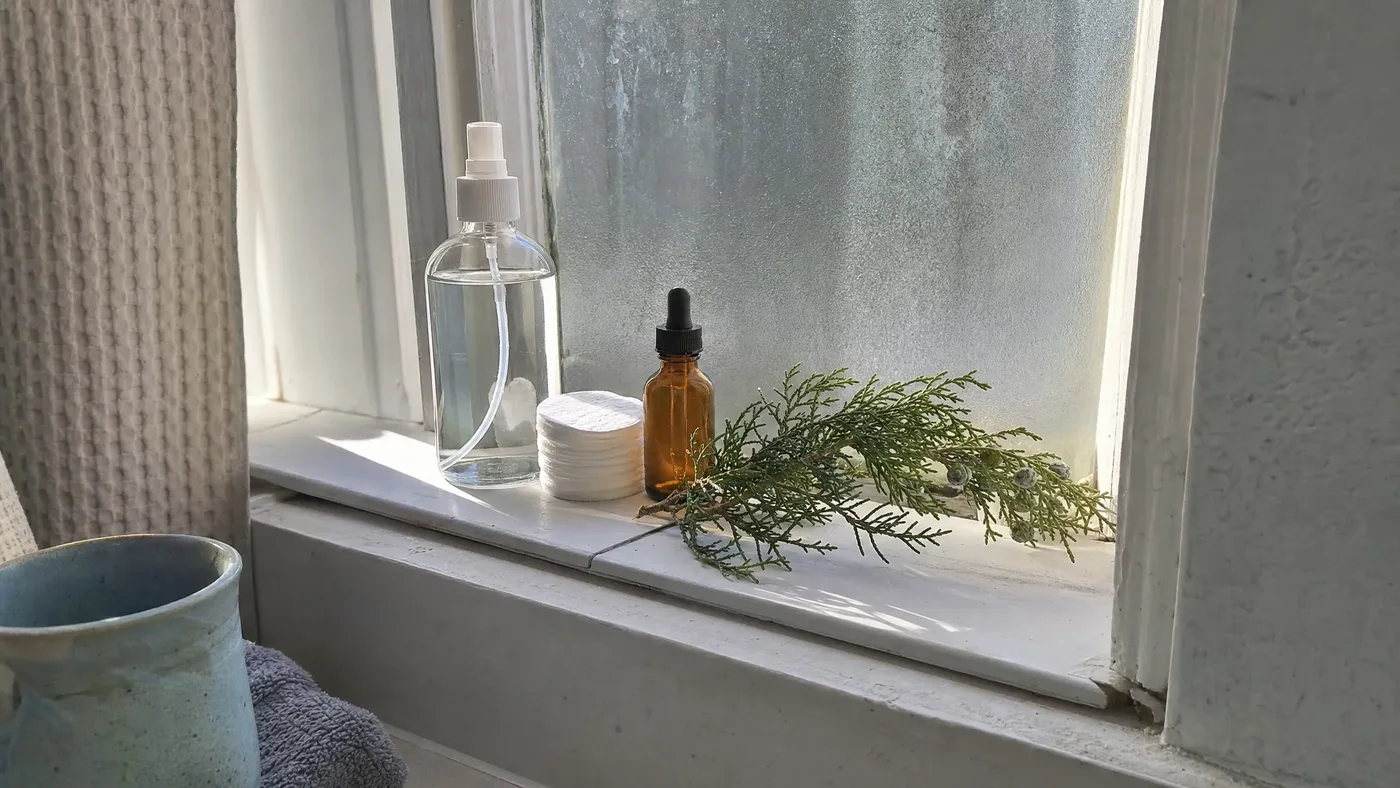
Cypress Facial Toner: Why Witch Hazel Needs Help
Pour cypress oil into a bottle of witch hazel, shake hard, and it looks like it has blended. Give it five minutes. The oil climbs back to the top, and the first few sprays onto your face carry far more of it than the last few. A good toner starts with solving that, and the fix is a small, inexpensive ingredient.
Cypress Essential Oil
Our own Cypress Essential Oil, in sizes from 0.5 oz to bulk.
From $10.99
Shop Now →Why the oil needs a go-between
Essential oils do not dissolve in water, and witch hazel is mostly water. The Tisserand Institute lists witch hazel among the water-soluble liquids that leave essential oil floating rather than dispersed, and it names polysorbate 20 as a surfactant that can hold essential oil evenly in water. That is the ingredient we build this toner around. You can find it at cosmetic-supply shops, and it is the piece of this recipe we cannot supply ourselves, since we sell the oil and nothing else.
The Institute's starting point is to mix the essential oil with an equal amount of polysorbate 20 first, then add water. We follow that ratio here: oil and polysorbate go together before they ever meet the witch hazel.
The toner, 50 ml at a time
We keep this recipe small on purpose. It works out to about 0.5 percent essential oil, which sits at the low end of our 0.5% to 2% dilution guidance and is a sensible place to begin on facial skin. Our reasoning on size is simple: a water-based product without a preservative gets opened, touched and breathed on every day, so a little bottle that gets finished quickly is the better design.
- 50 ml alcohol-free witch hazel (check the label; many bottles contain alcohol)
- 5 drops cypress essential oil, which is about 0.25 ml at the usual rule of thumb of 20 drops per ml, or roughly 0.5 percent of 50 ml
- 5 drops polysorbate 20, matching the oil one to one
- A clean 60 ml dark glass bottle with a fine-mist top
Drop size varies from bottle to bottle, so treat the drop counts as a good estimate. If you own a milligram scale, weighing is steadier.
Method
- Wash the bottle, cap and your measuring cup in hot soapy water, rinse well and let everything air-dry. A wipe with rubbing alcohol before drying is a good extra step.
- In a small clean cup, add the 5 drops of polysorbate 20, then the 5 drops of cypress. Stir slowly for about a minute until the mix looks even and slightly syrupy.
- Add the witch hazel a splash at a time, stirring between additions, rather than all at once.
- Look at it. The result should be clear to faintly hazy, with no oily beads. If you see droplets or a layer, add polysorbate 20 a drop or two at a time and stir again.
- Funnel it into the bottle, label it with the date, and keep it in the refrigerator.
Using it, and keeping it fresh
Close your eyes, mist a cotton pad and sweep it over the cheeks, forehead and chin, keeping clear of the eyes, lips and inner nose. After cleansing in the evening is a natural place for it. The idea is a cool, lightly woody, evergreen moment between washing and moisturizer. Our oil is described on our pages as having a clean, green, coniferous character, with a fresh, smoky-green note that finishes resinous, and that carries through even at this gentle strength.
Before the first use, do a patch test: dab a little on the inside of your forearm and wait a full day. If anything itches, stings or turns pink, skip it. Redo the patch test if you change the brand of witch hazel or open a new bottle of oil.
On shelf life, we would rather keep this honest than invent a number. Research on preserving water-containing cosmetics shows that no single factor, whether alcohol content, pH or water activity, guarantees a product stays safe, and proper preservation is judged with a challenge test in a lab. A kitchen batch cannot offer that. So the practical conclusion is to make a small batch, keep it cold, use it within a couple of weeks, and throw it out the moment the smell turns flat or sour, it clouds, or you see specks.
What it should look and smell like
A well-mixed toner looks clear or very slightly hazy, with no oil beads and no film on the surface. The scent is gentle: a faint green, dry evergreen note that you notice when you mist it and again when you lean in, then it fades. If you can smell it from across the room, there is probably too much oil, and the next batch should have fewer drops.
Give the bottle a gentle swirl before each use. It should stay mixed, but a swirl is a good habit with anything that has oil in it, and it takes a second.
Small changes you can make
For a drier, woodier edge, swap one of the five drops for a drop of another wood or needle oil from your local supplier. For a very gentle version, skip the oil and polysorbate and use the witch hazel alone, with the same short shelf life. Do not stretch a batch with tap water or add honey, aloe or fresh botanicals, because each one gives microbes more to feed on.
A few people should check first. Our Harvest page advises avoiding cypress oil in pregnancy as a precaution, so anyone pregnant or nursing should ask their midwife or doctor before using it. Anyone with reactive or medicated skin should ask a dermatologist. Keep the bottle away from children and pets. For other uses of the oil on skin, our notes on cypress for skin, the dilution chart and our guide to oily skin routines go further.
Made small and kept cold, this is a few drops of evergreen in a pretty bottle, and a pleasant part of an evening routine.
Cypress Essential Oil
Cypress Essential Oil from our own shop, in sizes from 0.5 oz to bulk.
From $10.99
Shop Now →Sources & Further Reading
- Tisserand Institute. Bath safety: how to use essential oils safely in the bath (dispersal, polysorbate 20, which liquids do not disperse oil). tisserandinstitute.org/safety/bath-safety
- Berthele H et al., 2014. Preservation of cosmetics: ethanol, pH and water activity. International Journal of Cosmetic Science 36(1):54-61. PubMed 24117694