Cypress Oil in Pregnancy: Why to Ask Your Midwife
If you are pregnant and wondering about cypress oil, the best answer we can give is also the shortest: ask your midwife or doctor, and let their answer win over anything you read here. We sell an aromatic oil. We are not in a position to judge anyone's pregnancy, and no seller should be the one offering reassurance.
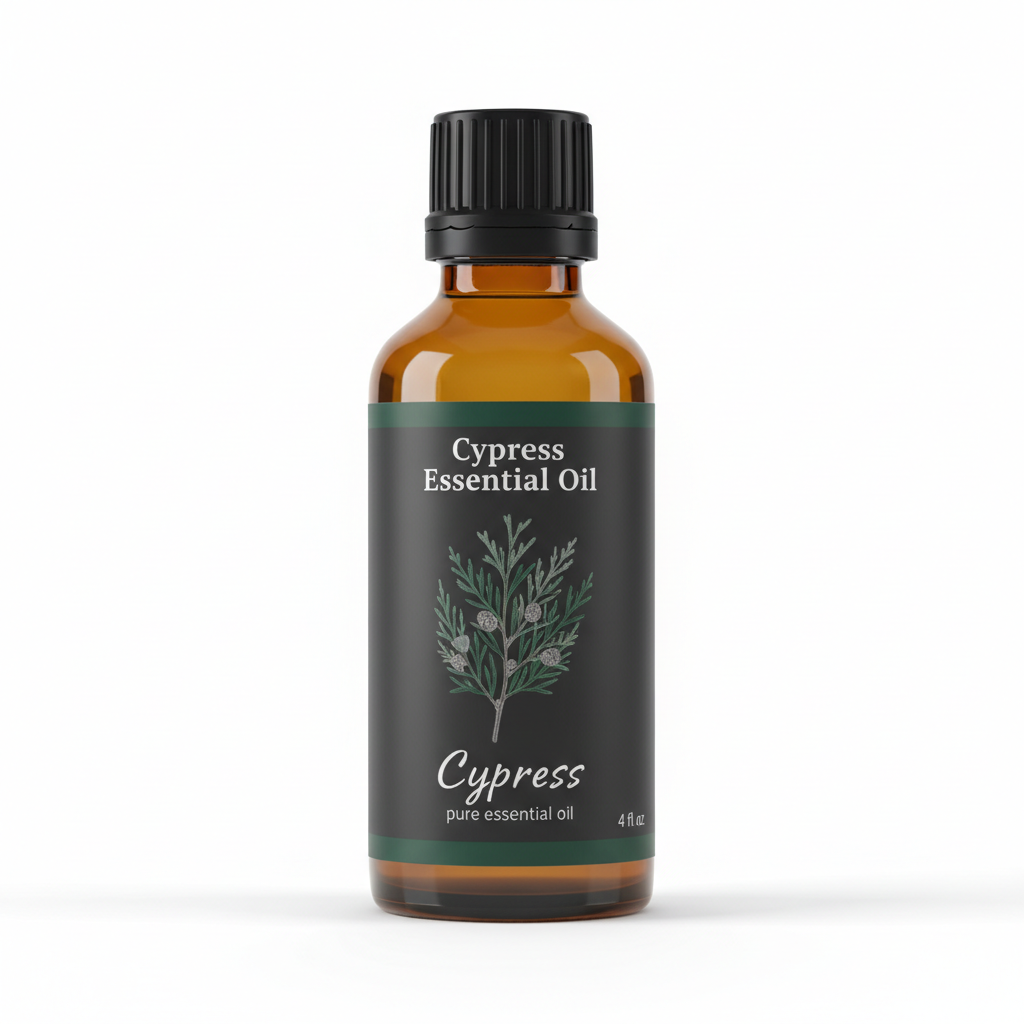
Cypress Essential Oil
Our own Cypress Essential Oil, in sizes from 0.5 oz to bulk.
From $10.99
Shop Now →What we say about our own oil
Our Harvest page advises avoiding cypress oil in pregnancy as a precaution, and we stand by that. It is a practical, conservative line, not a finding that the oil does anything alarming. For us, cypress is a fragrance material for the diffuser and diluted use on the skin, and we make no medical claims about it.
How the experts frame it
Even among aromatherapy writers, there is not one tidy rule. The Tisserand Aromatherapy company's guidance for pregnancy is to avoid essential oils entirely during the first trimester, to keep any handmade blend for the skin at a 1 percent dilution afterward (about 1 drop per 5 ml of carrier), never to apply oils undiluted or take them internally, and to check with a midwife, GP or health visitor when unsure. Robert Tisserand himself has questioned where the first-trimester rule comes from, pointing out that risks do not stop at three months and that such a guideline only makes sense if evidence supports it. He also acknowledges that proving safety in pregnancy is always a challenge.
Put those together and the picture is a cautious one with a lot of room for individual judgment, which is exactly why a professional who knows your pregnancy is the right voice. Those sources do not single out cypress for a verdict, and we are not going to invent one.
Practical habits if you and your clinician decide to use any aromatic
These are habits, not recommendations to use cypress, and they come from our own reading of the general guidance.
- Keep it very light. At 1 percent, 6 drops go into 30 ml (1 ounce) of carrier oil. Recipes written for general adult use are often stronger, so reduce them rather than copying them. Our dilution chart gives the arithmetic.
- Use one oil at a time. If something feels off, you will know what caused it.
- Patch test, even if you used it before. Skin and scent responses can shift. Our safety guide lists the steps.
- Skip the loose drops in the bath. Oil does not dissolve in water, so it floats and meets skin undiluted. The Tisserand Institute's bath guidance says to disperse oil first, using a dispersant.
- Keep sessions short in a ventilated room. If you diffuse at all, a short session with fresh air afterward is a sensible rhythm, and a diffuser is easy to switch off the moment the scent stops being welcome.
Scent can change, and that is fine
Many people report that their sense of smell shifts during pregnancy, and a favorite can turn sharp within days. Cypress is dry and resinous with a woody edge, and that can read as fresh one week and harsh the next. If it stops working for you, stop. No routine is worth pushing through. It is also a good reason to choose a small bottle.
Other ways to enjoy a quiet, pleasant room
If you are keen on a nice-smelling home but are keeping fragrance out of the picture for now, there is plenty to enjoy without any oil at all. Open a window in the morning and let in the air. Put fresh herbs from the garden or the grocery store in a jar on the counter. Hang laundry outside if you can, or tuck a clean sachet of dried lavender in a drawer. None of that is a recommendation or a treatment, only a reminder that a pleasant room does not depend on a bottle.
While nursing
The same general approach applies: keep any use minimal and diluted, and raise it with your midwife, lactation consultant or pediatrician first. Keep anything scented away from skin a baby touches, such as chest, neck and hands, and keep diffusers out of the room where the baby sleeps.
Our own approach is to keep the bottle capped and put away for the moment, and to pick it up again when your clinician says it is fine. Cypress keeps its character when stored well, and it is a lovely material to come back to later. Nothing about it needs to be rushed.
Questions you might ask
It can help to go in with a short list. Ask whether any scented products are fine for you at the moment, whether the answer changes as the weeks go on, and whether the same goes for the ones you already own, such as candles and cleaning sprays. Write the answers on your phone or on paper so you do not have to rely on memory. A direct answer from the person who knows you is worth more than a pile of reading.
What to bring to the appointment
The bottle, or a photo of the label. Our oil is Cupressus sempervirens, and the Certificate of Analysis we publish for one batch lists density, refractive index and optical rotation. If your clinician wants more detail, such as GC-MS results, write to us through the contact page and we will tell you what we can provide. If they say no, that settles it.
A label that promises "pregnancy safe" has nothing recognized behind it, and we would treat it as marketing. Your own provider is the one to ask, and the cypress will happily wait.
Cypress Essential Oil
Cypress Essential Oil from our own shop, in sizes from 0.5 oz to bulk.
From $10.99
Shop Now →Sources & Further Reading
- Tisserand Aromatherapy. Essential oils in pregnancy and early motherhood. tisserand.com/essential-oils-in-pregnancy-early-motherhood
- Robert Tisserand, 2011. Lavender oil and pregnancy (discussion of the first-trimester guideline). roberttisserand.com/lavender-oil-and-pregnancy
- Tisserand Institute. Bath safety. tisserandinstitute.org/safety/bath-safety