Cypress, Frankincense and Cedarwood: Diffuser Ratios
A three-oil diffuser blend of cypress, frankincense and cedarwood is easy to assemble and easy to get slightly wrong, and when it goes wrong it is almost always proportion rather than ingredients. Here is how we would set it up, as a worked formulation: what each oil brings, how to divide the drops, and how to judge the result on a blotter before it goes anywhere near a diffuser.
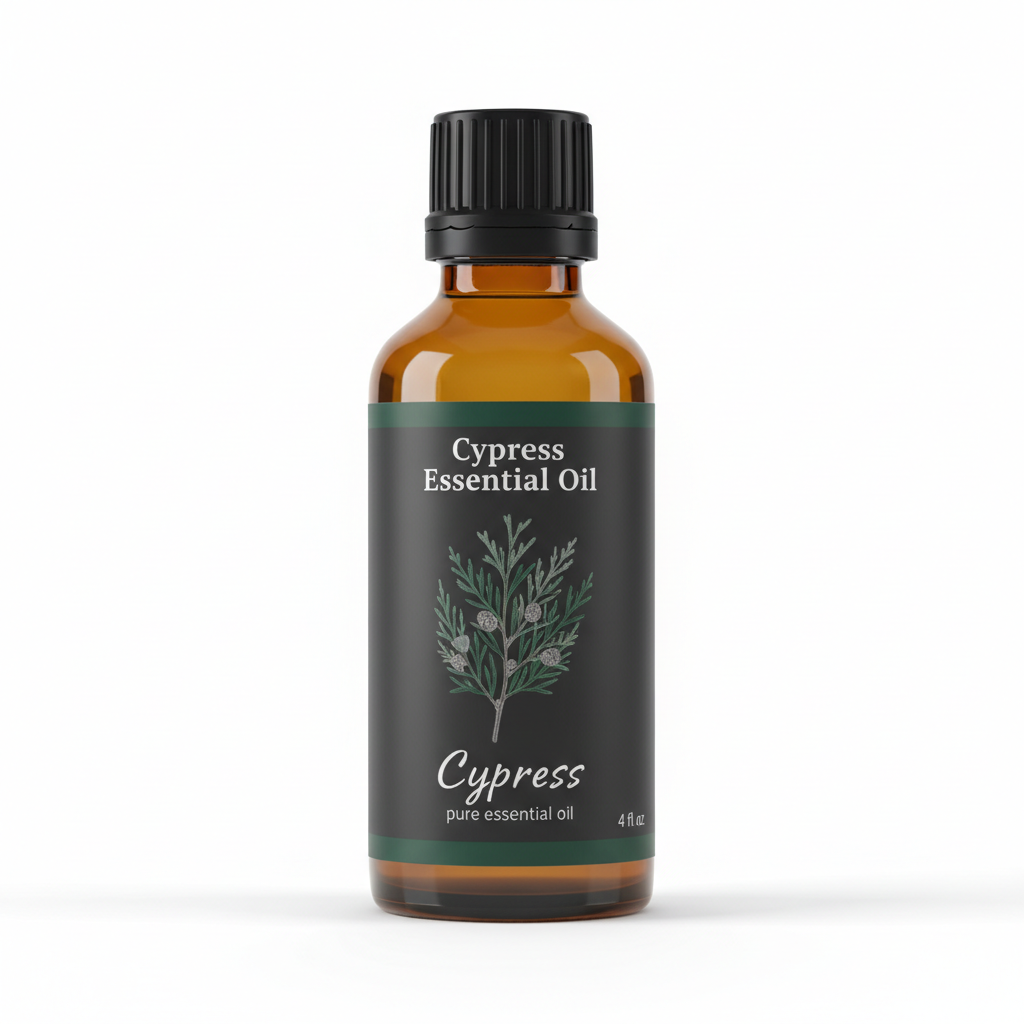
Cypress Essential Oil
Our own Cypress Essential Oil, in sizes from 0.5 oz to bulk.
From $10.99
Shop Now →Give each oil a job
Every good blend has a lift, a middle and a floor.
- Cypress is the green lift. We describe ours as fresh and smoky-green, drier and more refined than common pine oils, a top-to-middle note.
- Frankincense is the resinous middle. We sell cypress only, so you will buy this one from a supplier that names the species and plant part.
- Cedarwood is the dry floor that ties the first two together.
Why "cypress" is not one smell
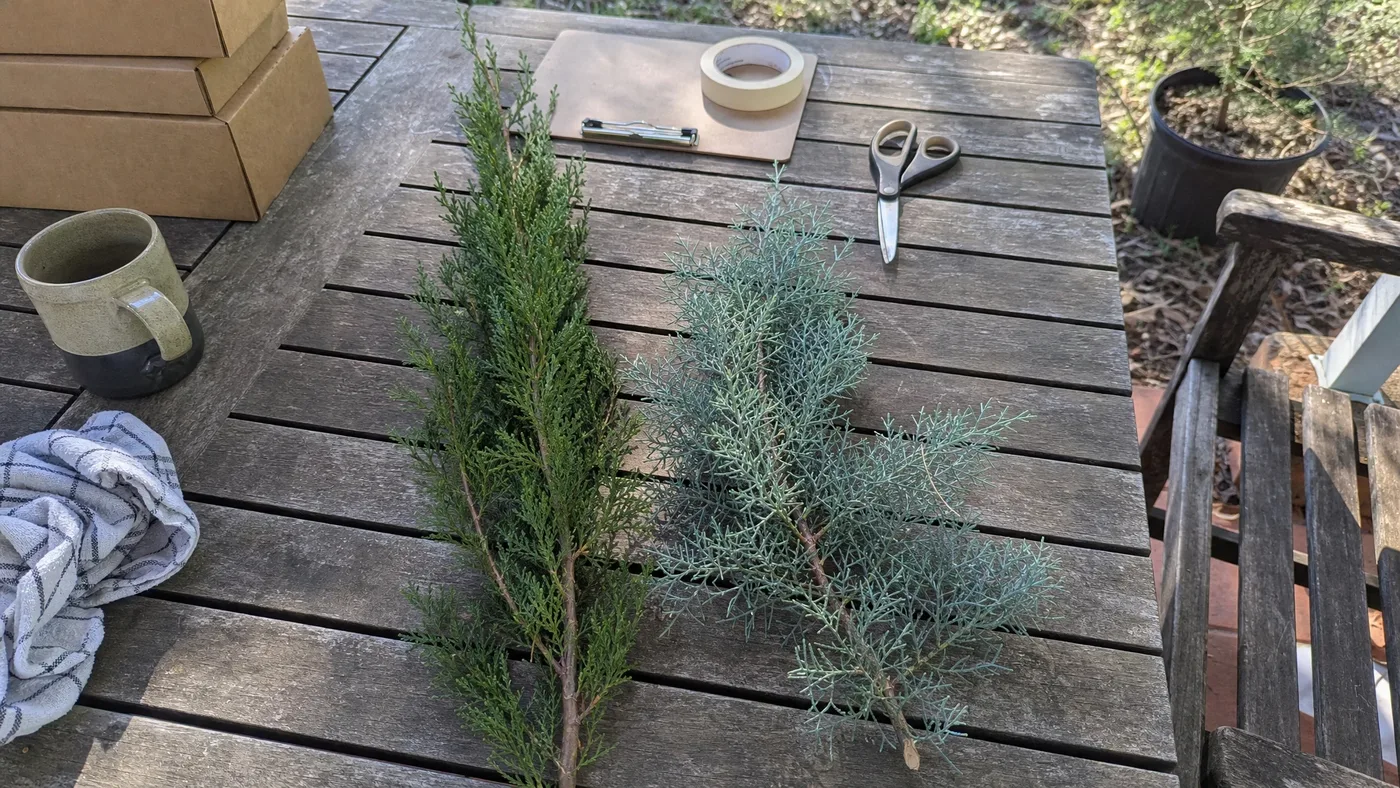
Two studies show how far a cypress oil can travel. A hydro-distilled Mediterranean sample was led by alpha-pinene and delta-3-carene (Selim et al., 2014), while aerial parts of a garden tree in Giza gave an oil dominated by cedrol (Ibrahim et al., 2017). Same botanical name, little else in common. So smell your bottle before you commit to ratios.
Frankincense has its own variability. A 2022 authentication study found that two commercial samples it examined were likely mixed with Boswellia serrata, showing alpha-thujene of 39.4% and 52.9% (Ojha et al., 2022). The takeaway for a blender is simple: ask the seller for the botanical name and, ideally, a batch report with a compound list, because pinene-rich frankincense overlaps more with a pinene-led cypress than you might expect.
For the floor, cedarwoods fall into two camps: the true cedars (Cedrus) are dominated by himachalenes and atlantones, while other cedarwoods are rich in cedrenes and cedrol (Setzer and Satyal, 2026). That matters because a cedrol-heavy cypress and a cedarwood are chemically close, and they can double up.
From roles to drops
Light molecules leave first and heavy ones last, and heavy materials are perceived at lower amounts. Reasoning from that, give the lift the largest share and the floor the smallest. Here is a starting formula, with volumes at the rough convention of 20 drops per ml.
| Oil | Role | Drops | About ml |
|---|---|---|---|
| Cypress | Green lift | 6 | 0.30 |
| Frankincense | Resinous middle | 4 | 0.20 |
| Cedarwood | Dry floor | 3 | 0.15 |
Thirteen drops is roughly one session in a small ultrasonic diffuser. Scale the whole table, never a single row. To keep a batch, multiply by ten into a 10 ml amber glass bottle: 60 drops cypress, 40 frankincense, 30 cedarwood. Label it with the date and keep it cool.
What the finished blend should feel like
When the proportions are right, the blend does not smell like three oils. It smells like a place: a quiet path at the edge of a wood, with something green overhead, a little resin on the air and dry bark underfoot. If you can pick out each oil separately, the blend has not come together yet, so give it a day and smell it again.
Good blending is as much patience as chemistry. Dip a strip, put it down, do something else for ten minutes, and come back to it. You will often find the blend has made up its mind while you were not looking.
Judge it on paper first
Dip four blotters: one per oil and one in the blend. Smell all four at one minute, then the blend again at thirty. If only the cypress remains, the floor is too light, so add a drop of cedarwood to a fresh 13-drop test, not to the batch. If it smells flat at minute one, the lift is too weak. Change one oil by one drop at a time, because a two-drop change in a 13-drop blend moves the proportion by more than 15%. Then wait a day; fresh blends read sharper. For other structures, see forest diffuser blends, what blends well with cypress and the longer recipe list.
Diffusing sensibly
Ultrasonic diffusers release fine particles as well as scent, and in a chamber study, tap water instead of deionized water raised fine-particle emissions about fivefold in a eucalyptus test (Schwartz-Narbonne et al., 2021). Cypress and frankincense were not tested, so we treat that as a reason for short sessions, a window open a crack, and clean water. Our oil is for external cosmetic use; keep it away from children and pets, and we suggest avoiding it in pregnancy as a precaution. If someone at home has asthma, ask a physician before diffusing anything, and pet owners should read cypress oil and dogs. A diffuser blend is not a skin product; for skin, we recommend 0.5% to 2% cypress in a carrier with a patch test.
Keep a blending notebook
Write down every version: the drops, the date and what you thought of it at one minute and at thirty. After a handful of tries, you will have a small library of your own, and you will start to see patterns about what you like. It is the cheapest way to get better at this, and the notes make a lovely record of your own taste.
The result should smell like a forest edge at dusk: green first, resin in the middle, dry wood underneath. Adjust it by nose, one drop at a time.
Cypress Essential Oil
Cypress Essential Oil from our own shop, in sizes from 0.5 oz to bulk.
From $10.99
Shop Now →Sources & Further Reading
- Selim SA et al., 2014. Chemical composition, antimicrobial and antibiofilm activity of the essential oil and methanol extract of the Mediterranean cypress (Cupressus sempervirens L.). BMC Complement Altern Med 14:179. pubmed.ncbi.nlm.nih.gov/24890383
- Ibrahim TA et al., 2017. Chemical composition and antimicrobial activities of essential oils of some coniferous plants cultivated in Egypt. Iran J Pharm Res 16(1):328-337. pmc.ncbi.nlm.nih.gov/PMC5423258
- Ojha PK et al., 2022. Comparison of volatile constituents present in commercial and lab-distilled frankincense (Boswellia carteri) essential oils for authentication. Plants 11(16):2134. pmc.ncbi.nlm.nih.gov/PMC9415502
- Setzer WN, Satyal P, 2026. Cedarwood oils: the wood essential oil compositions from trees known as "cedar". Plants 15(4):659. pubmed.ncbi.nlm.nih.gov/41754364
- Schwartz-Narbonne H, Du B, Siegel JA, 2021. Volatile organic compound and particulate matter emissions from an ultrasonic essential oil diffuser. Indoor Air 31(6):1982-1992. pubmed.ncbi.nlm.nih.gov/33905580