Choosing Cypress Oil for Diffuser, Skin or Perfume
Search for the best cypress oil for a diffuser and you will find one answer, and search for the best one for perfume and you will find another. In practice they are the same bottle. What changes from use to use is what you look at before you buy it and how you handle it once it is open.
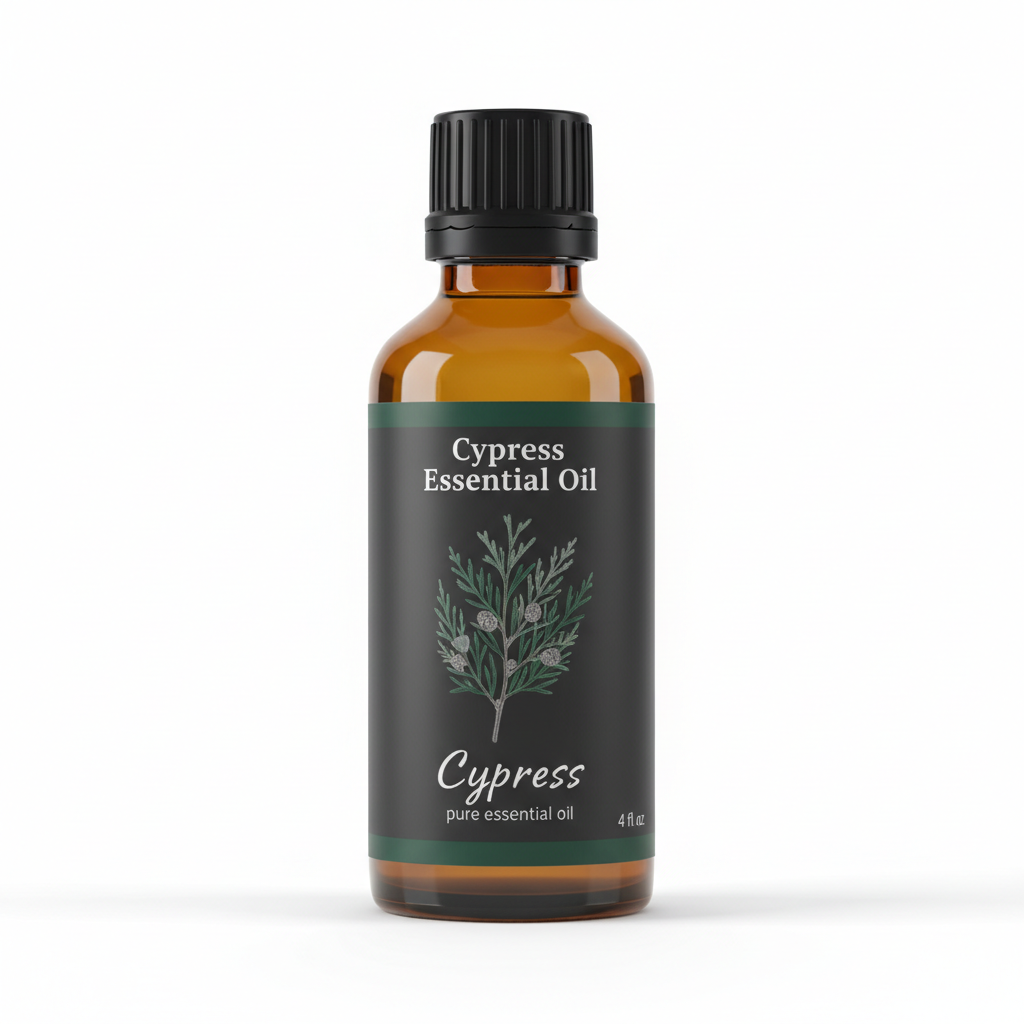
Cypress Essential Oil
Our own Cypress Essential Oil, in sizes from 0.5 oz to bulk.
From $10.99
Shop Now →Why no two cypress oils smell quite alike
Cypress is a variable oil, and published analyses show it. One hydrodistilled Mediterranean cypress came out at about 49% alpha-pinene, the bright, piney molecule. Three regions of Tunisia gave oils in the low-to-mid 30s for the same molecule. An Egyptian garden sample was led by cedrol, a woody, almost pencil-shaving compound, with alpha-pinene near 5%. Robert Tisserand notes that cypress oil is quite varied in its composition, in part because of how much leaf versus cone goes into the still.
So a "good" cypress is not defined by a country on the label. It is defined by what is in the bottle you are holding. We sell one cypress oil, steam-distilled from the green growth of Cupressus sempervirens, and we describe its aroma as fresh, smoky-green and a little resinous, drier than most pine oils. If you want to see how origin can move the scent, our French vs Mediterranean comparison goes deeper.
The paperwork worth reading, whatever the use
An international standard for this oil exists, ISO 20809:2017, so a seller and a buyer have a common reference for what Cupressus sempervirens oil should look like. Beyond that, four things are worth finding on any seller's page:
- The botanical name, so you know the species.
- A batch number that matches the number on your bottle.
- Physical readings such as density, refractive index and optical rotation, each shown next to the range it was checked against.
- A GC-MS compound list, if you are formulating something where you need to know exactly what you are balancing.
The Certificate of Analysis we publish is for one batch, CYPQGCCSUSC005A. It lists a density of 0.864 (range 0.860 to 0.880), a refractive index of 1.469 (range 1.460 to 1.480) and an optical rotation of +16.08 degrees (range +9.00 to +27.00). Those readings tell you an oil sits in the expected neighborhood; they do not list compounds. If you want a GC-MS report for the lot you are buying, ask us in writing through the contact page before you order. Our guide to reading our COA walks through each line.
In the diffuser: short sessions beat long ones
Pinene-led oils are made of light, quick-evaporating molecules, so it is reasonable to expect cypress to be at its liveliest in the first stretch and to soften as the session goes on. That is reasoning from composition rather than a diffuser trial, but it fits how most people describe conifer scents: strong at the start, then quieter.
It also points to a good habit. Researchers who ran ultrasonic diffusers in a test chamber with lemon, lavender, eucalyptus and grapeseed oils found that the devices released both volatile compounds and fine particles, and that using tap water raised fine-particle output markedly in the eucalyptus runs. Cypress was not in that study, but the lesson carries over: use clean water, ventilate the room, keep sessions modest, and keep the diffuser out of reach of children and pets, as our safety guidance says. How to use cypress oil covers the practical side.
On skin and in grooming products: the base matters as much as the oil
For an aftershave splash, beard oil or any leave-on product, the carrier and the dilution shape the result more than the cypress does. Our dilution guidance is 0.5% to 2% in a carrier oil with a patch test first, and for a product you will wear daily we would start at the low end. If you are formulating something to sell, check the current IFRA standards for your product category rather than relying on a general range.
Freshness counts here too, because an aged oil smells flatter and less green. Hana Tisserand of the Tisserand Institute points out that conifer oils oxidize faster than most, and that even unopened and refrigerated they are near the limit of usability after about two years. Buy the size you will finish, cap it tightly and keep it cool and dark. Formulations that put this into practice are in our cypress cologne and beard oil post.
In perfume: let it change on the blotter
Perfumers judge an oil over time, not at the first sniff. Put a drop on a blotter, smell it after a minute, then again after half an hour. A pinene-led cypress tends to move noticeably over that window, while a cedrol-heavy one changes less, so the exercise tells you a lot about the oil in your hands. We describe ours as sitting between a top and a middle note, and our perfumery post shows how that position helps in a woodland accord.
A quick rule of thumb if you are choosing between us and a lookalike: buy the oil whose seller can tell you the species, the batch and what the report actually measured. Everything else is adjectives.
A last practical thought: whichever use you start with, make notes. Write down the date you opened the bottle, how many drops you used and what you thought of the scent after an hour. A scribbled label on the bottle or a line in a notebook is all it takes, and it will tell you more about the oil in your hands than any description can.
Cypress Essential Oil
Cypress Essential Oil from our own shop, in sizes from 0.5 oz to bulk.
From $10.99
Shop Now →Sources & Further Reading
- Selim SA et al., 2014. Chemical composition, antimicrobial and antibiofilm activity of the essential oil and methanol extract of the Mediterranean cypress (Cupressus sempervirens L.). BMC Complement Altern Med 14:179
- Sriti J et al., 2024. Antioxidant, antibacterial and insecticidal activities of cypress (Cupressus sempervirens L.) essential oil. Int J Environ Health Res 34(2):1168-1179
- Ibrahim TA et al., 2017. Chemical composition and antimicrobial activities of essential oils of some coniferous plants cultivated in Egypt. Iran J Pharm Res 16(1):328-337
- ISO 20809:2017 Essential oil of cypress (Cupressus sempervirens L.)
- Schwartz-Narbonne H, Du B, Siegel JA, 2021. Volatile organic compound and particulate matter emissions from an ultrasonic essential oil diffuser. Indoor Air 31(6):1982-1992
- Tisserand Institute: Cypress oil as a deodorant
- Tisserand Institute: Keep essential oils cool