
What Is Cypress Essential Oil? A Complete Guide
Cypress essential oil is a pale, dry-scented oil steam-distilled from the needles, twigs, and small cones of Cupressus sempervirens, the Mediterranean cypress. It is made from the green parts of the tree, not the wood, which gives it a dry, coniferous character and a chemistry built mostly on light monoterpenes.
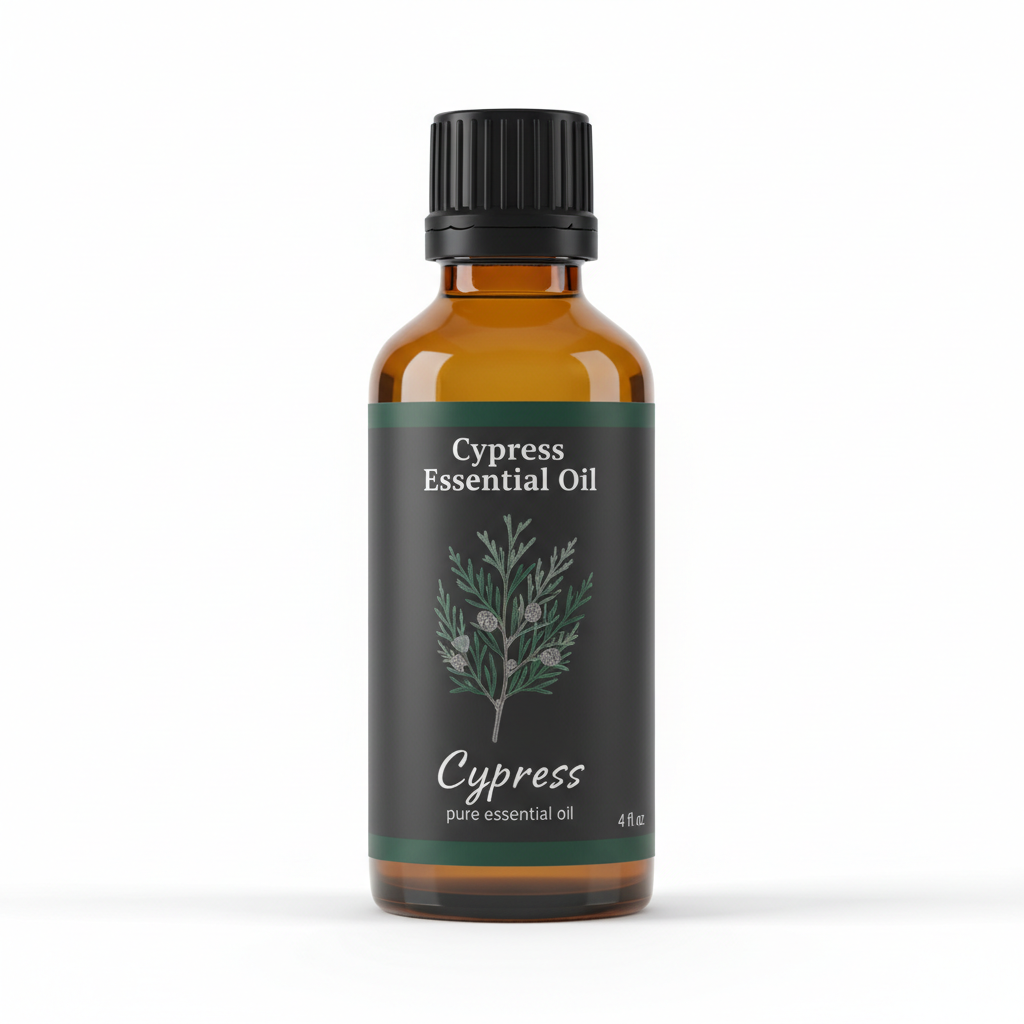
Cypress Essential Oil
Our own Cypress Essential Oil, in sizes from 0.5 oz to bulk.
From $10.99
Shop Now →That one sentence answers the question in the title. The rest of this guide is the longer conversation a good shopkeeper would have with you across the counter: what the oil is, what it smells like, what is in it, how it is made, how to handle it safely, and how to tell a well-made bottle from a vague one. Cypress oil is a small category with a surprising number of ways to buy the wrong thing, so the details matter.
Key takeaways
- True cypress oil comes from Cupressus sempervirens. The Latin name on the label is the fastest quality filter you have.
- A label that says only “cypress oil” leaves out the species, the plant part, and usually the origin. Treat that gap as information.
- The oil is rich in alpha-pinene, delta-3-carene, limonene, and cedrol. The first three are light, volatile monoterpenes that oxidize readily.
- Dilute for skin, never swallow it, and keep it fresh. Oxidized monoterpenes are more likely to irritate skin than fresh oil.
- Needle-and-twig cypress is a different product from wood-distilled “cypress” oils such as blue cypress or hinoki.
What Cypress Essential Oil Is
The tree behind the label
Cupressus sempervirens belongs to the Cupressaceae, the cypress family. You know its most famous form even if you have never heard the name: the tall, narrow, pencil-shaped tree that punctuates Tuscan hillsides and Mediterranean cemeteries. Botanists call that columnar form var. stricta. A wider, spreading form, var. horizontalis, also exists, and it is the older and less photographed of the two. The species is native to the eastern Mediterranean and has been planted around the basin for so long that its natural range is hard to separate from its cultivated one.
The species name is Latin for “always green,” and it earns it. The foliage is evergreen, dense, and made of tiny scale-like leaves pressed flat against the twigs. That is why distillers usually say “needles and twigs” even though the leaves are not needles in the pine sense. It is shop shorthand for the green, fine-textured material that goes into the still.
Which parts go into the still
A true cypress essential oil is distilled from the aerial green parts of the tree: the foliage, the fine twigs, and often the small round cones. The cones are woody, a few centimeters across, and they carry aromatic material of their own. The oil is held in microscopic glands in these tissues. Steam ruptures the glands and carries the volatile compounds out, which is exactly the process described in our walkthrough of how cypress essential oil is made.
Why needle-and-twig oils differ from wood oils
This is the distinction that most generic guides skip, and it explains a lot about why two products both called “cypress” can smell nothing alike.
Green tissue stores its aromatic compounds in surface glands, and those compounds tend to be small, light molecules that evaporate quickly. Heartwood is a different storage system. It accumulates heavier compounds over decades, and the oils pulled from it tend to be thicker, darker, and slower to fade. Different plant part, different chemistry, different scent.
Two well-known examples show the gap. Blue cypress oil comes from Callitris intratropica, an Australian tree, and is distilled largely from wood. It is famous for its deep blue color and a soft, woody scent that has little in common with the Mediterranean oil. We compare them directly in blue cypress versus Mediterranean cypress oil. Hinoki is the Japanese cypress, Chamaecyparis obtusa, a different genus altogether, and its oil has a lemony, forest-floor character that you can read about in our guide to hinoki and Japanese cypress oil.
Neither is a flawed version of the other. They are different products that share a family resemblance and a common name, and the name is where the trouble starts.
The name problem
“Cypress” is a common name, not a species. It gets applied to trees in several genera: Cupressus (the true cypresses), Chamaecyparis (the false cypresses, including hinoki), Callitris (the Australian cypress-pines), and Taxodium (the bald cypress of the American South). Each has a different aroma profile, and a bottle labeled only “cypress oil” could in principle come from any of them, or from a blend.
One more bit of confusion is worth clearing up. Perfume lovers sometimes assume the fragrance family called chypre is built on cypress. It is not. The word is French for Cyprus, the island, and the classic chypre accord is built around bergamot, labdanum, and oakmoss. Cypress oil can appear in woody and fresh compositions, but it does not define that family.
Our position on the label
Here is the stance we take as a shop, and it is simple. The Latin name on the label is the single fastest quality filter you have. A seller who distilled or sourced Cupressus sempervirens has no reason to hide it. A bare “cypress oil” on the front of a bottle tells you the seller hopes you will not ask which cypress. You can ask, of course, and a good seller will answer. But a label that volunteers the species, the plant part, and the country is already ahead of one that makes you dig.
What Cypress Oil Smells Like
Open a bottle of Cupressus sempervirens oil and the first impression is dry, green, and coniferous. Think of the air in a stand of evergreens on a cool morning, then take away the sweetness and the sticky resin. It is crisp rather than creamy and woody rather than floral. Nobody would call it plush.
The structure of that scent follows from the chemistry in the next section. Alpha-pinene gives the clean, pine-needle freshness. Delta-3-carene adds a sharper, slightly sweet and earthy-green edge. Limonene contributes a faint lift that reads as citrus peel in the background, never as lemon. And as the lighter molecules evaporate over the first minutes, the heavier cedrol component is left behind, which is why the dry-down is warmer, smoother, and more woody than the opening.
That evaporation order is reasoning from molecular weight, not a laboratory measurement, but it matches how the oil behaves on a paper strip. If you want to judge a bottle properly, smell it from a blotter after thirty seconds and again after ten minutes. Smelling straight from the bottle opening exaggerates the sharpest top note and tells you less than you would think.
Cypress sits close to other conifer oils such as fir, juniper, and pine, and it can be mistaken for them in a blend. What separates it is the dryness. Fir tends to read sweeter and balsamic, and pine can read sharper and more resinous. Cypress is the leaner of the group.
This section is only the short version. The full scent profile of cypress essential oil covers the opening, heart, and dry-down in more detail, along with what it blends with and what it clashes with.
Cypress Oil Properties and Key Constituents
When people search for cypress oil properties, they usually mean one of two things: what the oil is physically like, or what is chemically in it. Both are useful to know, and both help you spot a bottle that is not what it claims to be.
Physical properties you can check yourself
Cypress oil is a thin, mobile liquid, colorless to pale yellow, with a low viscosity compared with a carrier oil such as sweet almond. Like all essential oils it is lighter than water and does not dissolve in it. Drop it into a glass of water and it floats as a film instead of dispersing. It dissolves readily in fatty oils and in alcohol, which is why it blends easily into a body oil or a perfume base.
One simple check is the blotter test. Put a drop on plain white paper and let it sit for an hour. A pure volatile oil should evaporate with little or no visible ring. A translucent, greasy ring suggests a fatty carrier oil was mixed in. The test is not definitive, because it will not catch a cheaper volatile oil or a synthetic aroma chemical, but it does catch one common shortcut.
Key constituents in plain English
Essential oils are mixtures of aroma molecules, and the plant decides the proportions. For Cupressus sempervirens the compounds that matter most are these. Formulas and classifications below are the ones recorded in PubChem, the US National Library of Medicine's chemistry database.
| Compound | Class | Formula | What it contributes |
|---|---|---|---|
| Alpha-pinene | Monoterpene | C10H16 | The fresh, clean, pine-needle backbone of the scent |
| Delta-3-carene | Monoterpene | C10H16 | A sharper, slightly sweet, earthy-green edge |
| Limonene | Monoterpene | C10H16 | A faint citrus-peel lift in the background |
| Cedrol | Sesquiterpene alcohol | C15H26O | A dry, woody, lingering base that shows up late |
Three of those four share the formula C10H16. They are isomers, meaning the same atoms arranged differently, and that small difference in arrangement is what separates the pine-like note of alpha-pinene from the sweeter note of delta-3-carene. Cedrol is a larger molecule with fifteen carbons and an oxygen atom. It is heavier, evaporates far more slowly, and is the reason the oil does not vanish from a paper strip in minutes.
Other compounds often reported in cypress oil include myrcene, terpinolene, alpha-terpinyl acetate, and germacrene D. Exact proportions vary with the origin of the trees, the season of harvest, the proportion of twigs and cones to foliage, and how long the distillation runs. This guide does not quote percentages because they would be invented precision. Any single number for a “typical” cypress profile hides a real spread between batches.
That variation is the practical argument for a batch-specific GC/MS report. Gas chromatography with mass spectrometry separates and identifies the compounds in a sample. A report tied to your lot number lets you check that the main constituents above are present and that nothing unexpected is in the bottle.
Why the chemistry matters for storage
Alpha-pinene, delta-3-carene, and limonene all contain carbon-carbon double bonds, and double bonds react with oxygen. Over time and with exposure to air, heat, and light, these monoterpenes form oxidation products. In practical terms, oxidized oil smells flatter and sharper, a bit like turpentine, and it is more likely to irritate skin. Robert Tisserand and Rodney Young discuss oxidation of monoterpene-rich oils as a recognized source of skin sensitization in Essential Oil Safety (2nd edition), and limonene is the best-documented example.
One consequence follows from the chemistry itself. Because these compounds react with oxygen, a half-empty bottle ages faster than a full one, since there is more air trapped inside to react with the oil. That is reasoning from the chemistry, not a measured shelf life, but it is why we suggest moving a nearly empty bottle into a smaller one and why a tight cap matters more than most people think.
Research interest in these compounds exists, and you will find laboratory papers on alpha-pinene and limonene in the literature. Results from a lab dish do not translate into claims about what a bottle does for a person, and this page makes none. It is a guide to identity, scent, handling, and quality.
How Cypress Oil Is Made
Almost all true cypress essential oil is made by steam distillation. The method is old, simple in principle, and unforgiving in practice.
From branch to still
Foliage, fine twigs, and cones are cut and loaded into a still. Many producers use fresh or briefly wilted material, because the oil sits in glands that dry out with time. The plant matter is packed into a chamber above a water boiler, or above water inside the still itself.
What the steam does
Steam passes up through the plant material. The heat and moisture open the oil glands, and the volatile compounds are swept along in the vapor. That vapor travels into a condenser, where cold water around the outside turns it back to liquid. The liquid collects in a separator. Because cypress oil is lighter than water and does not mix with it, the oil floats on top and the water settles below. The water that remains is the hydrosol, a faintly scented by-product that is sold separately and is not the same thing as the essential oil.
Why the details change the result
Light compounds such as the pinenes come over first. Heavier molecules, including cedrol, arrive later in the run. By reasoning from that order, a short distillation will favor the lighter, fresher top notes, while a longer run will bring in more of the heavy base and shift the character toward woody. What a distiller chooses to do here shapes the final scent as much as the trees do.
The yield is small relative to the volume of plant material that goes in, which is why a genuine bottle carries a real cost and why a suspiciously cheap one deserves a question. Other extraction methods exist for aromatic plants, such as CO2 extraction and solvent extraction, but they produce different products with different compositions. If a label names a method other than steam distillation, read it as a different thing from the classic oil described here.
For a stage-by-stage look, including what separates a careful run from a rushed one, see how cypress essential oil is made.
Safety at a Glance
Cypress oil is a concentrated aromatic material. It deserves the same respect as any essential oil and no special alarm. The core rules fit in a short list.
- Dilute for skin. Do not apply undiluted oil to skin. A common cosmetic starting point is 1 percent, which is about 6 drops in 30 mL (one ounce) of carrier oil. Use half that for the face or for sensitive skin.
- Patch test first. Apply a small amount of the diluted blend to the inner forearm and wait 24 hours before wider use.
- Never ingest it. Essential oils are not food ingredients, and swallowing cypress oil is not safe. If someone swallows it, contact US Poison Control at 1-800-222-1222.
- Keep it fresh. Oxidized monoterpenes are more likely to irritate skin. If the scent has turned sharp, flat, or like turpentine, retire the bottle for room fragrance at most and do not put it on skin.
- Keep it away from eyes and mucous membranes. Water will not rinse oil away. A fatty oil such as olive oil will dilute it.
- Mind children and pets. Store the bottle out of reach. If you diffuse, ventilate the room and leave animals a way out. The ASPCA Animal Poison Control Center (888-426-4435) is the number to keep for pet exposure, and cats in particular are sensitive to many aromatic compounds.
- Check with a professional. If you are pregnant, nursing, or under a physician's care, ask your physician or another licensed clinician before using any essential oil.
Dilution at a glance
| Dilution | Per 30 mL (1 oz) carrier | Typical use |
|---|---|---|
| 0.5% | about 3 drops | Face, sensitive skin, first trial |
| 1% | about 6 drops | General body oil and daily-use blends |
| 2% | about 12 drops | Occasional use on small areas of skin |
These figures assume about 20 drops per milliliter, which varies a little by dropper. Treat them as guides and start low. For detailed dilution ceilings and the reasoning behind them, Tisserand and Young's Essential Oil Safety is the reference to consult.
The sunlight question
Some essential oils, mainly cold-pressed citrus, can make skin react more strongly to sunlight. Cypress is not generally listed among them, but it is a fair question to ask, and the answer deserves more than a sentence. Is cypress essential oil phototoxic? Dilution and safety covers it, along with how to read dilution guidance when different sources disagree.
Who this oil is not for
Be honest with yourself about a few cases. If dry, piney scents have always bothered you, cypress will not be the exception. If you have reacted to conifer products before, such as pine-scented cleaners or turpentine-type solvents, be especially careful, since related aroma compounds can cross over. If you are looking for something warm, sweet, or floral, you will be disappointed. And if you have been advised by a physician to do or avoid anything, a bottle of essential oil does not replace that advice.
What commonly goes wrong
The usual mistakes are mundane. People assume “natural” means safe at any strength. They use a bottle that has sat open on a sunny shelf for two years. They apply it undiluted “just a little” to skin. They diffuse for hours in a closed room. None of that has anything to do with cypress in particular, and all of it is avoidable.
How to Pick a Quality Bottle
Quality in essential oils is hard to judge by smell alone, especially for a beginner, so you rely on what the seller is willing to tell you. Here is the order in which we would check a bottle, from fastest to slowest.
1. The Latin name
Look for Cupressus sempervirens on the label. It takes two seconds and removes a large share of the problems described earlier. If the label says only “cypress,” “cypress oil,” or a brand name with a tree on it, you do not yet know what is inside. A seller with a real Cupressus sempervirens product has every reason to say so.
2. The plant part and country
A good label or product page says needle, twig, or cone, and names the country where the oil was distilled. The plant part tells you which family of oil you are buying, and the country gives you a place to start asking questions. Cypress oil is commonly produced around the Mediterranean, but we would rather you read the label than rely on our generalization.
3. A single ingredient
The ingredients list should read as one item. Words such as “fragrance,” “blend,” “nature-identical,” or “aroma oil” indicate something that is not a straight steam-distilled oil. They may be perfectly good for scenting a room, but they are not what this guide describes.
4. A batch-specific GC/MS report
Ask for the report and check that the lot number on it matches the lot number on your bottle. A report for “cypress oil” in general proves little. A report for your batch, listing alpha-pinene, delta-3-carene, limonene, and cedrol among the main components, is meaningful. If the seller cannot or will not provide one, that is useful information too.
5. Packaging and dating
Dark glass (amber or cobalt) with a tight cap and an orifice reducer is the standard for a reason: light and oxygen are what age these oils. Plastic is a poor choice for long storage. A distillation or bottling date, or at least a lot code that can be traced to one, helps you judge freshness. As a rule of thumb, plan on a year or two of good use after opening if the bottle is kept cool, dark, and well-capped, and less if it is stored warm. That is a conservative planning figure, not a precise shelf life.
6. Marketing language that means nothing
Terms such as “pure grade,” “premium grade,” and “certified pure” do not correspond to a regulated standard in the way people assume. Some sellers use them with real testing behind them, and some use them as decoration. Do not treat the phrase as evidence. Treat the Latin name, the plant part, the origin, and the batch report as evidence.
7. Your own nose
Once the paperwork checks out, smell it. A good Cupressus sempervirens oil should read as dry, green, and coniferous, with a woody backdrop. If it smells sweet, floral, or synthetic, or if the scent is sharp and harsh with a turpentine edge, something is off, either in the product or in how it has aged. If your reference points are thin, our scent profile will help you calibrate.
A caution about the filter itself
The Latin name is a filter, not a guarantee. A correctly labeled bottle can still be old, oxidized, or adulterated, and a missing Latin name does not prove fraud. What the Latin name does is raise the cost of being vague. A seller who prints it has made a claim you can test. A seller who does not has made none. When you are ready to compare, you can browse the current listings in the shop with this checklist in hand.
Common Questions
Is cypress oil the same as cedarwood oil?
No. Cedarwood oils usually come from Juniperus or Cedrus species and are distilled from wood. They share some woody character with cypress, and cedrol is the compound most associated with cedarwood, which is why the two can seem similar late in the dry-down. But cedarwood is typically a thicker, warmer, more pencil-shavings scent, while cypress needle-and-twig oil is leaner and greener at the opening.
Is cypress oil the same as blue cypress or hinoki?
No. Blue cypress is Callitris intratropica, an Australian species distilled largely from wood. Hinoki is Chamaecyparis obtusa, a Japanese species in a different genus. All three are called cypress in one sense or another, and all three smell different. See blue cypress versus Mediterranean cypress and hinoki and Japanese cypress oil for the details.
How do people use cypress oil?
In aromatic and cosmetic ways. It is diffused for a fresh, dry, woodland note in a room, added at low dilution to body oils and massage blends, and used by soapmakers and candlemakers who want a clean conifer accent. Because it is a lean, fresh scent, it tends to pair well with citrus and with warmer, sweeter oils that round it out. Keep any skin use diluted, as described in the safety section above.
Can I use cypress oil in a diffuser every day?
Many people diffuse in short sessions, often thirty to sixty minutes in a ventilated room, and that is a reasonable habit to start with. Constant all-day diffusion in a small closed space is where problems tend to begin, for people and especially for pets. Use less than you think you need and open a window.
How long does cypress oil last?
Longer than a citrus oil and shorter than a resin or a deep wood oil, because of the monoterpene content described earlier. A cool, dark cupboard, a tight cap, and a smaller bottle as the volume drops will all help. If it smells flat or sharp, stop using it on skin.
What if I cannot find a true cypress oil?
You have options. Several oils sit close to cypress in scent, and the right swap depends on what you want from the bottle. We walk through the closest matches and their differences in cypress essential oil substitutes and close matches. A substitute is a different oil, not a copy, so expect a shift in the scent.
Why does the species name matter so much?
Because the common name covers too much ground. “Cypress” spans several genera with different chemistry, different scent, and different handling notes. The Latin name is the one piece of information on a bottle that tells you exactly which plant was distilled, and it is the one a vague seller leaves out. Start there, then check the plant part, the origin, and the batch report, and you will already know more about the bottle than most buyers do.