Cypress Essential Oil FAQ: 20 Questions, Answered Plainly
Buyers ask the same handful of things about cypress oil: what it smells like, which bottle to order, how many drops go in the diffuser. Those are fair questions, and they get direct answers below. Two questions rarely get asked at all, and they matter more than the rest: how far to dilute the oil, and how to store the bottle. Nearly every answer here leans on one of them.
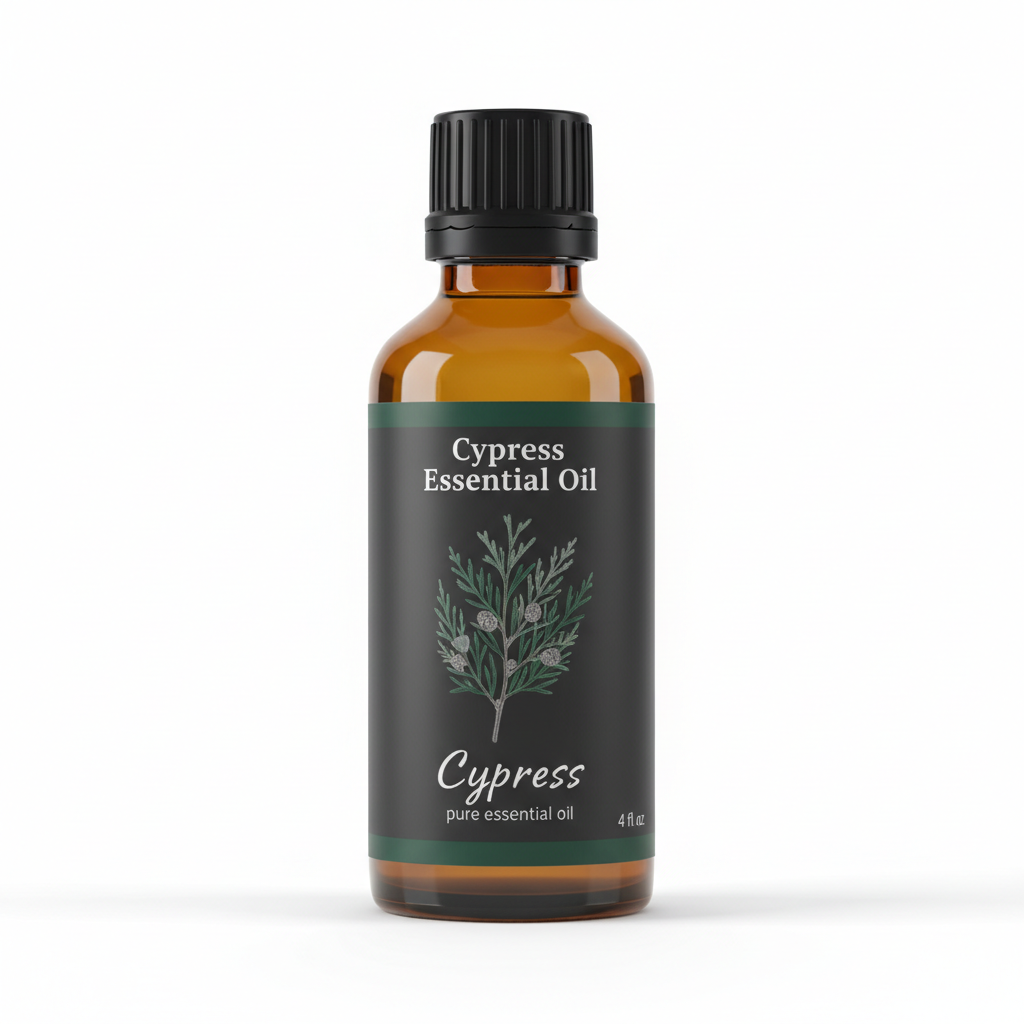
Cypress Essential Oil
Our own Cypress Essential Oil, in sizes from 0.5 oz to bulk.
From $10.99
Shop Now →If you searched for a cypress essential oil faq, a straight answer to whether cypress oil is safe, or a list of cypress oil questions, the twenty below are grouped by theme: the basics, safety, buying, and everyday use.
The Basics
1. What is cypress essential oil?
It is a concentrated aromatic liquid steam-distilled from the leaves and twigs of the cypress tree, and some producers include the small cones. Because it is concentrated, a few drops go a long way, and it is never used like a cooking ingredient. The complete guide to cypress essential oil covers the plant, the distillation and the vocabulary in more depth.
2. What does cypress oil smell like?
Green, dry and resinous, with a woody backbone and a faint sweetness, a bit like crushed conifer needles. The bright, sharp opening comes largely from alpha-pinene, the same compound that scents pine. Batches vary with harvest and distillation, so the full scent description is worth reading before you commit to a bottle.
3. Which species is it?
Most bottles sold as cypress are Cupressus sempervirens, the tall, narrow Mediterranean cypress. The common name is loose, though. Blue cypress (Callitris intratropica) is a different tree with a different, deeper scent, and some labels print only the word cypress with no Latin name. If the botanical name is missing, ask the seller. A reputable one answers in a sentence.
4. Where does it come from?
Spain, France and Morocco are commonly cited as sources, but no public figure splits the market cleanly, so treat any exact percentage with suspicion. Soil, climate and harvest timing shift the ratio of compounds, which is why two bottles of the same species can smell slightly different. A batch report tells you more about what is in your bottle than a country name does.
5. How is it made?
By steam distillation. Steam passes through the plant material, carries off the volatile compounds, and the oil is separated from the condensed water. Yield per kilo of foliage is low, which is part of why cypress costs more than bulk citrus oils.
Safety
6. Is cypress oil safe?
Safety describes how an oil is used, not the bottle itself. The main hazards are the ones that apply to any concentrated oil: irritation if used undiluted on skin, and harm if swallowed. Oxidized oil raises the odds of a skin reaction, which is another reason storage matters. For any specific question, check Robert Tisserand and Rodney Young's Essential Oil Safety, 2nd edition, and ask your own clinician about your situation.
7. How should I dilute it for skin?
A common conservative starting point for adults is 1 percent: about 6 drops in 30 ml (1 fl oz) of carrier oil, assuming roughly 20 drops per ml. Drop size varies with the bottle's dropper, so treat that count as approximate. Use half that strength for the face or for sensitive skin. Before first use, dab a little diluted blend on your inner forearm and wait a full day to see how your skin responds.
8. Is it okay to diffuse around pets?
Pets are more sensitive than people, and cats, small animals and birds more sensitive still. Diffuse in a room with the door open so the animal can leave, keep sessions short, and never apply oil to a pet. The ASPCA Animal Poison Control Center is the contact to call after any exposure, and the article on cypress oil and dogs goes through the details.
9. Can cypress oil be swallowed?
No. It is an aromatic and cosmetic ingredient, not something to ingest. If anyone has swallowed it, call US Poison Control at 1-800-222-1222 right away, and use the ASPCA Animal Poison Control Center for a pet. Keep the bottle capped and out of reach, and do not assume the cap is child-resistant.
10. What about children and pregnancy?
Be conservative. For young children, skip skin application unless a clinician agrees, and keep any diffusing brief in a well-ventilated room. For pregnancy, we cannot tell you what suits your situation, and published guidance is too thin to substitute for personal advice. Ask your own clinician before using it, and consider simply leaving it out for now.
Buying
11. Which bottle size should I order?
Order smaller than feels economical. At 3 to 5 drops per diffuser session, a 15 ml bottle holds roughly 300 drops, so about 60 to 100 sessions, and most of that time the bottle sits partly empty with air above the oil. The bottle size guide works through the arithmetic, and current options are in the shop.
12. What does a COA actually show?
A certificate of analysis, usually a GC-MS report, lists the compounds found in one specific batch and their percentages. Check that the botanical name and batch number match your bottle, and that the profile is plausible for the species. A report with no batch number cannot be tied to what you are holding. The buyer's checklist for GC-MS reports shows what to look for line by line.
13. Why do prices differ so much?
Yield, origin, distillation care, testing and bottling all move the price. A suspiciously cheap bottle may be stretched with a carrier or cut with cheaper oils, and a very expensive one may be paying for packaging. Price alone proves nothing in either direction, which is why paperwork matters more than the number.
14. Does a 'grade' label on the bottle mean anything?
No. Phrases such as 'premium grade', 'certified pure' or 'clinical grade' have no regulated definition behind them in the United States. They are marketing language, and no authority audits them. Look for evidence instead: a botanical name, a stated origin and a batch-specific report.
15. How can I tell if it is pure?
No single sniff test settles it, and home tricks such as the paper-drop test are unreliable. The practical route is to compare the label, the batch report and the scent against what you would expect. The guide to spotting pure cypress oil before you pay lays out the checks that hold up.
Use and Storage
16. How many drops belong in a diffuser?
In a typical ultrasonic diffuser holding about 100 ml of water, 3 to 5 drops is a sensible range. Start at 3, because pinene-rich oils read louder than people expect. Scale with water volume, at roughly one drop per 25 to 30 ml, and run it in intervals in a room with some fresh air.
17. What blends well with cypress?
The reasoning is simple. Cypress is green and woody and lacks a sweet top, so citrus such as bergamot or sweet orange lifts it, while a resin such as frankincense gives it a base. Lavender, juniper berry and cedarwood sit comfortably alongside it too. The article on what blends well with cypress gives ratios to start from.
18. How should I store it?
Keep it in dark glass, tightly capped, upright, in a cool spot away from windows and stoves. Alpha-pinene oxidizes readily on contact with air, and light and warmth speed it up. Because of that, a half-empty bottle ages faster than a full one: more air sits above the oil. The guide to storing cypress oil so it doesn't oxidize covers the details.
19. How long does an opened bottle last?
Nobody can give a date that holds for every bottle. A rough working figure for conifer oils is one to two years once opened, shorter if the bottle is mostly empty or kept warm. Write the opening date on the label so you are not guessing later.
20. What should I do with an oil that smells flat?
A flat, sharp or sour smell usually means oxidation. Do not put it on skin: Tisserand and Young discuss oxidized oils as a factor in skin sensitization. Retire the bottle and compare it against a fresh one, and the difference in brightness is usually obvious.
The Two Questions Worth More Than the Other Eighteen
Look back through the answers and notice how often they depend on dilution or storage. A well-tested oil applied undiluted is a worse purchase than an average oil diluted properly. A superb oil left half-empty on a sunny shelf will no longer smell like the batch on its report.
This page is not for anyone hoping for one magic drop count. No number replaces reading the label, the report and your own skin's response. The most common mistake is buying the large bottle for the better per-milliliter price and then losing the last third of it to air.