
What Blends Well with Cypress Essential Oil?
Cypress blends best with citrus, resins, cedarwood, lavender and other conifers. It is a dry green note that sits between top and middle, so it gives a blend structure without taking it over. Start near 2:1 cypress to partner for resins and woods, 1:1 for lavender and sweet orange, and let florals lead.
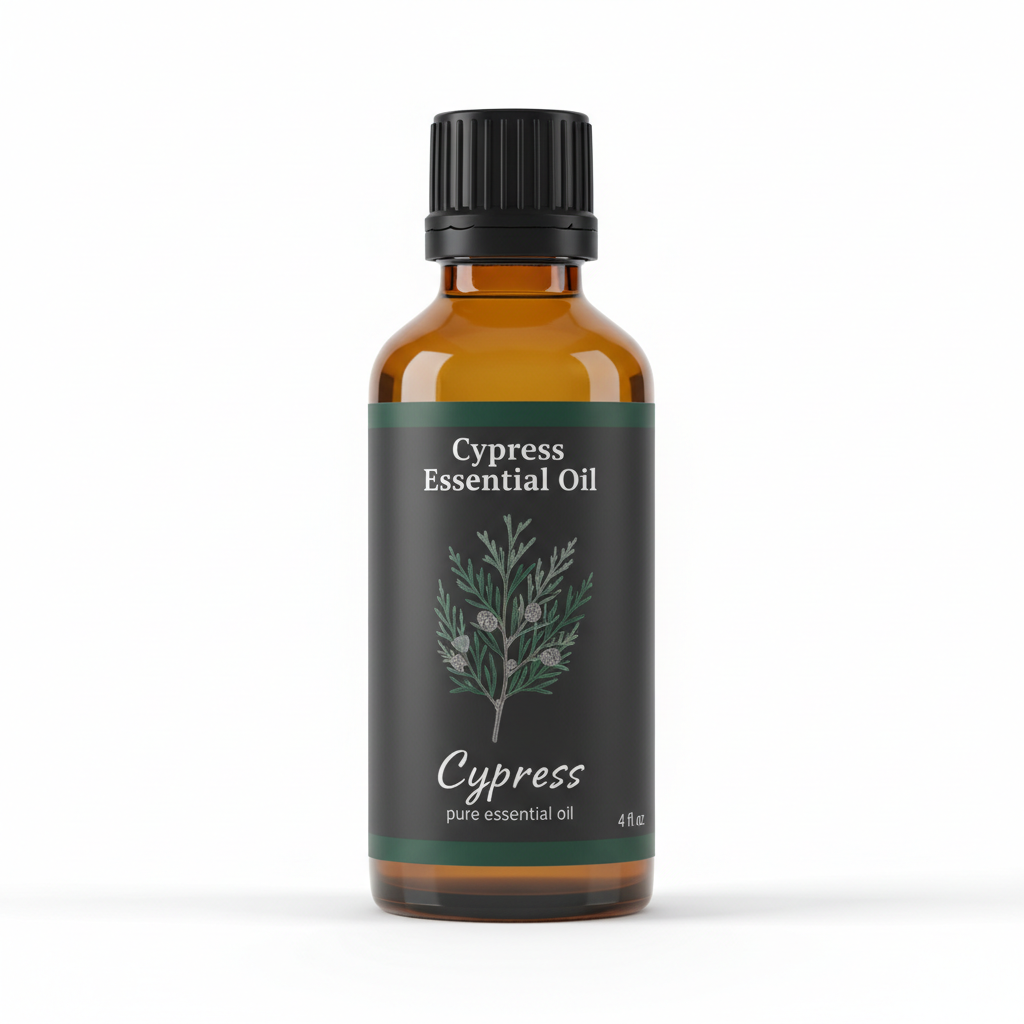
Cypress Essential Oil
Our own Cypress Essential Oil, in sizes from 0.5 oz to bulk.
From $10.99
Shop Now →A pairing without a starting ratio is trivia. Most blending charts list twenty partners and leave you to guess the proportions, which is how a bottle of cypress ends up either buried or shouting. Every pairing below carries a working ratio, written as drops of cypress : drops of partner, and a one-line reason. Treat them as starting points to adjust by nose, and read the complete cypress uses guide for the wider picture of how the oil fits into a home and skin-care routine.
Cypress in 60 Seconds
What does cypress smell like in a blend?
Dry, green and faintly resinous, with a smoky-woody edge rather than a sweet one. Cypress oil is typically rich in alpha-pinene, the same compound that gives pine its crisp snap, with a softer earthy undertone behind it. In a blend it reads as the cut stem and bark of the tree, not the cone.
Where does cypress sit in a blend, top or middle?
Both, which is why it is useful. It is volatile enough to lift off a diffuser or a scent strip early, yet it lingers long enough to bridge into the middle of a blend. That overlap lets it connect bright citrus above to resins and woods below.
Why do ratios matter more than the partner list?
Because the same two oils can make a clean, structured blend at 2:1 and a muddled one at 1:3. Cypress is dry, so it quietly subtracts sweetness from whatever it touches. The ratio decides whether it frames the blend or erases it.
The Cypress Blending Chart
This is the short version. The questions that follow explain each row.
| Family | Partner | Starting ratio (cypress : partner) | Why |
|---|---|---|---|
| Citrus | Sweet orange | 1:1 | Orange adds juice, cypress dries it out. |
| Citrus | Bergamot FCF | 2:1 | Cypress-forward keeps bergamot from going perfumey. |
| Woods | Cedarwood | 2:1 | Similar dryness, cedar adds depth underneath. |
| Woods | Sandalwood | 4:1 | Creamy and costly, so a little goes far. |
| Conifers | Fir, pine, juniper | 1:1 to 2:1 | Shared pinene gives a seamless forest line. |
| Resins | Frankincense | 2:1 | A kinship of dry austerity. |
| Herbs | Lavender | 1:1 | Soft floral herb against green bark. |
| Herbs | Clary sage | 3:1 | Potent and musky, so cypress leads. |
| Florals | Geranium, neroli | 1:3 | Cypress is the stem, the flower is the bloom. |
| Mint | Peppermint | 1 drop per 10 or more | One lifts, two take over. |
Citrus Partners
Does sweet orange work with cypress?
Yes, at 1:1. Sweet orange is rounded and juicy, and cypress supplies the dry green edge that stops it smelling like a candy aisle. Try 3 drops of each in a diffuser as a bright, clean daytime blend.
Why prefer bergamot FCF with cypress?
FCF means furanocoumarin-free, a bergamot with the light-reactive compounds removed. At 2:1 cypress-forward, it keeps the bergamot floral-bitter and elegant rather than loud. It is also the safer choice for anything that touches skin, which the care section below explains.
Can I use lemon or grapefruit instead?
For a diffuser, yes, at roughly the same 1:1 as orange. Lemon sharpens cypress toward a cleaning-cupboard scent, which suits some rooms and not others. Skip cold-pressed versions in anything you will wear on skin in daylight.
Woods and Conifers
How much cedarwood should go with cypress?
Use 2:1 cypress to cedarwood. The two share a dry, pencil-shaving quality, so the blend stays coherent while cedar adds a warmer, longer base. Reverse the ratio and the result turns flat and lumber-yard heavy.
Is sandalwood worth pairing with cypress?
Sparingly, at about 4:1. Sandalwood is creamy and soft, and its price makes generous ratios hard to justify anyway. One drop rounds the dry edge of three or four drops of cypress, and more than that mostly buys you a more expensive blend.
How do fir, pine and juniper pair with cypress?
Fir at 1:1 gives a soft evergreen, pine at 2:1 cypress keeps the blend from turning sharp, and juniper berry at 1:1 adds a peppery, gin-like lift. Because these oils share pinene, they overlap rather than contrast, so you are shading one forest note instead of building a new one. For the full theory of layering them, see our guide to green woodland accords.
Resins and Herbs
Why is frankincense the natural partner?
Both oils are dry and austere, with no sugar in them, so they sit together without friction. At 2:1 cypress to frankincense you get a quiet, cathedral-like atmosphere, with the resin adding a lemony-balsamic depth. This is the pairing to reach for when you want restraint.
What ratio works for lavender and cypress?
Start at 1:1. Lavender brings soft floral herb and cypress brings green bark, and neither dominates at equal weight. People often report this pairing as a tidy evening diffuser blend.
Can I blend clary sage with cypress?
Cautiously, at 3:1 with cypress in the lead. Clary sage is musky, herbal and strong, and a single extra drop can swallow a small blend. Add it last, one drop at a time, and smell between additions.
Florals and Mint
How do I pair cypress with geranium or neroli?
Think of cypress as the stem under the flower, and keep it to 1:3 or less. Geranium and neroli should lead with cypress as a green backbone. If the florals are not the star, the blend has no reason to exist.
How much peppermint is too much?
One drop lifts a blend of ten or more drops, and two drops take it over. Peppermint is so diffusive that it dominates a dry oil like cypress almost immediately. Keep it away from the faces of young children, and from pets in small closed spaces.
The Top 10 Pairings, Ranked
Which cypress pairings rank highest, and why?
The ranking weighs how well each partner balances cypress, how forgiving the ratio is, and how often it works across uses.
- Bergamot FCF (2:1). Bitter-floral brightness with a skin-friendlier profile than expressed citrus.
- Frankincense (2:1). The closest in character, so the hardest to get wrong.
- Sweet orange (1:1). A generous ratio and an easy, familiar warmth.
- Lavender (1:1). Forgiving at equal drops.
- Cedarwood (2:1). Adds a base without changing the dry theme.
- Geranium (1:3). Rewarding, but cypress must stay in the background.
- Fir (1:1). Softens cypress toward a Christmas-tree note.
- Juniper berry (1:1). Peppery, a little sharper, less forgiving.
- Clary sage (3:1). Strong character, narrow margin.
- Peppermint (1 drop). Effective, but easily overdone.
Pairings to Handle with Care
Is expressed citrus safe in topical cypress blends?
Not always. Cold-pressed (expressed) citrus oils such as bergamot, lemon and lime contain furanocoumarins, which can make skin more reactive to sunlight. Robert Tisserand and Rodney Young, in Essential Oil Safety (2nd edition), set a very low leave-on ceiling for expressed bergamot, so choose FCF bergamot for anything applied to skin, and always dilute and patch test first.
What is the peppermint rule again?
One drop is a lift, two drops are a takeover. Because the cooling note of peppermint carries so strongly, it can flatten the dry green character that makes cypress worth using. If a blend smells like toothpaste, remove the peppermint instead of adding more cypress.
Why does patchouli need a warning?
One drop of patchouli acts as a base note. Two drops make it a patchouli blend with cypress as a supporting voice. It is heavy, earthy and long-lasting, so add it by the drop to a 6 to 8 drop cypress blend.
Using the Chart
How many oils should one cypress blend contain?
Three is a workable ceiling: cypress plus two partners, such as cypress, bergamot FCF and frankincense. Each extra oil dilutes the structure that cypress provides. Seasonal ideas for rotating partners appear in our piece on cypress for the seasons.
What dilution should I use for skin blends?
A common cosmetic starting point is 1 percent, roughly 6 drops of total essential oil per 30 ml of carrier oil, and the ratios above apply within that total. Patch test on a small area first, and speak with a qualified physician or pharmacist before use if you take medication or have specific health concerns. This chart is for aromatic and cosmetic use only.
Does the age of my cypress bottle change the ratios?
It can. Alpha-pinene oxidizes readily on contact with air, so a half-empty, long-opened bottle may smell flatter and sharper than a fresh one, and you may need slightly more drops to get the same presence. Store it cool, dark and tightly capped, and browse fresh cypress in the shop if yours has turned.
Who is this chart not for?
It is not for anyone hoping for a single formula that works every time. Oils vary by harvest and distillation, and noses vary more. If a ratio smells wrong to you, trust your nose and adjust one drop at a time.