How to Store Cypress Essential Oil So It Doesn't Oxidize or Fade
Cypress oil does go bad, and it fades by reacting with oxygen, not by spoiling like food. Keep it in a full, tightly capped amber bottle somewhere cool and dark, and expect roughly two to three years of good aroma from a sealed bottle. Once opened, air is the clock that matters.
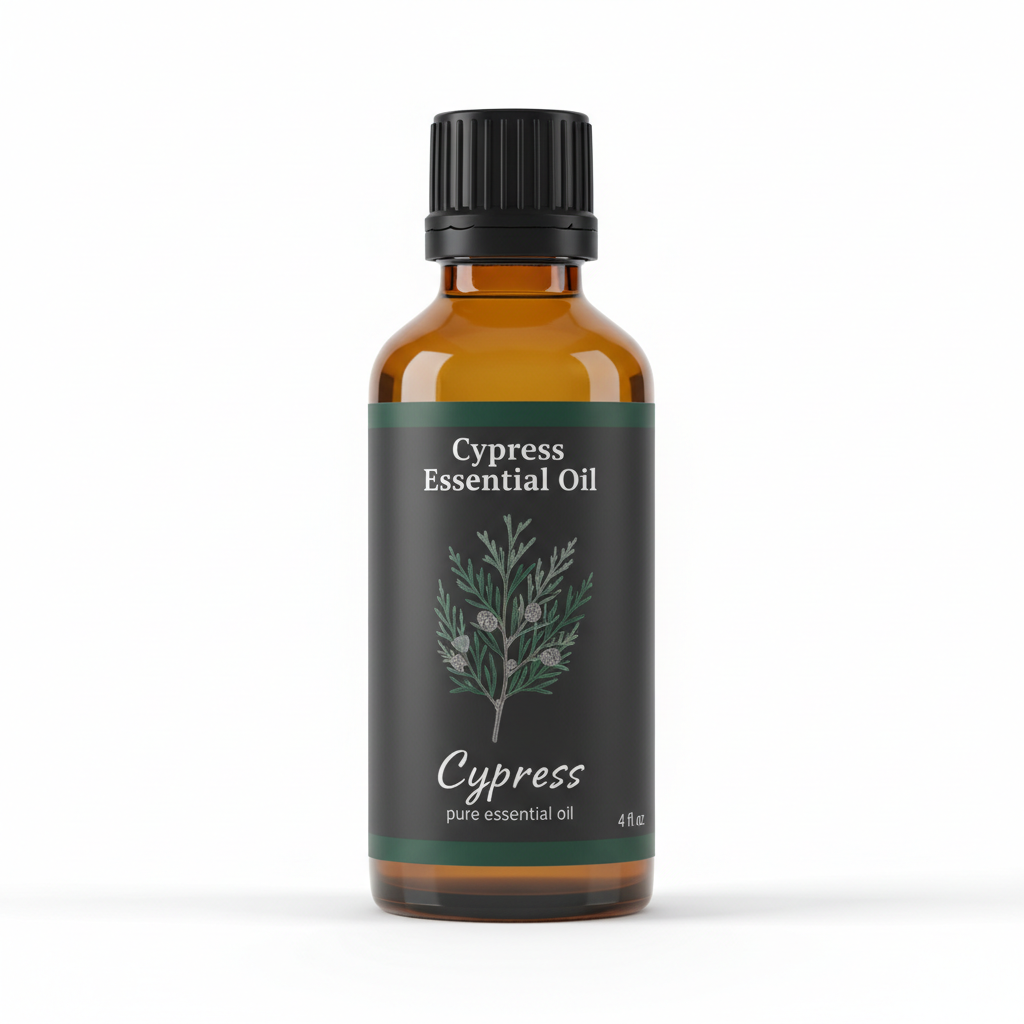
Cypress Essential Oil
Our own Cypress Essential Oil, in sizes from 0.5 oz to bulk.
From $10.99
Shop Now →Why cypress oil fades: the chemistry in one paragraph
Cypress oil (Cupressus sempervirens) is built mostly from monoterpenes. Alpha-pinene is usually the largest component, with delta-3-carene, limonene and terpinolene behind it. You can look up the structure of any of them on PubChem. What they share is a reactive carbon-carbon double bond, and that bond readily reacts with oxygen. Heat speeds the reaction. Light can start it.
The products of that reaction are not just a weaker version of the original. In Essential Oil Safety (2nd edition), Robert Tisserand and Rodney Young document that oxidation products of alpha-pinene are skin sensitizers, meaning compounds that can make skin more reactive with repeated contact. Delta-3-carene is another monoterpene with the same kind of double bond, so it is reasonable to apply the same caution to it.
That is the fact that reorganizes all the usual storage advice. An old, oxidized bottle is not only flat-smelling. It is more likely to irritate skin than the same oil was when you bought it. So the goal of storage is not to protect the scent. It is to keep the oil usable for the way you actually plan to use it.
Does cypress oil expire?
Functionally, yes. There is no printed date on the day it turns, and no law of nature that sets one, but the chemistry only runs in one direction. Oxidation products accumulate and never convert back.
As practical guidance rather than lab precision:
- Sealed, stored well: roughly two to three years of good cypress oil shelf life.
- Opened and used regularly: noticeably less, because every opening brings in fresh oxygen and the headspace above the oil keeps growing as you pour.
- Opened, half-empty, stored carelessly: it may be past its best within months.
Treat those numbers as a planning range. A bottle's starting quality, the oxygen already dissolved in it at bottling and your home's temperature all move them. Tisserand and Young group pinene-rich oils among the shorter-lived ones, which is why the fresh-bottle advice here is more cautious than what you may hear for slow-aging oils such as patchouli or sandalwood.
A common misconception is that essential oils are "too concentrated to go off." Concentration is exactly what makes them react: there is a lot of reactive material in a small volume, with nothing in the bottle to slow it down.
What you need
- Your cypress oil in its original amber glass bottle
- One or two smaller amber glass bottles (5 mL and 10 mL cover most cases), with caps that fit tightly
- Orifice reducer caps, the kind with a small built-in drip hole, rather than rubber bulb droppers
- A small glass funnel or a clean glass pipette
- Paper labels and a pen
- A cool, dark spot: an interior cupboard, a lidded box, or a refrigerator shelf (more on that below)
- Unscented paper blotter strips for smelling the oil
The steps, ranked by what actually matters
Most storage articles hand you a flat list: keep it dark, keep it cool, keep it capped. They are all true, but they are not equally important. The order below follows the chemistry. Oxygen is a reactant, so it comes first. Heat and light are accelerators, so they come after.
Step 1: Close the air gap (this beats everything else)
Oxidation needs oxygen. A full bottle has very little of it. A 15 mL bottle with 7 mL left has nearly half its volume filled with air, and every opening swaps that air for a fresh batch. Reasoning from the chemistry, a half-empty bottle ages faster than a full one even if both sit side by side in the same drawer.
So when a bottle drops to about half, decant it:
- Wash and fully dry a smaller amber bottle. Any water left inside will cloud the oil.
- Using the funnel or pipette, move the oil across in one go.
- Fill to the shoulder of the new bottle so the air gap is a few millimeters, not a few milliliters.
- Cap it firmly and label it with the oil name and the date you decanted.
If you use cypress oil slowly, buy 5 mL or 10 mL bottles to begin with. A 30 mL bottle that you empty over three years spends most of its life mostly air.
Step 2: Keep it cool, and use the fridge if you are a slow user
Heat speeds almost every chemical reaction, and oxidation is no exception. The places that quietly cook a bottle are the windowsill, the shelf above a radiator, the kitchen counter beside the stove, a parked car and the bathroom (heat and steam together).
A cool interior cupboard is a good default. For anyone who opens the bottle once or twice a month, a refrigerator is a legitimate choice, not an overcautious one. Keep these points in mind:
- Store it on an interior shelf rather than the door, which swings in temperature every time someone grabs the milk.
- Put the bottle in a small lidded jar so food odors stay out and any leak stays in.
- Let the bottle come to room temperature, about 20 to 30 minutes, before you open it. A cold bottle opened in a warm room pulls in condensation, and water in the oil is a different problem you do not want.
Step 3: Keep it out of light
Amber glass exists for a reason: it filters out much of the ultraviolet and blue light that can kick-start oxidation. Clear and pale-green bottles filter far less, so if your cypress oil arrived in one, move it into amber glass.
Amber glass is not a force field, though. A bottle on a sunny shelf still warms up, and that works against Step 2. Put the bottle in a drawer, a cupboard or a small opaque box, and think of the amber glass as a second layer of protection rather than the first.
Step 4: Practice cap discipline
The oil should be open for minutes, not hours. Have your blotter, your carrier oil and your measuring tools ready before you unscrew the cap. Then open, pour or drip, and close right away.
- Fit an orifice reducer cap so you can dispense without removing the whole cap.
- Wipe the neck and threads with a clean paper towel. Dried oil residue on the threads stops the cap from sealing fully.
- Never pour used oil back into the bottle. Whatever touched it has been exposed to air and possibly to moisture.
- Tighten until firm, not until the cap strains.
Rubber bulb droppers deserve a mention. The bulb holds air, and oil vapor can slowly degrade rubber. Use them only for the minutes you are actually measuring, and never as a long-term closure.
Step 5: Label with dates and rotate
Write the date you opened the bottle, and the date you decanted it if you did. Memory is a poor tool here. At the one-year mark on an opened bottle, move it to the front of the line and smell it before your next use. At two years, plan on assessing it carefully.
Step 6: Check by nose, not only by date
The date is a guide and your nose is the test. The next section explains what to look for.
How to recognize oxidized cypress oil by nose
Fresh cypress oil smells green, dry, resinous and woody, with a clean evergreen top note that settles into a soft, balsamic base. Oxidized oil moves away from that in a few recognizable ways:
- A sharp, turpentine edge. Alpha-pinene is the main component of turpentine, so as the balanced aroma breaks down, that solvent-like pine note can dominate.
- A thin, flat character. The round woody middle and the dry-down fade, leaving something that smells like cypress in outline only.
- A sour or stale note that was not there when you opened the bottle.
- Residue or stickiness around the cap or on the bottle neck, and sometimes a slightly thicker pour.
The blotter method gives you the clearest read. Put a single drop on an unscented paper strip. Smell it right away, again after five minutes and again after thirty. A healthy oil develops through those stages. A tired one smells sharp at the start and then nearly disappears.
Be honest about the limits of this test. Your nose is not a lab instrument. Oxidation can be well underway before the smell shifts enough to notice, and your nose adapts to a bottle you smell every week. If you have a fresh bottle to compare against, smell the two side by side. If a bottle is past the two- to three-year mark, assume some oxidation has occurred even if it smells acceptable.
What to do with oil that has oxidized
Here is the plain position: oxidized cypress oil does not belong on skin. That includes diluted blends, massage oils, lotions, bath products and anything leave-on. Dilution lowers the dose of every compound in the bottle, including the oxidation products, but it does not make an oxidized oil equal to a fresh one. Fresh oil is what the standard dilution guidance assumes.
It still has uses where skin contact is not the point:
- Household cleaning sprays: a few drops in a spray bottle of water and a little vinegar for a fresh, resinous smell on counters and sinks. Label it as a cleaning spray and keep it away from skin and from food-preparation surfaces you have not rinsed.
- Room scenting: a few drops on a cotton ball tucked in a closet, a shoe cabinet or a gym bag, in a space with decent airflow.
- Wood and craft scenting: a drop or two on unfinished wooden hangers or cedar blocks, where the aroma, not the skin, is the goal.
If you are scenting a room that animals share, check with the ASPCA Animal Poison Control Center before you start, since household animals can respond differently to essential oils than people do. If a large amount of oil needs to go, take it to your local household hazardous waste collection rather than pouring it down the drain.
Common mistakes
- Keeping a half-empty bottle "just in case." It is the single most common way a good bottle ages early. Decant it or use it up.
- Trusting amber glass to do everything. It handles light. It does nothing about heat or the air inside the bottle.
- Storing it in the bathroom. Warmth and steam are both working against you.
- Leaving the cap loose after dispensing. A cap that is a quarter-turn short of sealed lets in air all day.
- Opening a cold bottle straight from the fridge. Wait for it to warm up first.
- Putting the dropper back on the skin, then in the bottle. You introduce moisture and impurities. Pour into a clean dish instead.
- Judging a bottle only by its date. A hot-car summer can age a bottle faster than the calendar suggests.
- Using old oil in a skin blend because "it still smells fine." Smell is a late signal. When in doubt, move it to the cleaning shelf.
Who this advice is not for
If you reach for cypress oil a few times a month and you own a 30 mL bottle, perfect storage will not rescue you. The better fix is a smaller bottle, bought more often. Decanting helps, but it cannot make a three-year supply out of a bottle you use at a one-year pace.
It is also not for anyone hoping to salvage a bottle that has clearly gone sharp and thin by blending it into a skin product. The cleaning-spray route is the honest one.
A word on buying, since storage starts at purchase: a bottle that has sat on a warm shelf for a year before it reaches you has already used up part of its life. Look for a recent bottling or harvest date where one is given, amber glass and a bottle filled close to the neck. A supplier that is open about the botanical name and origin, and willing to share a batch-specific analysis, is also more likely to be careful with how its stock is stored. If you are ready to restock, you can browse the full range in the cypress oil shop.
What you can reasonably expect
With a full bottle, a cool dark spot and quick, clean opening habits, you may find that your cypress oil keeps its green, woody character through the two-to-three-year range, instead of turning sharp within a year. People who decant half-used bottles often report that the aroma holds its shape noticeably longer, which fits what the chemistry would predict.
Good storage may also help keep your oil closer to the composition you bought, which matters most for anything that touches skin. It will not stop aging altogether. It slows it.
Safety notes
- Essential oils are highly concentrated. For any skin use, dilute fresh oil in a carrier oil at a conservative ratio and patch test a small area first.
- Keep bottles out of reach of children and animals.
- Never take essential oils internally unless a qualified professional has advised it.
- Essential oils are not a substitute for professional advice. If you are under a healthcare provider's care or taking any medication, ask them before adding essential oils to your routine.
Date the bottle, fill the shoulder, keep it cool and dark, and close the cap on time. Those four habits cover most of what goes wrong.