
How to Buy Cypress Essential Oil: The Complete Buyer's Guide
To buy cypress essential oil well, verify eight things before you pay: the Latin name Cupressus sempervirens, the plant part and distillation method, a stated origin, batch documentation, a dark glass bottle with an orifice reducer, a size you will finish, a believable price, and no reliance on self-awarded grade labels. Documents beat adjectives every time.
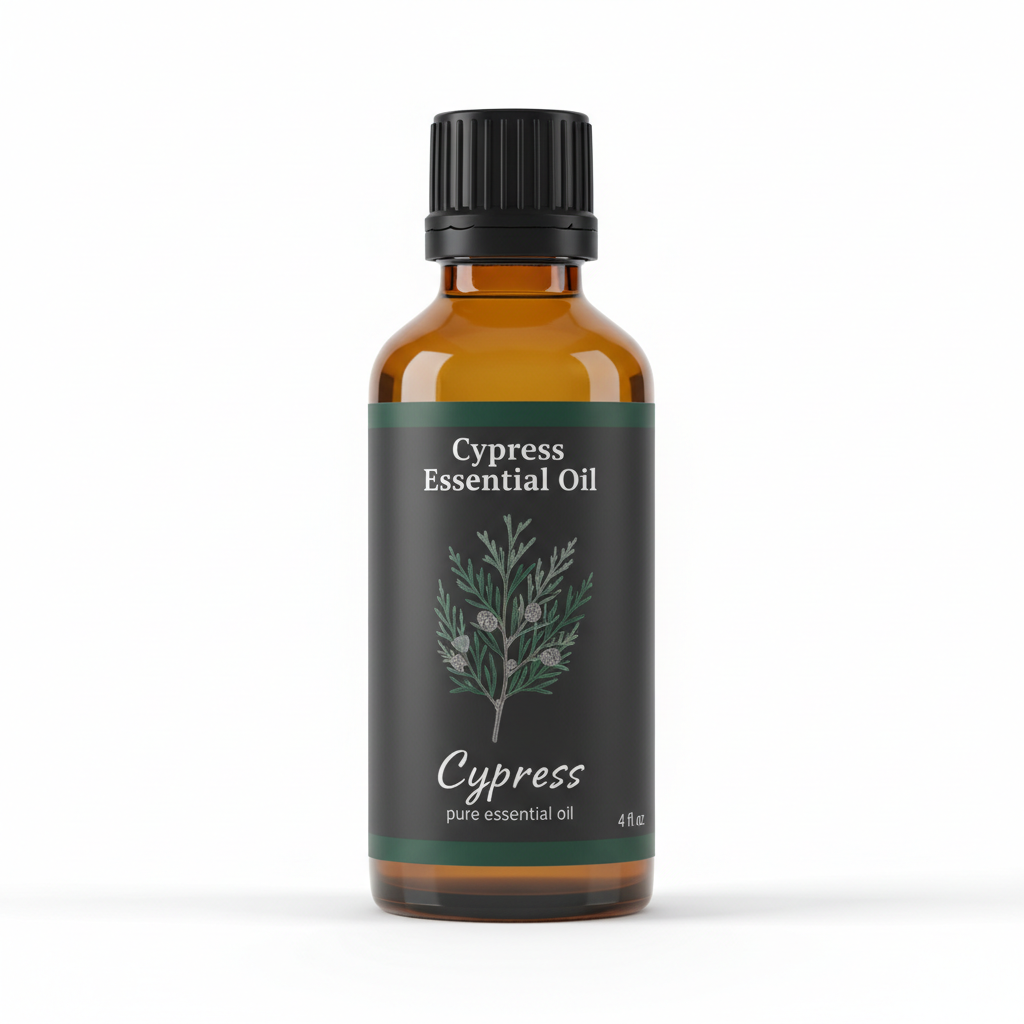
Cypress Essential Oil
Our own Cypress Essential Oil, in sizes from 0.5 oz to bulk.
From $10.99
Shop Now →Cypress is an easy oil to buy badly. It is a steam-distilled conifer oil with a dry, woody, slightly resinous scent, and that profile is cheap to imitate with other conifer oils, aroma chemicals, or old stock that has quietly oxidized on a warehouse shelf. The bottle in your hand will not tell you which of those you have. The paperwork and the label will, if you know what to read.
This guide walks through the question the way a good shopkeeper would: what you are actually buying, what to check on the label, what proof to ask for, what the bottle and the size do to the oil over time, and which marketing phrases to ignore. It ends with a 60-second routine you can run on any seller, including this one.
" +"Key Takeaways
- No Latin name, no purchase. “Cypress” alone can mean several different plants and several different oils.
- Documents outrank adjectives. A batch-matched COA, and ideally a GC/MS report, tells you more than any label phrase.
- Origin is information, not a guarantee. It says where, not how well, how recently, or whether anything was added.
- Dark glass plus an orifice reducer is the baseline for neat oil. Plastic is not.
- Buy the size you will finish. Cypress is rich in compounds that oxidize on air contact, and a half-empty bottle ages faster than a full one.
- Grade phrases have no regulated definition. A seller who leans on them instead of documents has made your decision easy.
The Short Answer, and Who This Guide Is Not For
The position of this guide is simple: you cannot taste quality through a screen, so stop trying to judge it by adjectives. “Pure,” “premium,” “therapeutic grade,” and “certified” are words a seller writes. A Latin binomial, a batch number, and a chromatogram are things a seller has to produce. Buy from whoever produces the second kind of evidence.
That position has a cost. It means a handsome bottle with a gorgeous story and no documents loses to a plain bottle with a lot number and a lab report. It also means some sellers you may like will fail the checklist. That is the checklist working.
Who this guide is not for
- Anyone shopping for a product to replace advice from a qualified healthcare provider. Cypress oil is an aromatic and cosmetic ingredient. Nothing here suggests otherwise, and nothing here should change a routine a provider has recommended.
- Buyers who want the cheapest bottle. The checklist screens for risk, not for price. If the lowest number on the page is your only filter, you will probably end up with something that the checklist would have flagged.
- Buyers looking for a single “best” brand name. There is no universal winner. The best cypress essential oil for you is the one that passes all eight points, in a size you will use, from a seller you can question. For use-case comparisons, see our breakdown of cypress oils by use, from diffusing to grooming.
What commonly goes wrong
Three failures account for most disappointing purchases. First, the oil is not Cupressus sempervirens at all, or is a blend labeled by its most marketable ingredient. Second, the oil started fine but was stored or bottled badly, so it arrives flat or sharp. Third, the buyer purchased a large bottle for a small habit and watched it change over the following months. Every point in the checklist below targets one of those three.
" +"What You Are Actually Buying
Before the checklist makes sense, it helps to know what a genuine bottle of pure cypress oil is supposed to be.
The plant and the oil
Mediterranean cypress, Cupressus sempervirens, is the tall, narrow evergreen you picture lining Tuscan driveways. The oil is distilled with steam from its needles and twigs (the fine scale-like foliage and the small branch tips). The resulting liquid is pale to colorless or very light yellow, thin in body, and smells of dry evergreen, a little smoky-resinous, with a faintly sweet, balsamic edge.
Chemically, it is a monoterpene-led oil. For Cupressus sempervirens, alpha-pinene and delta-3-carene are typically the largest named components, with smaller contributors such as limonene, cedrol, and terpinyl acetate often appearing further down the report. You can look up any compound name on a seller's report in PubChem, the US National Library of Medicine's chemical database, to confirm it is a real compound and see its structure. That one habit catches a surprising amount of nonsense.
The look-alikes that cause confusion
The word “cypress” is used loosely in commerce, and that loose use is where most mislabeling lives.
- Blue cypress is Callitris intratropica, an Australian tree. Its oil has a deeper color and a different aroma profile. It is a legitimate product, but it is not the oil this guide is about.
- Cypress “cone” or “wood” oils come from other plant parts. Plant part changes the chemistry, so they may smell and read differently from needle-and-twig oil.
- Common names borrowed from other trees such as bald cypress (Taxodium) or Leyland cypress (a hybrid genus) belong to different botanical groups. A label that says only “cypress” leaves room for any of them.
- Cedarwood and juniper oils share the woody conifer register and are sometimes used to stretch or imitate cypress. A pleasant evergreen smell does not prove the species.
What cypress oil is traditionally used for
In aromatic practice, cypress oil is traditionally used in diffuser blends and in diluted cosmetic preparations for its crisp, forest-floor scent. Some people report that its woody freshness suits a grounding evening ritual, and the oil may help promote a sense of calm in a well-ventilated room when diffused briefly. These are traditional and anecdotal uses, not promises. If you have questions about how a fragrance ingredient fits your own situation, ask a qualified healthcare provider.
" +"The Label Checks: Points 1 to 3
The first three checks cost nothing. You can run them from a product page or a shelf label in under half a minute, and they eliminate a large share of poor purchases before you spend anything.
Point 1: The Latin name on the label (Cupressus sempervirens)
The rule is blunt: no Latin name, no purchase.
The botanical name is the only identifier that does not change between languages, brands, or marketing seasons. A seller who knows exactly which plant is in the bottle has no reason to leave the name off. A seller who leaves it off is either careless or keeping the option open to swap species when supply shifts.
Look for the full binomial, Cupressus sempervirens, on the bottle itself and not only on the website. The two sometimes diverge. Be equally wary of a Latin name followed by “type,” “style,” or “inspired,” and of a name that is correct but attached to a product called a “fragrance blend” or “aroma oil.” Those are different categories from an essential oil.
Point 2: Plant part and method (needles and twigs, steam distilled)
The second line of a good label or product page states what was distilled and how. For this oil, the expected answer is needles and twigs, steam distilled.
Why both pieces matter:
- Plant part shapes the chemistry. Foliage, cones, and wood do not yield identical oils, so the part tells you which profile to expect.
- Method separates essential oil from other products sharing the same shelf. Steam distillation is the standard for conifer foliage. A “CO2 extract” is a different material with a different profile. An “absolute” is solvent-derived and not how cypress is normally sold. A “fragrance oil” is a manufactured scent, sometimes with no plant material at all.
Also check what else is in the bottle. A product labeled simply “cypress” and priced low may be a few percent of cypress oil in a carrier such as jojoba. That can be a perfectly honest pre-diluted product, but it is not the neat oil you meant to buy, and it should say so plainly on the front.
Point 3: Origin stated, and what origin does and does not guarantee
Cypress oil is commonly sourced from Mediterranean-climate regions, and sellers often name countries such as France, Spain, or Morocco. A stated origin is a good sign because it means the seller has traced the material at least as far as a country. A vague “Mediterranean” or no origin at all is a weaker one.
Here is the honest part. Origin tells you where the trees grew or where the oil was distilled (those are not always the same place, and labels do not always say which). It does not guarantee any of the following:
- that the species is correct,
- that the batch was distilled carefully, since temperature and run time shape the final scent,
- that the oil is recent, since a bottle can sit in a warehouse for a long time,
- that nothing was added after distillation.
Think of origin as a clue, not a verdict. A French label on an unlabeled, undocumented bottle is worth less than an unfussy origin line on an oil with a matching lab report. If a seller markets origin as the main proof of quality, the next point is where you test that claim.
" +"The Proof Check: Point 4
Point 4: Batch documentation, a COA at minimum and GC/MS access ideally
This is the point that separates sellers who can show their work from sellers who ask you to trust them. Every other check on this list is a courtesy by comparison.
COA: the minimum
A Certificate of Analysis is a document tied to a specific batch of oil. At a minimum, a useful one shows a lot or batch number, the botanical name, the date, and the name of whoever did the testing. The single most important detail is the batch number, because it has to match the number on the bottle you receive. A generic PDF that applies to “our cypress oil” in general proves nothing about the bottle on your counter. For a plain-language walkthrough of what to look for and what to be skeptical of, read how to spot pure cypress essential oil before you pay.
GC/MS: the ideal
Gas chromatography with mass spectrometry separates an oil into its individual compounds and reports each one with an approximate percentage. For cypress, a reader can see whether the expected leaders (alpha-pinene and delta-3-carene) are present and in a plausible balance, and whether odd compounds show up that a plant would not normally make in that amount. It is the closest thing a buyer has to an ingredient list for a natural oil. Our buyer's checklist for reading a cypress oil GC/MS report walks through it line by line.
Two cautions. A GC/MS report does not rank an oil on a quality scale, and natural variation between harvests is normal, so a figure that is slightly different from another batch is not automatically a flaw. And a report can be pasted from another product, so the lot number match remains the gatekeeper.
The baseline this site sets
This site publishes its COA. Treat that as the baseline to demand everywhere, not as a perk. When you ask any other seller for the same thing, the response is informative in itself: a prompt, specific answer with a matching batch number is a good sign, and a reply about “proprietary testing” or “our internal standards” is a sign that you should keep shopping. A seller who has a report and will not show it, or who shows one only after you spend, has told you what you need to know.
" +"The Bottle and the Money: Points 5 to 7
Once an oil passes the label and the paperwork, the remaining questions are about what happens between the distillery and your shelf, and what you are being asked to pay for it.
Point 5: The bottle (amber or cobalt glass, orifice reducer, never plastic for neat oil)
A cypress essential oil bottle has three jobs: block light, limit air, and release the oil slowly.
- Amber or cobalt glass filters much of the ultraviolet and blue light that speeds the degradation of terpene-rich oils. Clear glass on a sunny shelf is a bad sign. Green glass is better than clear but offers less protection than amber.
- An orifice reducer (the small plastic insert in the neck that makes the oil leave drop by drop) limits spills and limits how much air gets into the bottle. If you must unscrew a cap and pour, or if the oil arrives in a loose-fitting container, that is a weak design for a volatile product.
- Never plastic for neat oil. Concentrated terpenes can soften, cloud, or be absorbed by many plastics, which both damages the container and may alter the contents. Plastic can be fine for a heavily diluted finished product, but the neat oil belongs in glass.
A caution on droppers: a rubber-bulb dropper is convenient, but rubber is also vulnerable to concentrated terpenes and can degrade over time. A dropper that is stored in the bottle can leave the oil sitting against that rubber. An orifice reducer with a tight cap avoids the problem.
Point 6: Size economics (small bottles turn over before they oxidize)
Larger bottles feel like the smart purchase because the price per milliliter drops. That arithmetic is real. The part many buyers miss is that the oil's quality has a clock on it too.
The compounds that dominate cypress, alpha-pinene and delta-3-carene among them, are monoterpenes, and monoterpenes oxidize readily on contact with air. Robert Tisserand and Rodney Young discuss oxidation of monoterpene-rich oils in Essential Oil Safety (2nd edition), including its relevance to skin sensitivity, which is one reason older, heavily oxidized oil is a poor candidate for skin-contact products. Because each time you open a bottle some air replaces the oil you used, a half-empty bottle holds more air relative to oil than a full one. That is reasoning from the chemistry, not an observation from a specific test, but the direction is not in doubt: slow use plus large headspace is the fastest way to age an oil.
A concrete example. Assume a rough figure of 20 drops per milliliter (drop size varies with the oil and the reducer). A 5 mL bottle holds around 100 drops. If you diffuse with 4 drops, three times a week, that is 12 drops weekly, or roughly eight weeks of supply. A 15 mL bottle holds around 300 drops, so the same habit stretches it to roughly six months, with the headspace growing every time you open it. Whether the larger size is a bargain depends on whether you would finish it before the oil changes.
My rule of thumb, which is a judgment and not a regulation: choose the smallest size that covers a few months of your actual use. If you are blending in batches, making products for others, or sharing across a household, a larger size can make sense, and our guide to cypress essential oil sizes and which bottle to order goes through the options. If you are buying for a business, the economics shift again, and this guide to wholesale cypress oil and bulk sizes covers what changes.
Point 7: Price sanity
A price is a piece of evidence. Steam distillation of conifer foliage takes real plant material, real time, and real fuel, and the result is usually priced in the same neighborhood as other distilled conifer oils. Cypress is not an exotic rarity like some resins or flowers, so it is not expected to be extremely expensive. It is also not a commodity solvent, so it should not be extremely cheap.
Here is a practical test. Compare the seller's cypress price per milliliter with the same seller's other conifer oils, such as juniper or fir. If cypress is the cheapest oil on the shelf by a wide margin and no explanation is offered, ask why. A conifer oil priced like bulk fragrance is telling you something: that it may be diluted, blended, synthetic, old, or sold at a loss to get you into the shop. Sellers do occasionally run honest sales, but a permanent, unexplained discount is not a sale.
The opposite error also exists. A high price is not evidence of quality. Fancy packaging, a luxury name, and a dramatic origin story can add cost without adding anything to the oil. The price should match the documents, not replace them. For the factors that move the cost of a bottle up and down, read our cypress essential oil price guide.
" +"The Marketing-Term Decoder: Point 8
Point 8: Treat claims as claims, not credentials
This is the center of the guide. In the essential oil market, a set of phrases appears on labels and websites as though it were a certification. It is not.
There is no regulated definition, anywhere, for the grade-style wording that pairs the word “grade” with a medical-sounding adjective. No government agency awards it, no independent standard body defines it, and no inspector checks it. The same is true of “certified pure,” “100% pure,” “medical grade,” “clinical grade,” “Grade A,” and “food grade” when used as a vague quality mark. These are brands grading their own homework. The grade is real only in the sense that the seller wrote it.
| Phrase on the label | What it actually tells you | What to ask for instead |
|---|---|---|
| “Pure” or “100% pure” | Nothing standardized. It can describe an oil that is unadulterated, or one that is simply undiluted by carrier oil. | A batch-matched GC/MS report |
| Grade phrases with a medical adjective | A brand's own marketing category. No outside body defines or audits it. | A COA with a batch number and lab name |
| “Certified pure” | Ask who certified it. If the certifier is the seller or an affiliate, it is self-grading. | The named third-party lab and the report |
| “Medical grade” or “clinical grade” | Borrowed authority. Essential oils are not sorted into medical grades. | Documents, not vocabulary |
| “Premium,” “luxury,” “artisan” | Style words. They describe the brand, not the bottle's contents. | Origin, plant part, method, lot |
| “Natural” | Applies to many things, including some that began as plants and were then altered. | Latin name plus a GC/MS report |
The point is not that every seller using these words is dishonest. Many honest sellers use them out of habit, because a market full of competitors uses them. The point is that the words carry no information you can verify. A seller who also supplies a Latin name, a plant part, an origin, and a batch-matched report is giving you things you can check. A seller who leans on the phrases in place of those things has made your decision easy.
One more warning about authority language. In the United States, the regulator that oversees cosmetic labeling does not grade essential oils, and no agency maintains a ranking that a brand can join. If a label implies an official tier, treat the implication as the marketing it is.
" +"Safe Handling and Common Mistakes
Buying well is half of the work. The other half is storing and using the oil sensibly once it arrives. This section is short because the principles are few, but they matter.
Handling the bottle after it arrives
- Store it cool, dark, and upright with the cap tight. A cupboard works better than a sunny windowsill or a bathroom shelf that swings between hot and humid.
- Write the date you opened it on the label or the box. It makes the “is this still good?” question answerable.
- Smell it when it arrives and again after a few months. A shift toward a sharp, harsh, or sour note is a reason to stop using it on skin.
- Keep it out of reach of children and pets.
Dilution and skin
Neat essential oil is concentrated. For anything that touches skin, dilute it in a carrier oil to a modest strength, and do a small patch test on a patch of inner forearm before wider use. Tisserand and Young's Essential Oil Safety is the standard reference for dilution and sensitization considerations, and it is a good book to own if you plan to use oils regularly. Do not apply neat oil near eyes or mucous membranes, and do not ingest it.
Diffusing, households, and pets
Ventilate the room, run the diffuser for short sessions, and take breaks. Households with cats, dogs, birds, or other animals should check first with a veterinarian. The ASPCA Animal Poison Control Center is a reasonable place to consult if an animal has been exposed to an oil and you are unsure what to do. If someone swallows an oil, contact US Poison Control (1-800-222-1222) right away.
Who should ask first
If you are pregnant or nursing, are using the oil around infants or young children, or are under a qualified healthcare provider's care, ask that provider before introducing a new aromatic product. Do not stop or change anything a provider has recommended on the strength of an essential oil.
The mistakes that come up most often
- Judging by smell alone. A nose can detect a sharp or flat oil, but a skilled blend can smell right and still contain something unexpected. Smell is a supporting check, not a replacement for a report.
- Trusting the product page and ignoring the bottle. Photos and copy can describe one thing while the container says another. Check what is printed on the bottle that ships.
- Buying big on a discount. The saving evaporates if the last third of the bottle is something you would no longer use on skin.
- Storing it by the stove or on a sunny sill. Heat and light accelerate the same oxidation you bought a dark bottle to avoid.
- Using the same bottle for every purpose. A bottle opened constantly for blending ages faster than one opened occasionally for a diffuser. If you do both, a second small bottle can be sensible.
The 60-Second Pre-Purchase Routine
Put the checklist to work. Keep these eight questions open in a note on your phone and run them in order on any seller. Most sellers will fail somewhere in the first thirty seconds, which is the point.
- Latin name (about 5 seconds). Is Cupressus sempervirens printed on the bottle or the product page? If not, stop here.
- Plant part and method (5 seconds). Does it say needles and twigs, steam distilled? Is it sold as an essential oil rather than a fragrance or a pre-diluted blend?
- Origin (5 seconds). Is a country named? Remember it is a clue, not a guarantee.
- Batch documentation (15 seconds). Is there a COA with a lot number that matches the bottle? Is there a GC/MS report you can open? Or will the seller send one before you buy?
- Bottle (5 seconds). Amber or cobalt glass? Orifice reducer? No plastic for neat oil?
- Size (10 seconds). Can you finish it in a few months? If not, choose the smaller one.
- Price (10 seconds). Divide by milliliters. Compare to the seller's other conifer oils. Does the price match the documents?
- Marketing terms (5 seconds). Is the seller leaning on grade phrases in place of documents? If so, you have your answer.
If the oil clears all eight, you have done more due diligence than most buyers of essential oils ever do. If you want to browse a seller that publishes its COA and states the basics up front, you can see the range in our cypress oil shop, and then apply the same eight questions to us as you would to anyone else.
Keep the checklist even after the purchase. Reuse it when you reorder, when a seller changes its packaging, and when a new batch arrives. A good oil from a good seller should hold up to the same questions every time.