
Cypress Essential Oil Price Guide: What Drives the Cost per Ounce
Cypress essential oil price is set mostly by plant mass, labor and distillation scale, then adjusted by origin, certification and bottle size. A fair price reflects all of that. A price far below the going range for a single-species conifer oil usually means something in that chain was skipped or substituted.
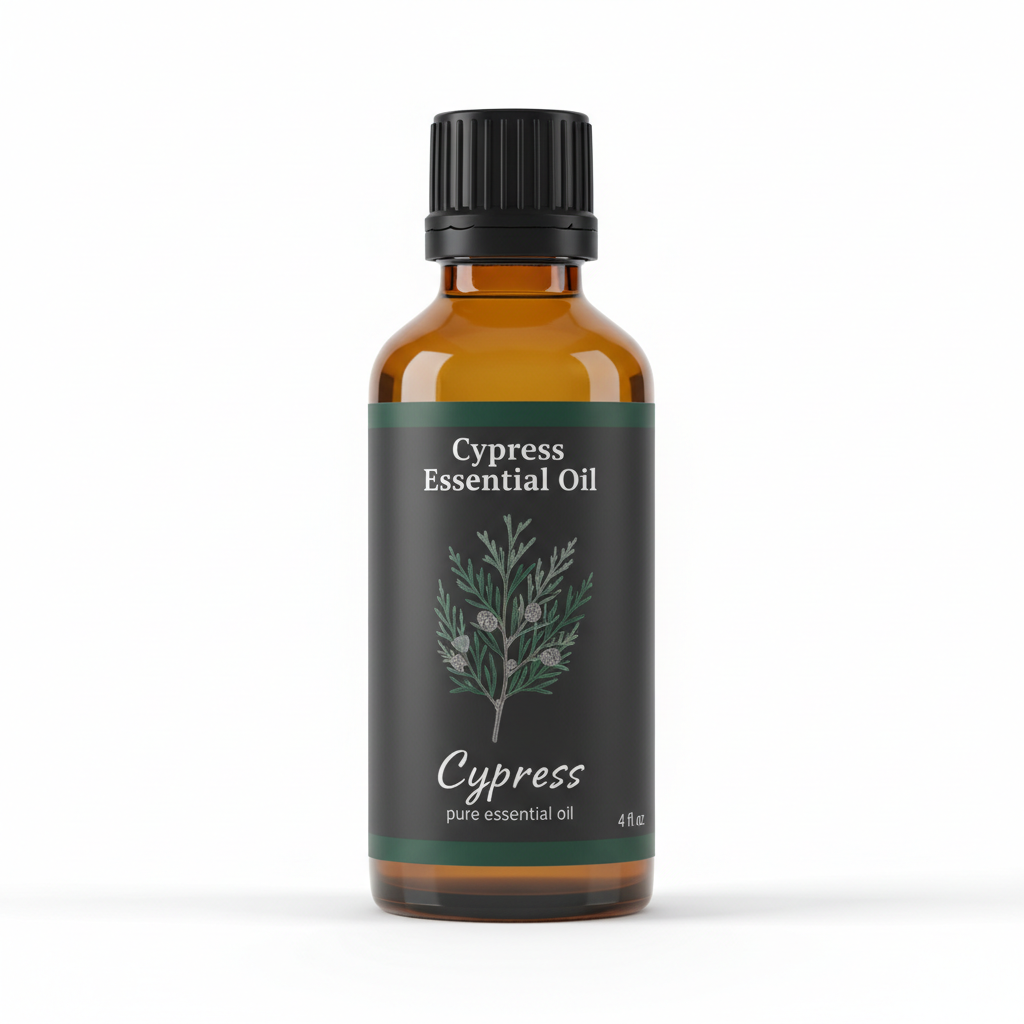
Cypress Essential Oil
Our own Cypress Essential Oil, in sizes from 0.5 oz to bulk.
From $10.99
Shop Now →Start with the biomass
Cypress oil comes from steam distillation of needles, small twigs and sometimes cones. The oil lives in tiny glands in that foliage, and it makes up a very small fraction of the plant's weight. Picture a still loaded to the brim with branches, running for hours, and a collecting vessel that ends up with a thin film of oil floating on a large volume of water.
That proportion is the first fact of cypress oil cost. Every bottle on a shelf represents a mass of foliage many times heavier than the liquid inside it. Cut, bundle, haul, load and distill that foliage, then dispose of the spent material, and the work scales with the biomass, not with the bottle. When you wonder why cypress oil prices vary from one seller to the next, begin here: two sellers can use the same species and still differ widely in how much plant they spent per milliliter.
Yield also moves with the material itself. Fresh versus partly dried foliage, the proportion of woody twig to needle, the season of cutting and the length of the distillation run all change how much oil a given load gives up. Fast, short distillations can leave heavier compounds behind. Slower runs recover more of them, at the cost of fuel and still time. Neither choice is wrong, but each one has a price.
Harvest labor and seasonality
Cypress trees are tall, dense and often grown as windbreaks or ornamental rows, so foliage is cut with pruning tools, gathered by hand and carried to the still. Mechanical harvesting exists for some crops, though it suits some stands and terrain better than others. Wherever people do the cutting, wages are a direct line item in the oil.
Seasonality adds a second pressure. Distilleries tend to run when foliage is available and when weather allows cutting and drying. A poor season, a pruning cycle that shifts, or a buyer competing for the same material can tighten supply and raise the price of the next batch. Essential oils are agricultural products. Their cost is not fixed the way a manufactured item's cost is, and a seller who quotes the same price every year across a bad harvest is either absorbing the difference or sourcing from somewhere that does not feel it.
Distillation scale: small runs versus industrial ones
Large industrial stills process enormous loads and spread fuel, labor and equipment costs across a lot of oil. Small artisanal stills process modest loads, often from a single property or small group of growers, and carry nearly the same fixed effort per batch. Per milliliter, the small run costs more. That is arithmetic, not marketing.
Does the difference show up in the bottle? Often, a little. Small batches can be cut closer to ideal timing and distilled more gently, and some buyers describe the resulting scent as cleaner and more layered, with a resinous, woody top note that does not flatten out. Treat that as a subtle difference, not a dramatic one. Industrial oil from a well-run operation can still be a sound product. What you are paying for with small-batch cypress is traceability and a finer scent profile, and whether that is worth the premium depends on what you plan to do with it.
Origin and certification premiums
Origin changes price in two ways. First, growing regions differ in labor cost, scale and export logistics. Second, a named origin gives a buyer something to verify, and verification has value. A bottle that states the species (Cupressus sempervirens is the usual Mediterranean source), the country, the plant part and the distillation year gives you more to check than one that says only "cypress."
Organic certification adds its own premium. Growers pay for inspection, paperwork and the discipline of keeping a certified plot separate. That cost is real and shows up in the price. What it buys is documentation about how the plant was grown. What it does not buy is a guarantee about the finished oil's aroma or composition, since certification covers farming practice and not the contents of the bottle. The complete cypress buyer's guide walks through what to ask a seller about certification and how to weigh it against other quality signals.
Bottle size: per-ml price falls, until it doesn't
Larger bottles almost always cost less per milliliter. Glass, caps, labels and filling labor are spread across more oil. A 30 ml bottle usually beats a 10 ml bottle on unit price, and a 100 ml bottle usually beats both.
There is a catch, and it comes from chemistry. Cypress oil is rich in monoterpenes such as alpha-pinene, which oxidize readily when exposed to air. PubChem's compound record for alpha-pinene describes its reactivity. Every time you open a bottle, air replaces some of the oil you removed, so a half-empty bottle has more headspace and ages faster than a full one. Oxidized oil smells flatter and sharper, and Tisserand and Young's Essential Oil Safety notes that oxidized oils are more likely to irritate skin. That is reasoning from documented chemistry, not a lab result about any particular bottle.
The practical rule: buy the size you will finish within a year or so of opening. A large bottle you use at a drop or two at a time may become a poor value long before it runs out. If you do buy big, decant into smaller dark glass bottles filled nearly to the top, keep them cool and capped tight.
The other direction: when a price is too low
Everything above pushes the price of honest cypress oil up. Now consider what happens when a seller wants to sell below that floor.
Industry reporting on adulteration has long described a pattern with conifer oils: higher-priced oils being extended with cheaper material, including turpentine-derived fractions and synthetic compounds. The pattern is economically rational. Cypress oil is rich in pinene, and pinene-type material is abundant and inexpensive from other sources, notably pine processing. Extending a costly oil with a cheap lookalike cuts cost while keeping a conifer-like smell that most shoppers cannot dissect by nose.
To be clear, this is a documented pattern across the industry, not a charge against any brand. Plenty of sellers deal honestly. The point is narrower: with a single-species conifer oil, a suspiciously low price is not a bargain. It is information. It tells you the seller's cost structure does not match the biomass, labor and distillation described above, and something has to account for the gap.
You can test this with a simple question. If a seller prices their 30 ml cypress oil at about what a large bottle of an inexpensive, high-yield oil costs, where did the foliage, the labor and the still time go? Sometimes the answer is scale and a favorable region, which is fine. Sometimes the answer is that the bottle holds less cypress than the label suggests. A batch-specific GC-MS report is how you tell the two apart, and our checklist for reading a cypress GC-MS report shows what a consistent profile looks like and what should make you pause.
Honest price bands, reasoned from cost
Treat these as reasoning, not market data. Prices move by year, region and seller, and nothing here is a quote. What stays stable is the relationship between bands.
| Band | What the cost structure implies | What to expect |
|---|---|---|
| Well below the going range for single-species conifer oils | Cannot cover biomass, labor and testing at honest scale | Possible extension or substitution. Ask for batch testing before buying |
| Lower-middle | Larger stills, efficient regions, larger bottles, no certification | Reasonable if species, origin and testing are stated |
| Middle | Named origin, batch documentation, standard bottle sizes | The sensible default for most home use |
| Upper | Organic certification, small-batch distillation, single-estate sourcing | Worth it if you value traceability. The scent gain may be subtle |
Top picks at different price points
Instead of ranking brands, here is how a knowledgeable shopkeeper would match a shopper to a band. Start with how you plan to use the oil, since that changes how much quality detail matters. Our guide to the best cypress oils by use, from diffusing to grooming sorts the options that way.
- Best for first-time buyers: a small bottle in the middle band, with species, origin and a batch report. Small size limits the oxidation risk while you learn how often you reach for it.
- Best for regular diffusing: a mid-size bottle in the lower-middle or middle band. You use more per session, so unit price matters, and a bottle you finish quickly avoids the aging problem.
- Best for scent-focused blending: the upper band, small-batch and single-origin. If you are building a woodland or forest accord, the finer top notes are where the premium shows.
- Best for a gift: a small, well-labeled bottle with a clear distillation date. Presentation and traceability matter more than volume.
Red flags to avoid
- A price far under comparable single-species conifer oils, with no explanation of scale or region.
- No botanical name on the label, or only "cypress" with no species.
- No country of origin, plant part or distillation year.
- Clear or light-colored plastic bottles, which let in light and air.
- A "fragrance oil" or "perfume oil" label sitting next to words like "pure." Those are different products.
- Refusal to provide a batch-specific GC-MS report, or a report that is generic and undated.
- Huge bottles at a deep discount from a seller with no guidance on storage or use-by timing.
Where to buy
Buy from sellers who treat the oil as an agricultural product with a batch history: specialist essential oil retailers, distilleries that sell direct, and small brands that publish origin and test data. Marketplace listings with thin descriptions and anonymous sellers sit at the other end. Before you commit, ask three questions: which species, which batch, and can I see the report? A seller who answers quickly and specifically is usually a seller worth buying from. If you want to see what a documented bottle looks like, browse the cypress oil collection and compare the label detail against the checklist above.
Who this guide is not for
If you want the cheapest possible bottle for room scenting, and you are comfortable with an unspecified blend, this guide will not change your mind and does not need to. Fragrance oils exist for that purpose and are sold honestly as such. The trouble starts when an inexpensive product is labeled as pure essential oil and used on skin or in a diffuser around other people and pets. For safety questions, consult Essential Oil Safety by Tisserand and Young, and for pets, the ASPCA Animal Poison Control Center or your veterinarian. Always dilute oils properly, patch test before topical use, and speak with a qualified healthcare provider if you are pregnant, taking medication or have concerns.
The most common mistake is not overpaying. It is assuming that a lower price on the same word, "cypress," means the same thing in the bottle. Read the label, read the report, and let the price tell you what it is telling you.