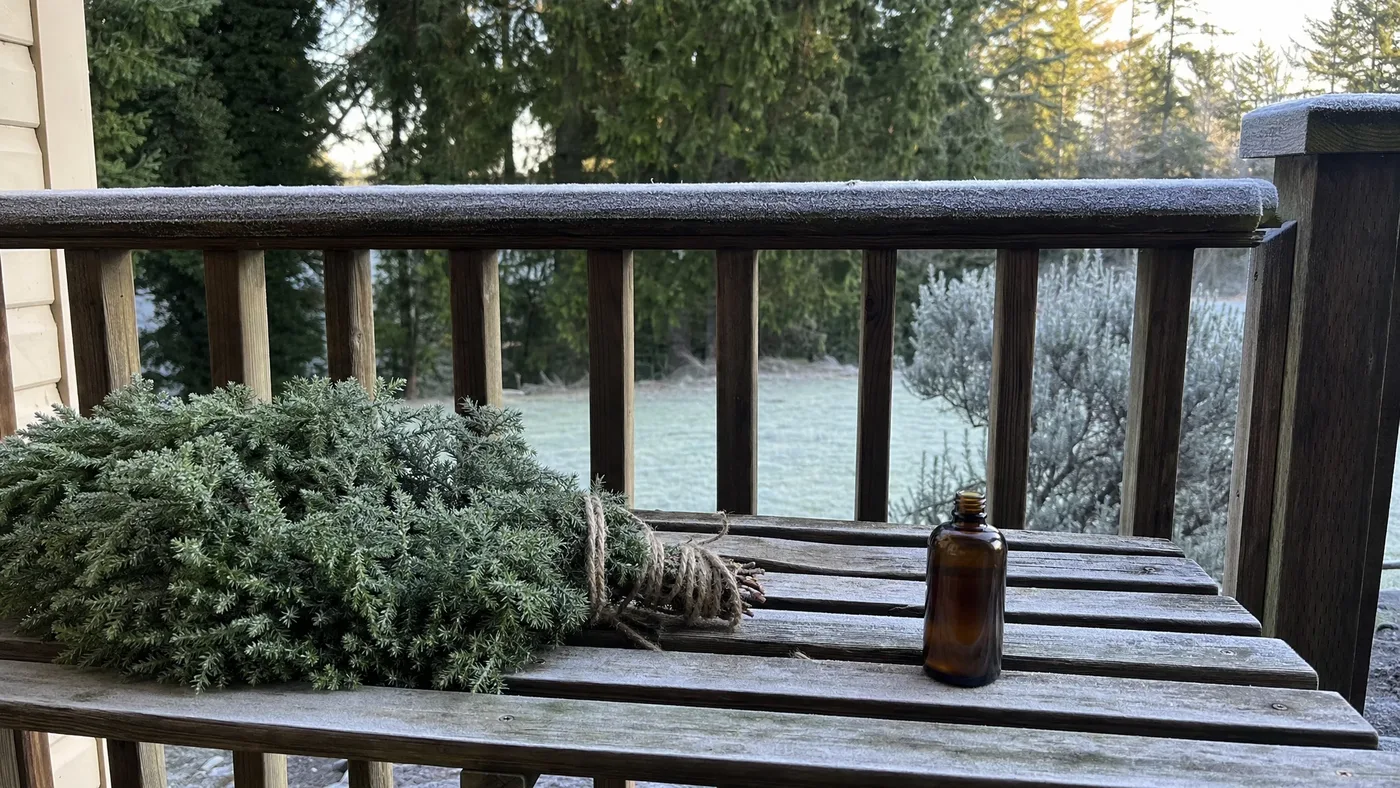
Cypress Home Scents for Every Season
By early October the holiday scent aisle is already filling up, and every seasonal blend list seems to rename the same recipe: "Winter Woods" in December, "Fresh Start" in January, "Spring Meadow" in April, four oils shuffled into a new order. The oils are not really the seasonal variable. The room is. A sealed, heated living room in January and an open-windowed kitchen in May are different volumes of air with different turnover, and the same handful of drops behaves very differently in each.
Cypress Essential Oil
Our own Cypress Essential Oil, in sizes from 0.5 oz to bulk.
From $10.99
Shop Now →Why conifers own the cold months
Part of the link between evergreens and winter is simply habit. Bringing boughs indoors, hanging wreaths and cutting a tree are old seasonal customs in much of Europe and North America, and if you grew up with a real tree, a conifer scent probably files itself under "December" before you can think about it. Cypress is a natural fit. We describe our oil as fresh and smoky-green, drier and more refined than common pine oils, which is just the thing for a heated room: a woodland note without the sweetness of vanilla or amber.
Dose for the room, not the recipe
Every blend below is a starting point for a standard 100 ml ultrasonic diffuser tank, built from how the oils behave. Then adjust for where you are.
- Closed winter rooms hold scent longer. Run short sessions, 30 to 45 minutes, then rest, and crack a window now and then.
- Small rooms need fewer drops, not different recipes. Halve the quantities and keep the ratios.
- Big airy rooms can take the full dose. If you can still clearly smell the blend after walking out and back in, you have gone a little far.
Deep winter
For November and December, think of a cut tree and an orange: 3 drops cypress for the dry, green backbone, 2 drops fir for a sweeter balsam note, 2 drops sweet orange for brightness, and a single drop of clove bud as seasoning. Clove is the one to measure carefully; it is strong, so treat it as a pinch rather than a pillar. We sell cypress only, so the fir, orange and clove come from another supplier, and each has its own safety limits to read.
The January reset
When the tree comes down, a spiced room starts to feel stale. Go spare: 3 drops cypress and 2 drops lemon. Cypress is dry and woody, lemon is sharp and bright, and together they smell like a room that has just been put back in order. Run it for half an hour in the morning while you air the house.
Spring
By April the windows are open for part of the day, so soften the blend: 2 drops cypress, 2 drops lavender, 1 drop lemon. Dropping cypress from three to two matters, because lavender needs room to be noticed. With fresh air moving through, you can run a session a little longer, as long as you are not stacking one on top of another. The same dry green anchor shows up in perfumery accords, where cypress sits beneath brighter notes.
Summer and fall
Heat makes resinous notes feel thick, so July and August are fine months to give conifers a rest. If you want a little cypress anyway, add a single drop to a citrus blend for a hint of dry greenness, and keep sessions short with the windows open. For fall, with its smoke and warm spice, we have a dedicated piece on a bonfire-season scent layer. For ways to scent a home without a diffuser at all, see fresh ways to use cypress at home.
Little rituals that go with each season
A scent works best when it is attached to something you actually do. In the cold months, start the diffuser when you come in from outside and take your coat off. In the new year, run the lemon blend while you wipe down the kitchen. In spring, set a small session going when you open the windows for the first time. In summer, use the faintest drop with the door open. In fall, run it as you light the first fire or bring out the heavier blankets. The oil is the same, and the habit gives it a season.
When less is more
It is tempting to add another drop when a room does not smell like much after ten minutes. Resist that for a while. Your nose gets used to a scent quickly, so the room may be perfectly fragrant to a guest who walks in fresh. Step outside for a minute and come back, and the scent usually turns up again. Stopping a little early is the single easiest way to keep a blend pleasant.
Good habits for any season
A chamber study of ultrasonic diffusers found that they release fine particles as well as scent, and that tap water in place of deionized water raised fine-particle emissions about fivefold in a eucalyptus test (Schwartz-Narbonne et al., 2021). Cypress was not tested, so take it as a nudge toward short sessions and fresh air. Hosting? Start the diffuser an hour before guests arrive, use the lower end of your dose, and switch it off as they come in. With pets, ask a veterinarian before diffusing, and read cypress oil and dogs.
Conifer oils also age faster than most once opened. Hana Tisserand notes that even unopened in a refrigerator they are at the limit of usability after two years (Tisserand Institute), so smell last year's bottle before you build a holiday blend around it. Our cypress is for external cosmetic use; keep it away from children and pets, and we suggest avoiding it in pregnancy as a precaution. For the wider picture, our guide to cypress uses goes further.
A well-dosed diffuser should be a faint backdrop you notice on entering and then forget. If a season ever asks for more than that, a candle or a simmer pot is the better tool.
Cypress Essential Oil
Cypress Essential Oil from our own shop, in sizes from 0.5 oz to bulk.
From $10.99
Shop Now →Sources & Further Reading
- Schwartz-Narbonne H, Du B, Siegel JA, 2021. Volatile organic compound and particulate matter emissions from an ultrasonic essential oil diffuser. Indoor Air 31(6):1982-1992. pubmed.ncbi.nlm.nih.gov/33905580
- Tisserand Institute (Hana Tisserand). Keep essential oils cool. tisserandinstitute.org