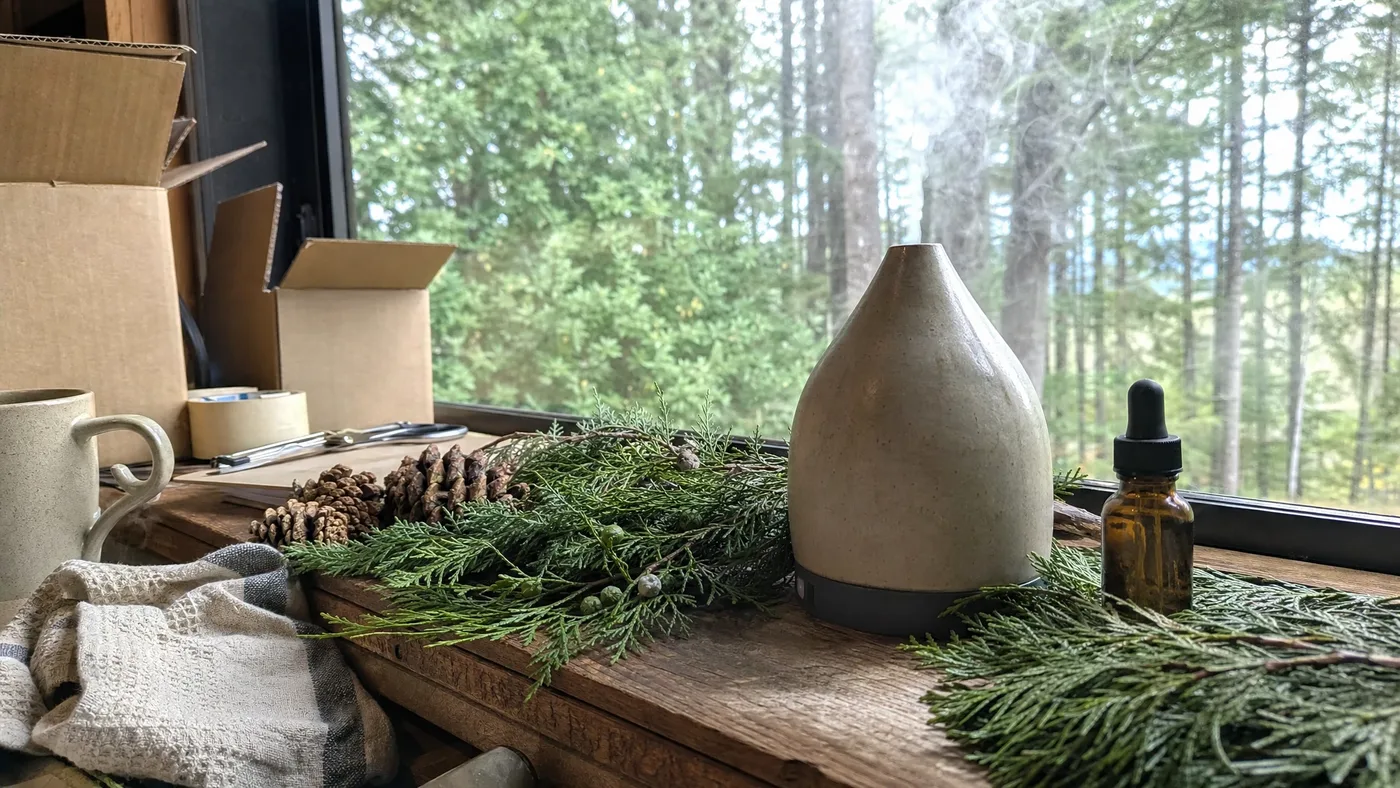
Forest Diffuser Blends: Cypress, Cedarwood, Fir, and Friends
Open five different blogs about woodsy diffuser blends and you'll find the same instinct repeated: if cypress smells like a forest, and fir smells like a forest, then cypress plus fir plus pine plus cedarwood plus juniper berry must smell like more forest. It doesn't. Past about three conifer oils in one blend, the individual notes stop reading as trees and start reading as a hardware-store air freshener. The fix isn't fewer ingredients for their own sake. It's understanding what each oil is actually doing in the blend, so you can pick for contrast instead of piling on more of the same thing.
Cypress Essential Oil
Our own Cypress Essential Oil, in sizes from 0.5 oz to bulk.
From $10.99
Shop Now →Why conifer oils collapse into "pine cleaner" when you over-stack them
Nearly every oil that reads as "forest" shares a backbone of alpha-pinene and beta-pinene, the same monoterpenes that give pine trees their name and that show up, in varying ratios, in cypress, fir, pine, spruce, and juniper berry oil (PubChem lists alpha-pinene as a major constituent across all of these). That shared backbone is exactly why they all smell related, and exactly why stacking four or five of them together doesn't multiply the forest effect. It just concentrates the same pinene signature until the oils that are supposed to be distinct notes start canceling each other into one generic, slightly solvent-like smell: the scent most people associate with cleaning products that borrowed "pine" as a marketing shorthand rather than a real forest floor.
The way out is to stop thinking about conifer oils as one category and start thinking about register, the way you'd think about bass, midrange, and treble in a mix. If you want the fuller theory behind this, the differences between cypress, pine, and fir are worth reading end to end, but here's the short version:
- Cypress (Cupressus sempervirens) is dry and green, with alpha-pinene joined by delta-3-carene. It reads as cool and a little austere, more like the shaded side of a hillside than a sunny clearing.
- Fir needle (commonly Abies sibirica or Abies balsamea) carries pinene alongside esters like bornyl acetate, which is what gives fir its sweeter, fresher top note compared to cypress's dryness.
- Pine (Pinus sylvestris) leans brighter and more resinous, with its own pinene and carene load reading sharper and more "sap on bark" than fir's softness.
- Cedarwood isn't a pine-family oil at all. Depending on species it's rich in cedrol or related sesquiterpenes, heavier and slower to evaporate, which is why it functions as a floor the lighter needle notes stand on rather than another needle note competing for the same space. Cypress and cedarwood come from entirely different plant families, and that structural difference, not just a difference in smell, is why the pairing works.
- Juniper berry (Juniperus communis) shares the pinene backbone too, but adds sabinene and myrcene, giving it the fruitier, gin-like edge that's literally why gin tastes the way it does: juniper berry is gin's flavoring agent.
Treat that list as a palette, not a shopping cart. The working rule below holds up across all five recipes in this piece: one wood oil as the floor, at most two needle notes layered on top, and everything else is an accent.
Who this isn't for
If you want a single, pure, unmistakable "forest" smell with no complexity, skip the blending entirely and just diffuse fir or pine on its own. These recipes are for people who want a forest scent with some structure and movement to it, which means accepting a slightly more abstract, less literal smell than a one-note oil gives you. If you find resinous, dry scents overwhelming in general, several of these blends (Old Growth and Snowline especially) will read as austere rather than cozy. The Clearing recipe below is built specifically for that reaction.
What you'll need
- An ultrasonic diffuser with at least a 100 ml water reservoir
- Essential oils: cypress, cedarwood, fir needle, pine, juniper berry, and (for two of the variations) patchouli and sweet orange
- A set of small amber glass bottles (5 to 10 ml) if you want to premix any blend ahead of time
- A glass or stainless dropper, or bottles with integrated orifice reducers, so you can count drops accurately
- Labels and a permanent marker
Five forest diffuser blends (drops per 100 ml water)
Each ratio below assumes a standard 100 ml diffuser reservoir. Scale proportionally for larger or smaller units; most tabletop diffusers run 100 to 500 ml.
| Blend | Ratio | Why it works |
|---|---|---|
| Old Growth | 3 cypress, 2 cedarwood, 1 fir | Cedarwood sets the floor, cypress supplies the dry green midrange, and a single drop of fir keeps the top from feeling flat. |
| Snowline | 2 cypress, 2 fir, 1 pine | No wood oil at all; this one stays entirely in the needle register, with pine's brightness kept to a single accenting drop so it doesn't flatten fir's sweetness. |
| Gin and Juniper | 3 cypress, 2 juniper berry | Two ingredients only, so juniper's fruit note has nothing to compete with and cypress's dryness has room to show through it. |
| Campfire Adjacent | 3 cypress, 2 cedarwood, 1 drop patchouli | Same wood-plus-cypress spine as Old Growth, but patchouli's earthy, smoky undertone stands in for the fir note and pushes the whole thing toward a smolder rather than a clearing. |
| Clearing | 2 cypress, 2 fir, 1 sweet orange | For anyone who finds all-conifer blends too austere; sweet orange doesn't fight the pinene backbone, it just adds light on top of it. |
Notice that none of these exceed three conifer-family oils (cypress, fir, pine, and juniper all count; cedarwood doesn't, since it's a different plant family entirely), and the two blends that come closest to the ceiling (Old Growth, Campfire Adjacent) use a non-needle ingredient, cedarwood or patchouli, to do the heavy lifting instead of a fourth needle oil. If you want ten more combinations built on the same logic, our broader roster of cypress diffuser blends covers seasonal and mood-based variations beyond the forest theme specifically.
Step-by-step instructions
- Fill your diffuser reservoir to the 100 ml line (or whatever line matches your unit's capacity) with room-temperature water.
- Add the drops for your chosen blend directly to the water, counting carefully with a dropper or the bottle's built-in reducer.
- Swirl the water gently with the dropper tip to disperse the oil across the surface before switching the diffuser on; oils float, so a few seconds of mixing evens out the first few minutes of mist.
- Run the diffuser in intervals rather than continuously, something like 30 to 60 minutes on followed by an equal break, which is standard guidance for ultrasonic diffusers regardless of which oils you're using.
- If you're premixing a blend ahead of time for repeat use, combine just the undiluted oils (no water) in a small amber bottle at the ratios above, then add the appropriate number of total drops to the reservoir each time you diffuse.
- Rinse the reservoir with warm water between different blends. Leftover residue from a previous blend will muddy the next one, especially when you're trying to keep cypress's dryness distinct from fir's sweetness.
Safety notes
Diffusing is a vapor-phase use, not a skin-contact one, but a few precautions still apply:
- Ventilation and duration: run diffusers in a ventilated room and in intervals rather than around the clock. Essential oil vapor in an enclosed, unventilated space can be irritating to eyes, nose, and airways even when the individual oils are generally well regarded.
- Pets: the ASPCA Animal Poison Control Center notes that cats in particular process many plant-derived compounds differently than humans do, and birds have especially sensitive respiratory systems. If you keep cats or birds, diffuse in a separate room they can leave, or skip diffusing when they're present.
- Children and anyone pregnant or nursing: keep diffusers and oil bottles out of reach of children, and if you are pregnant, nursing, or managing any ongoing health concern, check with a qualified healthcare provider before making essential oil diffusing a regular routine.
- Ingestion: essential oils are not for internal use. If a bottle is swallowed, contact US Poison Control immediately rather than waiting to see what happens.
- Patch testing, if you adapt any of these for skin use: these ratios are written for diffusing, not topical application. If you want to turn one into a personal inhaler stick or rollerball, dilute in a carrier oil first. Robert Tisserand and Rodney Young's Essential Oil Safety (2nd edition) is the standard reference for dilution guidance, and its general range for adult skin use runs low, often cited around one to five percent depending on the oil, with the lower end preferred for sensitive skin. Always patch test a small area of inner forearm and wait 24 hours before wider use.
Storage and shelf life
Premixed concentrate blends (the undiluted oil combination, before you add water) should go in a capped amber glass bottle, stored somewhere cool and dark, away from direct light and heat. Alpha-pinene and the other monoterpenes that dominate cypress, fir, pine, and juniper berry oxidize on exposure to air and light faster than the heavier sesquiterpenes in cedarwood do, which is why a bottle of cypress or fir left half-full and exposed to air will drift and dull noticeably within a year, while cedarwood holds its character much longer. Use conifer-forward blends within 6 to 12 months of opening the individual oils for the truest scent, and cap bottles tightly immediately after each use.
Variations and substitutions
- Fir: Siberian fir and balsam fir both work in these ratios; spruce needle oil is a reasonable substitute if fir isn't on hand, though it reads slightly sharper.
- Pine: Scotch pine is the most widely available and matches the brightness called for in Snowline; white pine is softer and can be used at the same ratio with a slightly gentler result.
- Cedarwood: Atlas cedarwood (sesquiterpenes including atlantone-type compounds) smells rounder and slightly sweeter than Virginia cedarwood (cedrol- and thujopsene-rich), which is drier and more pencil-shaving in character. Either works as the "floor" in Old Growth or Campfire Adjacent; the choice is a matter of which direction you want the base to lean.
- Juniper berry: juniper twig and leaf oil exists as a separate product and smells greener and less fruity than juniper berry. Don't substitute it into Gin and Juniper expecting the same gin-like note, since the fruitiness is specifically a berry-oil characteristic.
- Non-conifer accents: beyond patchouli and sweet orange, a single drop of vetiver can stand in as an alternate floor to cedarwood if you want something smokier and more rooted; bergamot can replace sweet orange in Clearing for a slightly more bitter citrus top note.
For a deeper look at why cypress specifically pairs so well with wood and resin notes in constructed scents, not just diffuser blends, how perfumers build woodland accords walks through the same wood-plus-two-needles logic used here, applied to formulations meant to last on skin rather than evaporate into a room.
Difficulty and prep time
Difficulty: easy. None of these recipes require equipment beyond a diffuser and a dropper. Prep time: under 5 minutes per blend if you're measuring directly into the reservoir, or about 10 minutes if you're premixing a batch of concentrate into a labeled bottle for repeat use. If you're building a small collection of conifer and wood oils from scratch, our shop page lists the oils used across all five blends here.