
Cypress vs Cedarwood Essential Oil: Two Different Woods Compared
Cypress is a bright, dry oil with a green edge, distilled from needles and twigs. Cedarwood is a soft, deep, sweet-dry oil distilled from wood, and the word covers several species. Choose cypress for fresh structure and cedarwood for cozy depth. Blend two parts cypress to one part cedarwood and you get something better than either alone.
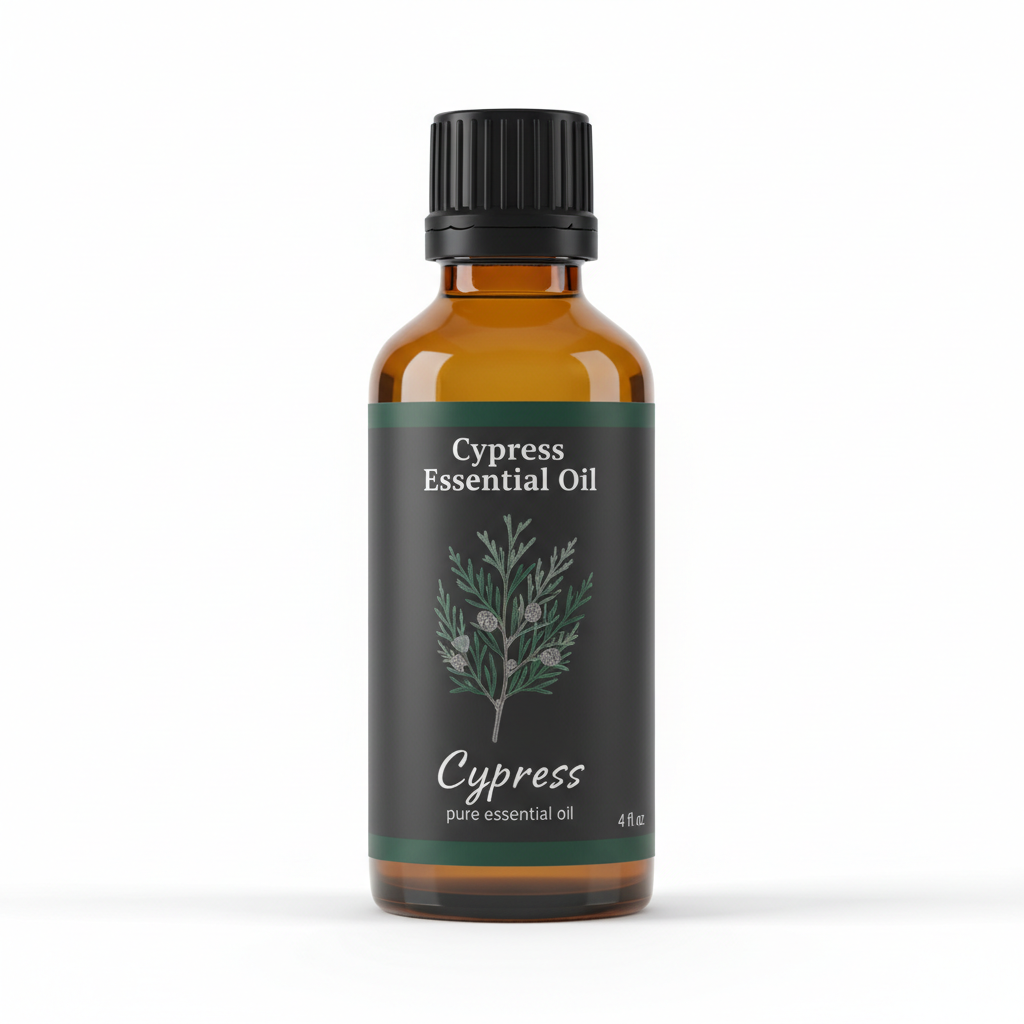
Cypress Essential Oil
Our own Cypress Essential Oil, in sizes from 0.5 oz to bulk.
From $10.99
Shop Now →Start Here: 'Cedarwood' Is Not One Oil
Most cypress vs cedarwood essential oil articles skip this step, and it explains why they contradict each other. One writer says cedarwood smells sweet and warm. Another says it smells sharp and pencil-like. Both can be right, because they are smelling different plants.
Here are the materials that commonly sell under the single word 'cedarwood':
- Virginia cedarwood (Juniperus virginiana). Despite the name, this is a juniper, the eastern red cedar of North America. It is distilled from the heartwood and often from sawdust left over from lumber. The scent is dry, woody and a little sharp, like fresh pencil shavings.
- Atlas cedarwood (Cedrus atlantica). This is a true cedar from the Atlas Mountains of North Africa. It smells rounder and sweeter than Virginia, with a balsamic, faintly amber warmth.
- Himalayan cedarwood (Cedrus deodara). Another true cedar, with a drier, smokier and more resinous profile than Atlas.
- Texas and Chinese 'cedarwoods'. Juniperus ashei is a Texas juniper. Oil sold as Chinese cedarwood is usually from a Cupressus species, which puts it in the same genus as cypress. A bottle labeled only 'cedarwood' can be a close botanical cousin of the oil you are comparing it to.
Cypress is simpler. The oil is Cupressus sempervirens, the tall, narrow Mediterranean cypress, distilled from its leaves, twigs and sometimes cones.
So this guide takes a position: a fair cedarwood essential oil comparison has to say which cedarwood. Where the species matters, we name it. Where it does not, 'cedarwood' means the woody family trait the species share.
Why They Smell Different: The Chemistry in Plain English
You do not need a chemistry degree to understand the difference between these two. You need one idea: the part of the tree matters.
Cypress comes from needles and twigs, which are rich in small, light, volatile molecules called monoterpenes. Alpha-pinene is the headline one. It smells green, resinous and crisp, like crushed conifer foliage. Light molecules evaporate fast, so cypress opens quickly and fades earlier.
Cedarwoods come from wood, which holds larger, heavier molecules called sesquiterpenes. Virginia cedarwood is rich in cedrene and cedrol (PubChem lists both). Cedrol is a sesquiterpene alcohol that is solid at cool room temperature, which is why a bottle of Virginia cedarwood kept in a cold room can develop small crystals. That is a physical property of the compound and not a flaw. Warm the bottle in your hands and it clears. Heavy molecules evaporate slowly, so cedarwood stays on a blotter for a long time.
Picture a building. Cedarwood is the floor and foundation: broad, low and steady. Cypress is the framing: lean vertical lines that give the room its shape. They occupy different floors of the same building, which is why they pair so naturally and why asking which one wins is the wrong question.
The Side-by-Side Table
| Attribute | Cypress | Virginia Cedarwood | Atlas Cedarwood |
|---|---|---|---|
| Botanical name | Cupressus sempervirens | Juniperus virginiana | Cedrus atlantica |
| Plant part | Leaves, twigs, sometimes cones | Heartwood and sawdust | Wood |
| Note position | Top to heart | Base | Base to heart |
| Scent register | Pinene-bright, dry, green, slightly smoky | Dry, pencil-shaving, sharp-soft | Sweeter, balsamic, rounded, warm |
| Staying power | Moderate, fades sooner | Long | Long |
| Dominant chemistry | Monoterpenes (pinene-type) | Sesquiterpenes, cedrol | Sesquiterpenes |
| Best use | Fresh diffuser blends, structure in grooming blends | Anchoring blends, cozy diffusion, perfumery base | Softer perfumery bases, sweeter woody blends |
Scent Jobs: Which One for Which Task
Diffusion
If you are choosing cypress or cedarwood for diffuser use, decide first what the room should feel like.
Cypress in a diffuser reads as fresh austerity: a cool, dry, green air, like a path through conifers on a clear morning. It suits a home office, a hallway or a morning routine. Because its molecules are light, the scent lifts fast and then thins, so many people run it in short cycles.
Cedarwood reads as cozy depth: closets, cedar chests, pencil boxes, a quiet room with the lamp on. Virginia gives the dry version. Atlas gives a gentler, sweeter one. It suits evening routines and winter rooms. Its weight means a few drops go a long way, and a heavy hand can make a small room smell like the inside of a drawer.
Verdict for diffusion: cedarwood for atmosphere, cypress for freshness.
Grooming
Both appear in men's grooming products such as beard oils, shave soaps and aftershave blends, but in different roles. Cypress supplies the clean, green top that makes a blend smell freshly shaved. Cedarwood supplies the dry-woody body that makes it smell like a barbershop. A product built on only one of them tends to read flat: cypress alone can feel thin and sharp, cedarwood alone can feel heavy and one-dimensional.
Verdict for grooming: use both, cypress for lift and cedarwood for body.
Perfumery
Perfumers sort materials by how long they last. Cedarwood is a base note: it fixes lighter materials and anchors the dry-down. Cypress sits as a heart note: it bridges the bright opening to the woody base and adds a dry, green, slightly smoky texture that citrus and lavender both lean on.
If you are making a simple solid or roll-on perfume, this tells you the order of operations. Build the cedarwood foundation first, then add cypress to give the blend a vertical line.
Verdict for perfumery: cedarwood as base, cypress as heart.
The Blend That Beats Both: 2 Parts Cypress to 1 Part Cedarwood
The ratio behind many of the forest blends on this site is two parts cypress to one part cedarwood. It works for a reason that follows from the chemistry above. Cypress carries the volatile, green opening. Cedarwood slows the evaporation of the whole mixture and gives the dry-down some weight. At 2 to 1, you hear the forest first and the wood second. Flip it to 1 to 2 and the cedarwood swamps the cypress, which is the most common mistake in this pairing.
Diffuser version. In a 100 ml diffuser, use 4 drops of cypress and 2 drops of cedarwood, and add water as directed by your diffuser's instructions. Atlas gives a rounder result. Virginia gives a drier, more pencil-like one.
Skin version (cosmetic use only). Mix 4 drops of cypress and 2 drops of cedarwood into 1 ounce (30 ml) of carrier oil such as jojoba or fractionated coconut oil. That is roughly a 1 percent dilution. Use it as a scented body oil or as the base of a roll-on.
Safety notes for the skin version.
- Always dilute. Never apply either oil undiluted.
- Patch test first: apply a small amount of the diluted blend to the inner forearm and wait 24 hours.
- Stop using any blend that causes irritation.
- Check dilution limits for your specific oils in Robert Tisserand and Rodney Young's Essential Oil Safety (2nd edition) before going stronger than 1 percent.
- Keep oils away from the eyes and out of reach of children.
- If you are pregnant or nursing, or take any medication, ask a qualified physician before using essential oils.
On pets: cats in particular process aromatic compounds differently than people do. The ASPCA Animal Poison Control Center is the right place to check before diffusing around animals. Ventilate the room and give pets a way to leave it.
Cypress: Pros and Cons
Pros
- Gives blends a vertical, structured line that heavier oils cannot supply.
- Dry, green and clean without the sweetness of many other conifer oils.
- Pairs well with citrus, lavender, sage and woods, so it is easy to place in a blend.
- Works as a heart note, bridging bright openings and deep bases.
Cons
- Fades sooner than a wood oil because its main molecules are light.
- Alpha-pinene oxidizes readily on contact with air, so a half-empty bottle ages faster than a full one. This is chemical reasoning, not a promise about any one bottle, but it explains why a stale cypress smells flat and turpentine-like.
- Can read as austere or cold when used alone in a room.
Cedarwood: Pros and Cons
Pros
- Long-lasting base that holds lighter oils in a blend.
- Cozy, familiar wood scent that suits evening and cold-season routines.
- Several species to choose from: Virginia for dry, Atlas for sweet, Himalayan for smoky.
- Typically the more economical wood oil in this comparison (see buying notes below).
Cons
- The word 'cedarwood' on a label tells you little. Two bottles can smell quite different.
- Heavy in a diffuser. Overdoing it can make a room feel stuffy.
- Cedrol can crystallize in cool storage, which surprises first-time buyers.
- Alone, it can smell one-dimensional and dusty.
Best For: Recommendations by Use Case
- Morning diffuser: cypress.
- Evening diffuser: cedarwood, Atlas if you want it softer.
- Beard oil or shave blends: both, at 2 parts cypress to 1 part cedarwood.
- Solid perfume or roll-on: cedarwood for the base, cypress for the heart.
- Forest-style room scent: the 2:1 blend.
- Wardrobe or drawer sachets: Virginia cedarwood on a wooden block or cotton, kept away from direct contact with fabric.
- A first single bottle for a beginner: whichever matches your preference. Fresh and green points to cypress. Warm and cozy points to Atlas cedarwood.
Buying Notes: Latin Names and the Price Logic
Read the Latin name first. A trustworthy label gives the botanical name, the plant part and the country of origin. For cypress, look for Cupressus sempervirens. For cedarwood, look for Juniperus virginiana, Cedrus atlantica or Cedrus deodara. A label that says only 'cedarwood' leaves you guessing about the scent and the cost.
Why the prices differ. Wood oils and needle oils follow different supply logic. Virginia cedarwood is often distilled from lumber-industry leftovers such as sawdust and shavings, so the raw material is plentiful and the oil is usually the lowest priced of the group. Atlas cedarwood comes from slow-growing trees in a more tightly managed supply, and oil from true cedars tends to cost more. Cypress is a renewable harvest of twigs and foliage, which does not require felling a tree, but the yield per kilogram of plant is modest, so it generally sits between the two.
A very low price on a bottle labeled Atlas cedarwood is worth a question. Cheaper species are sometimes sold under the broader name, which is one more reason to ask for the Latin name.
Storage. Keep both in dark glass, tightly capped, away from heat. Because of the oxidation point above, buy the smaller bottle of cypress if you use it slowly. If your cedarwood crystallizes, hold it in your palms for a few minutes before using it.
If you want to smell both before committing, a small bottle of each answers the question faster than any description, and our cypress oil is a good place to start for the cypress side.
Who Should Skip Which
Be honest about your nose. If you dislike dry, pencil-like woody scents, Virginia cedarwood will not win you over, and Atlas is the better bet. If you want sweet, warm and cozy, cypress will feel too austere to use alone, and you will probably end up using it only in blends. If you dislike any conifer-like smell, neither oil is for you, and a floral or citrus oil will serve you better.
The Verdict
Cypress and cedarwood are not competitors. They are different parts of the same tree-shaped idea, and the confusion between them comes mostly from the word 'cedarwood' hiding three or more species.
- Buy cypress if you want fresh, dry, green air and a way to give blends structure.
- Buy cedarwood if you want depth, warmth and a base that lasts. Pick Atlas for sweet and rounded, Virginia for dry and economical.
- Buy both if you like to blend. The 2:1 cypress-to-cedarwood mix is the best single answer this comparison can give, because each oil covers what the other lacks.
If you can only keep one bottle on the shelf, choose by room: cypress for spaces you want to feel open, cedarwood for spaces you want to feel enclosed and quiet. This article is educational and cosmetic in focus. For questions about how essential oils fit your own situation, speak with a qualified physician.