
Cypress vs Pine vs Fir Essential Oil: Choosing Your Conifer Note
Short answer: choose fir needle for sweet, balsamic softness, pine for bright, resinous nostalgia, and cypress for a dry, green, smoky austerity that sits politely in blends. All three are pinene-rich, so they overlap, but your nose can separate them in under a minute. Pick by the room you want, not by the tree.
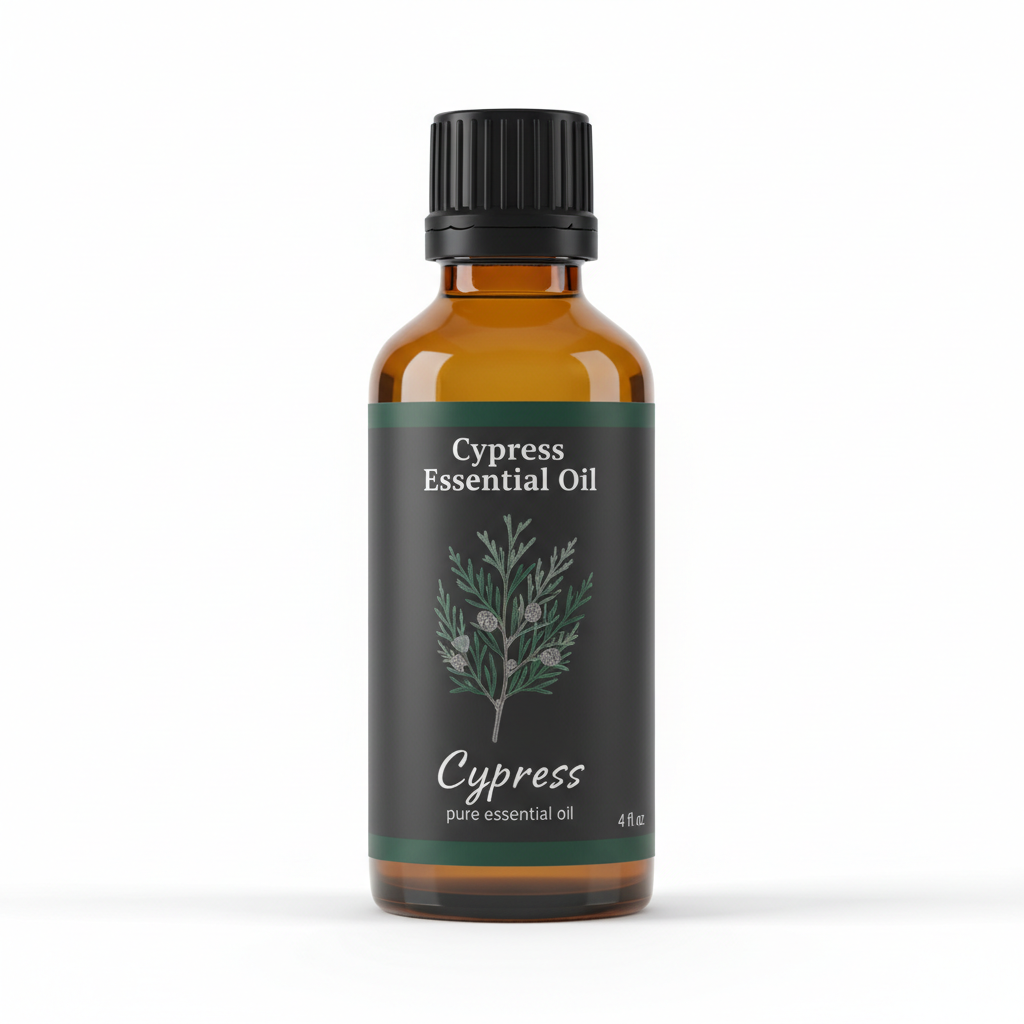
Cypress Essential Oil
Our own Cypress Essential Oil, in sizes from 0.5 oz to bulk.
From $10.99
Shop Now →Why first-time buyers are surprised
Most people's idea of how "pine" smells comes from a cleaner. Floor wash, bathroom spray, car air freshener. Those products are built to a cultural shorthand for "clean," and the shorthand has drifted a long way from a bottle of distilled needles. So when a first-time buyer opens genuine pine oil and finds it greener, sharper and more turpentine-like than expected, they assume something is wrong with the bottle. Nothing is. Their reference point is skewed.
The fix is to calibrate with fresh oils, not with memory of products. Open all three side by side, one at a time, on separate paper strips, and let each sit for a minute before judging. Smell the fir last if you want the sweetness to register. The rest of this piece gives you things to look for so the comparison is something you can verify yourself.
The constituent contrast
PubChem lists the main aroma molecules in these oils, and the three share a backbone: alpha-pinene and beta-pinene, the piney, fresh-cut-wood compounds, along with camphene, limonene and delta-3-carene in varying amounts. That shared chemistry is why they smell related. The differences are in the supporting cast. Exact proportions shift with species, harvest season and distillation, so no single figure is reliable, and none is given here.
| Attribute | Cypress | Pine | Fir needle |
|---|---|---|---|
| Typical species | Cupressus sempervirens | Pinus sylvestris (Scots pine) is the common one; others exist | Abies balsamea (balsam), Abies alba (silver), Abies sibirica (Siberian) |
| Shared core | Alpha-pinene, delta-3-carene | Alpha-pinene, beta-pinene, delta-3-carene | Alpha-pinene, beta-pinene, camphene |
| What sets it apart | Woody sesquiterpene alcohols such as cedrol, plus terpinolene, giving a dry, smoky base | Higher share of sharp, resinous monoterpenes | Bornyl acetate, an ester with a sweet, balsamic, slightly camphor-like facet |
| Scent register | Driest and greenest, dry wood and smoke | Brightest and most resinous, close to sap and turpentine | Sweetest and rounder, closer to a Christmas-tree lot |
| Behavior in a blend | Recedes and supports | Dominates quickly | Blends smoothly, adds sweetness |
| Species risk when buying | Lower, one dominant species | High, several species, different characters | High, several species, different characters |
The ester is the useful clue. Esters tend to smell soft and fruity-sweet next to the sharper hydrocarbon terpenes, and bornyl acetate is why fir reads as rounder than pine even though both open with the same pinene brightness. Cypress lacks that sweet ester layer and leans on woody, drier material underneath, which is why it reads as austere.
Three smell tests you can run at home
- The first second. Pine hits the nose hardest with a sappy, almost solvent-like brightness. If it is the sharpest of the three, it is behaving as expected.
- The sweet hunt. Fir should have a faint sweetness behind the green, something like balsam resin or a freshly opened box of ornaments. If you cannot find it, check the Latin name on the label.
- The dry-down. After ten minutes on a strip, cypress is the one still smelling of dry wood and smoke while the others have faded into soft resin. It will not smell sweet at any point.
Cypress: the dry one
Pros: It stays in the background of a blend instead of taking it over. The scent has a green, slightly smoky character that reads as clean without reading as cleaner. One dominant species keeps bottle-to-bottle variation lower than with pine or fir.
Cons: It is austere on its own. If you want a cozy, sweet room, cypress will disappoint you. It can also smell a little flat when diffused alone, since it lacks the bright top note pine offers.
Pine: the bright one
Pros: The most immediately recognizable scent of the group and the strongest at low dosage. A few drops carry a room.
Cons: It shouts. In a blend it can flatten everything around it, and the sharpness can tip toward harsh in small, closed rooms. Quality also varies more by species and by how fresh the bottle is.
Fir needle: the sweet one
Pros: The softest, most naturally festive of the three, with the ester sweetness that makes it feel rounded instead of sharp.
Cons: It is the most species-dependent. Balsam fir, silver fir and Siberian fir each smell a little different, and "fir" on a label can also refer to oils from trees that are not true firs. Its lighter body fades faster than the others when diffused.
The verdict, use by use
Room diffusion
Three different rooms, three different answers. Fir for sweetness: a living room in December, a reading corner. Cypress for austerity: an entryway or a study where you want something dry and quiet that does not announce itself. Pine for bright nostalgia: a mudroom, a cabin weekend, anywhere a bold scent is welcome. Keep sessions short and the room ventilated, and if you share your home with cats, birds or small pets, check with the ASPCA Animal Poison Control Center or your vet before diffusing any conifer oil. Pine and fir oils are rich in terpenes that animals can handle poorly.
Perfumery and grooming
Cypress, almost always. The reason is behavioral. Its drier, woody base sits under other materials and gives structure, so citrus, lavender, vetiver or leather accords keep their identity. Pine's sharp resinous top note dominates a composition within a few drops and tends to take the whole blend toward a forest-floor cliche. That is why cypress shows up in aftershave-style blends, beard oils and solid perfumes while pine rarely does. For anything that touches skin, dilute in a carrier (1 to 2 percent is a conservative range), patch test first, and keep the bottle fresh. Because alpha-pinene and delta-3-carene oxidize readily on air contact, a half-empty bottle ages faster than a full one, and Tisserand and Young's Essential Oil Safety (2nd edition) notes that oxidized monoterpene-rich oils are more likely to irritate skin. Retire old pine and fir oil from skin products first.
Household cleaning sprays
Pine. Here the cultural association does the work: the scent is what tells you the surface is clean, and it is the one you were trained to expect. A few drops in a water and vinegar spray or a laundry-room freshening mist carries that association without a fragrance additive. The scent is the point; it should not be relied on to sanitize anything. Test on a hidden spot before using on finished wood, and keep sprays off pets' bedding and food areas.
Blending them together
The three combine well, with one rule: build around one wood-note base and add two needles. Cypress works as the wood base when you want dry and quiet, and a fir or pine pairs with it as the first needle. The forest-blends recipe piece on this site covers actual ratios, but the principle is that only one oil gets to lead. Two bright needles with no wood underneath tend to fight each other, and three pines or firs at equal strength read as a candle aisle.
The buying note that matters more here
For cypress, the Latin name is a good habit. For pine and fir it is close to mandatory. Both categories span several species with real differences in character: a Scots pine oil, a dwarf pine oil and an unspecified "pine" can smell quite different, and balsam fir, silver fir and Siberian fir are not interchangeable either. A label that says only "fir" or "pine" tells you very little. Look for the Latin binomial, the plant part (needle, not wood or cone), and a batch or harvest reference. Our complete guide to buying cypress essential oil walks through label reading in more detail, and the same questions apply to pine and fir. If you are ordering from a new supplier, this first-order checklist is worth running before you commit.
Bottle size also changes how your oils age. A conifer you will use slowly is better bought small, since oxidation is a real cost. See which cypress bottle size to order for the reasoning, and apply the same logic to pine and fir. If you want to start with the dry, quiet one, our cypress selection is where to look.
Who this comparison is not for
If you want a single oil that smells like the pine cleaner under your kitchen sink, expect a gap between that memory and the real thing. If you are pregnant, nursing, or take regular daily medications, check with your doctor or pharmacist before using essential oils. And if sweet and cozy is the only goal, skip cypress and start with fir.
The final call
If you buy only one, make it cypress. It is the most versatile of the three because it is the only one that behaves in a blend, in a diffuser and on a skin-contact product without taking over. Add fir when you want sweetness and pine when you want brightness or a cleaning-spray scent. Smell them fresh, side by side, and trust your nose over your memory of a floor wash.