Does Cypress Oil Go Bad? Shelf Life and Telltale Signs
A bottle of cypress oil that has sat at the back of a cupboard for a couple of winters is a common sight, and the question that follows is always the same: is it still good? The honest answer is that it depends on the bottle, the cupboard and, above all, your nose. Cypress is a conifer oil, and conifers are the family that ages fastest.
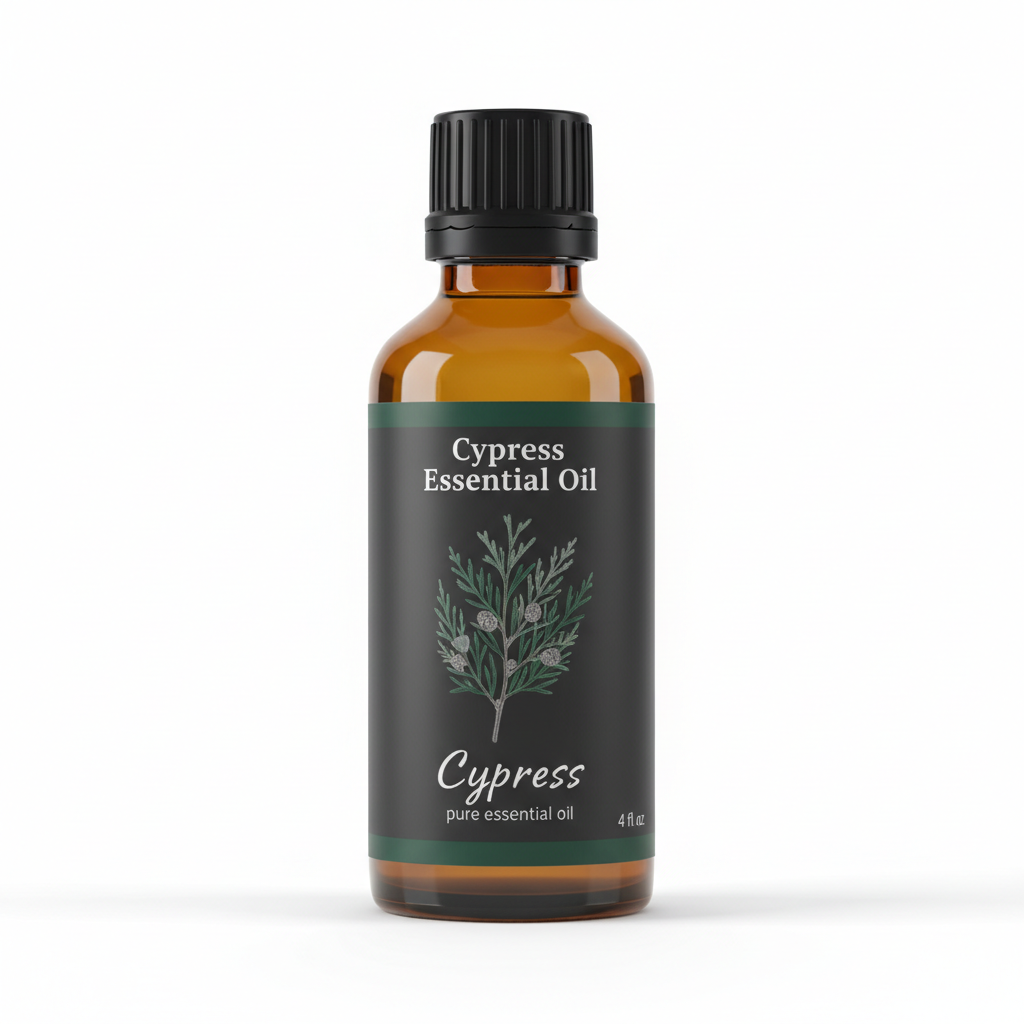
Cypress Essential Oil
Our own Cypress Essential Oil, in sizes from 0.5 oz to bulk.
From $10.99
Shop Now →Why conifers hurry
Essential oils are mixtures of small, lively molecules, and those molecules react with oxygen over time. Heat, light and air speed it along. A review of essential oil stability by Turek and Stintzing names temperature, light and oxygen as the three things that matter most, and warns that oxidation and polymerisation can change an oil's quality. Cypress oil is built largely on terpenes such as alpha-pinene and delta-3-carene, so it is easy to see why it sits at the lively end of the shelf.
The Tisserand Institute makes the same point in plain terms: conifer oils such as pine and spruce, and citrus oils, oxidise quicker than most. In a reply on its storage page, it puts conifers at the limit of usability after about two years even when refrigerated and unopened. Heavy oils like vetiver, sandalwood and patchouli sit at the slow end. That is general guidance for the family, not a countdown printed on any one bottle, and we would not want you to read it as one.
What the batch on our COA tells you, and what it does not
The Certificate of Analysis we publish is for a single batch and lists a best-by date of 04/30/2028. That date is useful as a marker for that batch, and the bottle you receive carries its own still date, fill date and lot, so you can see the age of what you are holding. We ship in amber glass in every size, which keeps light out, and we say plainly that conifer oils turn faster than woods or resins. Our storage guidance is simple: tightly capped, cool, dark, away from heat and sunlight. The rest is up to your shelf.
Three ways to tell, using your own senses
The Tisserand Institute's page on oxidised oils is refreshingly unscientific about this: oxidation alters the perceptible odour, and the clearest way to notice is to compare against a fresh bottle. So the first check is the nose. Cypress should smell green, dry and resinous. If it has turned flat, sharp, sour or oddly sweet, the bottle has moved on.
Then look at it. The same page says very old oils may become more viscous and eventually solidify, though that usually takes many years, and that citrus oils sometimes go cloudy as they oxidise. A drop that feels sticky between your fingers or leaves a tacky ring on the bottle neck is another cue, which fits that picture of thickening. None of these is a laboratory test. A bottle can smell fine and still be well along, which is why the date matters as much as the nose.
Why we would not put an old bottle on skin
Here is the practical part. The Tisserand Institute describes the products of oxidation as raising the risk of adverse skin reactions. So the question is not just whether an ageing bottle still smells nice, but where it is going. Our view is that a bottle you are unsure about belongs in a diffuser or a room scent, away from skin, and that anything meant for the body should come from a bottle you are confident in. That is editorial judgment built on the guidance above rather than a rule from a regulator. If a bottle has clearly turned, your local household waste guidance is the place to ask how to dispose of it.
Keeping the green scent longer
- Write the date you opened the bottle on a piece of tape on the box, not on the bottle. The Tisserand Institute suggests keeping a purchase or opening date.
- Choose a size you will finish. A half-empty large bottle is mostly air, and air is what the oil reacts with. Our bottle size guide shows how far each size goes.
- Cap it tightly the moment you have poured, and keep it out of the kitchen, the windowsill and the car.
- If you have room, a fridge shelf roughly doubles useful life according to the Tisserand Institute. A small lidded box keeps the scent from reaching the butter.
We go through the full routine, including air gaps and decanting, in how to store cypress oil, and our safety basics cover dilution and patch tests for the oil you do keep. If you want to know what the COA on a bottle does and does not show, reading each line is a good next step.
Treat a bottle of cypress oil like fresh herbs rather than a tin of beans: buy what you will enjoy over a year or so, keep it cool and capped, and trust your nose over a number on a page. The best bottle is the one you are still happy to open.
Cypress Essential Oil
Cypress Essential Oil from our own shop, in sizes from 0.5 oz to bulk.
From $10.99
Shop Now →Sources & Further Reading
- Turek C, Stintzing FC. "Stability of Essential Oils: A Review." Comprehensive Reviews in Food Science and Food Safety, 2013; 12(1):40-53. doi.org/10.1111/1541-4337.12006
- Tisserand Institute. "Is my bottle of essential oil oxidized or no longer good to use?" tisserandinstitute.org/learn-more/oxidized/
- Tisserand Institute. "Keep essential oils cool!" tisserandinstitute.org/learn-more/keep-essential-oils-cool/
- Selim SA et al. "Chemical composition, antimicrobial and antibiofilm activity of the essential oil and methanol extract of the Mediterranean cypress (Cupressus sempervirens L.)." BMC Complementary and Alternative Medicine, 2014; 14. pubmed.ncbi.nlm.nih.gov/24890383