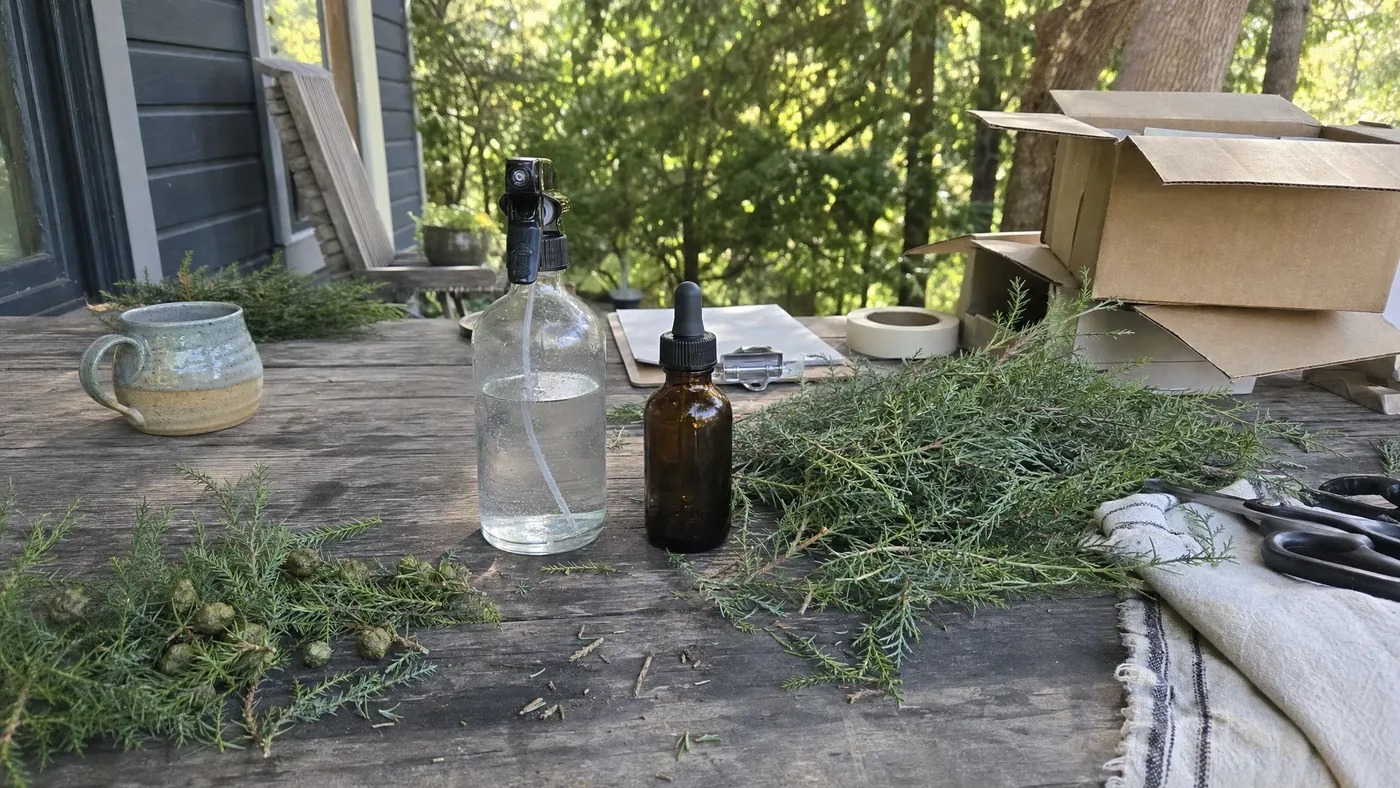
Cypress Hydrosol vs Cypress Essential Oil: Which One Do You Actually Need?
Get the essential oil if you want to diffuse, blend into a diluted skin product, or build a fragrance. Get a hydrosol if you want a ready-to-use mist for linens, rooms, or skin. They come from the same still run, but they are not interchangeable: one is concentrated and long-lived, the other is faint and perishable.
Cypress Essential Oil
Our own Cypress Essential Oil, in sizes from 0.5 oz to bulk.
From $10.99
Shop Now →First, an honest note about this shop
We sell cypress essential oil. We do not sell a hydrosol. You have probably seen "cypress hydrosol" and "cypress floral water" listed beside the oil elsewhere and wondered whether you are missing a product. This article is meant to help you decide that, even when the answer sends you to another supplier. A buyer who picks the right product the first time is better served than one who buys the wrong bottle from us.
What a hydrosol actually is
A hydrosol is the water that comes out of the still. When steam passes through cypress needles and twigs, it carries volatile aromatic compounds with it. The steam condenses, and the condensate separates into two layers. The oil, which does not mix well with water, collects as a thin layer that is drawn off. The water underneath is the hydrosol. If you want the full walk-through of that process, we cover it in how cypress essential oil is made.
That water is not blank. It holds traces of the aromatic compounds that dissolve in water, along with a small amount of finely dispersed oil. Terpene hydrocarbons such as alpha-pinene, which makes up a large share of cypress oil, are poorly water-soluble. Many of the more oxygenated compounds dissolve a little better. The practical result is that a hydrosol tends to smell softer and a bit different from the oil, not simply like a diluted copy of it. (Tisserand and Young discuss the chemistry of distillation and its constituents in Essential Oil Safety, 2nd edition, if you want the technical background.)
The misconception worth clearing up
A hydrosol is not "weak essential-oil water." It is a distinct product with its own composition, and it comes from a different phase of the distillation.
It also cannot be recreated at home. Dropping a few drops of cypress oil into a bottle of water does not make a hydrosol. Oil and water separate. The drops float, cling to the bottle neck, and arrive in your first sprays as concentrated beads. That is a real problem for anything touching skin or fabric. A homemade "oil in water" mist is unevenly strong, and the first spritz can be much stronger than the last.
This is why proper spray recipes use a base that lets the oil disperse. That means an alcohol such as a perfumer's-grade ethanol, or a solubilizer. Our cypress linen and closet spray guide walks through that structure so the scent stays even from the first spray to the last.
Concentration: the difference that drives everything else
Essential oil is the concentrated fraction. A drop contains a great deal of aromatic material, which is why it is measured in drops and diluted for skin. The hydrosol holds far less. That is exactly why it can be misted as it comes, in a way whole-strength oil never should be.
Lower concentration does not mean no precautions. A hydrosol is still a botanical product, and skin can react to any plant material. Test a small area first and stop using it if you notice irritation. If you are pregnant, taking medication, or have a skin sensitivity, ask your doctor before adding new botanical products to your routine.
Cypress hydrosol vs essential oil at a glance
| Attribute | Cypress essential oil | Cypress hydrosol (floral water) |
|---|---|---|
| What it is | The oil layer drawn off the still | The condensed water layer from the same run |
| Strength | Highly concentrated | Very faint, with only traces of aromatic compounds |
| Scent | Resinous, green, woody, with a dry-down | Softer, lighter, often described as fresher and more watery |
| Used as-is on skin or fabric | No. Always diluted | Generally yes, with a patch test first |
| Typical uses | Diffusion, diluted skin blends, perfumery, scented products | Linen, room, and skin mists |
| Mixes with water | No, it needs an alcohol base or solubilizer | It is already water |
| Shelf life | Years if stored well | Perishable. Weeks to months, depending on preservation |
| Storage | Cool, dark, tightly capped | Refrigerated if unpreserved |
| Microbial risk | Low | Real, especially if unpreserved |
| Cost per use | Higher bottle price, very small amount per use | Lower bottle price, used in larger volumes |
Cypress essential oil: pros and cons
Pros
- It lasts. Stored in a tightly capped dark glass bottle away from heat, it keeps for years. Keep the bottle full where you can: alpha-pinene oxidizes readily on air contact, so a half-empty bottle ages faster than a full one.
- It is versatile. One bottle can scent a diffuser, a diluted body oil, a linen spray with the right base, and a handmade candle or soap.
- It is economical in practice. You use a few drops at a time.
- It has a clear aroma profile. The scent is dry, green, and woody, which is easy to blend with citrus or other conifer oils.
Cons
- It demands respect. It must be diluted before it touches skin and handled carefully around children and pets. The ASPCA Animal Poison Control Center publishes guidance on essential oils and animals, and it is worth reading before you diffuse in a home with cats or dogs.
- It will not mist on its own. You need a base to disperse it, which adds a step.
- It is potent. A heavy hand makes a room smell sharp and overwhelming.
Cypress hydrosol: pros and cons
Pros
- It is ready to use. You can spray it without mixing, measuring, or choosing a solubilizer.
- It is gentle in scent. A light mist over a pillowcase or a bath towel leaves a faint woody-green note rather than a strong perfume.
- It suits a quick refresh. A spritz on a face after a long day is an easy ritual, provided your skin agrees with it.
Cons
- It is perishable. Water with trace organic compounds is an inviting medium for microbes. An unpreserved hydrosol can turn cloudy, develop a sour or musty smell, or grow visible films. Once that happens, discard it.
- It needs cold storage. An unpreserved bottle belongs in the refrigerator, not on a bathroom shelf.
- It is hard to evaluate. Because the scent is faint, a weak, old, or adulterated product can be difficult to spot until it has already gone off.
- Quality varies. Some products labeled "floral water" are simply water with fragrance added.
Best for: matching the product to the job
Choose the hydrosol if you want to
- Mist pillowcases, towels, or a closet lightly, without mixing anything.
- Freshen a room with a faint woody scent rather than a strong one.
- Keep a skin mist in the refrigerator for a cool, light evening ritual.
- Introduce cypress to a household that is sensitive to strong aromas.
Choose the essential oil if you want to
- Diffuse a clean, green, woody aroma, using only a few drops in a properly sized diffuser.
- Blend a diluted body oil or balm. Our guide to cypress oil for skin covers dilution and patch testing step by step.
- Build a fragrance, candle, or soap, where concentration matters.
- Own something that sits in a cabinet for a year or more without special handling.
Who each is not for
A hydrosol is not for anyone who wants a long-lasting scent from a single bottle, or who will not refrigerate and monitor it. The essential oil is not for anyone who wants to spray straight from the bottle without any mixing, or who is unwilling to handle a concentrated product carefully. If you are not sure you will use up a hydrosol within a few weeks, the oil is the safer buy.
If you decide you want a hydrosol: what to look for
Since we do not sell one, here is what to ask of a specialist supplier. These checks matter more than the label design or the price.
- Distillation date. A hydrosol is a fresh product. A supplier that lists when it was distilled is showing you the one fact that determines how much life it has left. If no date is given, ask.
- Preservation status. The label or product page should say plainly whether the hydrosol is preserved or unpreserved, and with what. An unpreserved product is not wrong, but it needs different handling and a shorter use window.
- Refrigerated storage and shipping. A reputable seller of unpreserved hydrosols keeps them cold and tells you to do the same. Be wary of a bottle that has sat on a warm shelf for months.
- Botanical name and plant part. Look for Cupressus sempervirens and whether the still ran on needles, twigs, or both. A vague "cypress" does not tell you which species you are getting.
- Single-ingredient labeling. A true hydrosol is distilled plant water. A long ingredient list with fragrance, glycerin, or emulsifiers describes a different product.
- Small bottle sizes. A smaller container you finish quickly is a better choice than a large one that sits open for months.
When it arrives, check the clarity and smell. Cloudiness, floating particles, or an off, sour note means it should not be sprayed on skin or fabric.
The verdict
If you can own only one, own the essential oil. It does more jobs, lasts far longer, and gives you a way to make a hydrosol-style mist yourself, provided you use the alcohol base or solubilizer the job requires. The oil is also the better value for someone who uses cypress occasionally, because it does not spoil on a shelf the way unpreserved plant water does.
The hydrosol earns its place for a narrower buyer: someone who wants a gentle, ready-made mist, will keep it cold, and will use it up quickly. That person is better served by a specialist distiller than by a shop like ours, and we would rather say so than pretend otherwise.
If the oil is the right choice for you, our cypress essential oil is the product we stand behind. If you are still new to it, start with what cypress essential oil is for a grounding in its aroma and origins before you buy anything.