
Cypress Oil for Skin: Clean Green Notes for Your Routine
Cypress oil can add a dry, resinous, green scent to a skin routine, and it blends easily into light carrier oils at low dilution. That is the whole offer. It does not change what skin fundamentally does. Start on your body, patch test, and bring it to your face last.
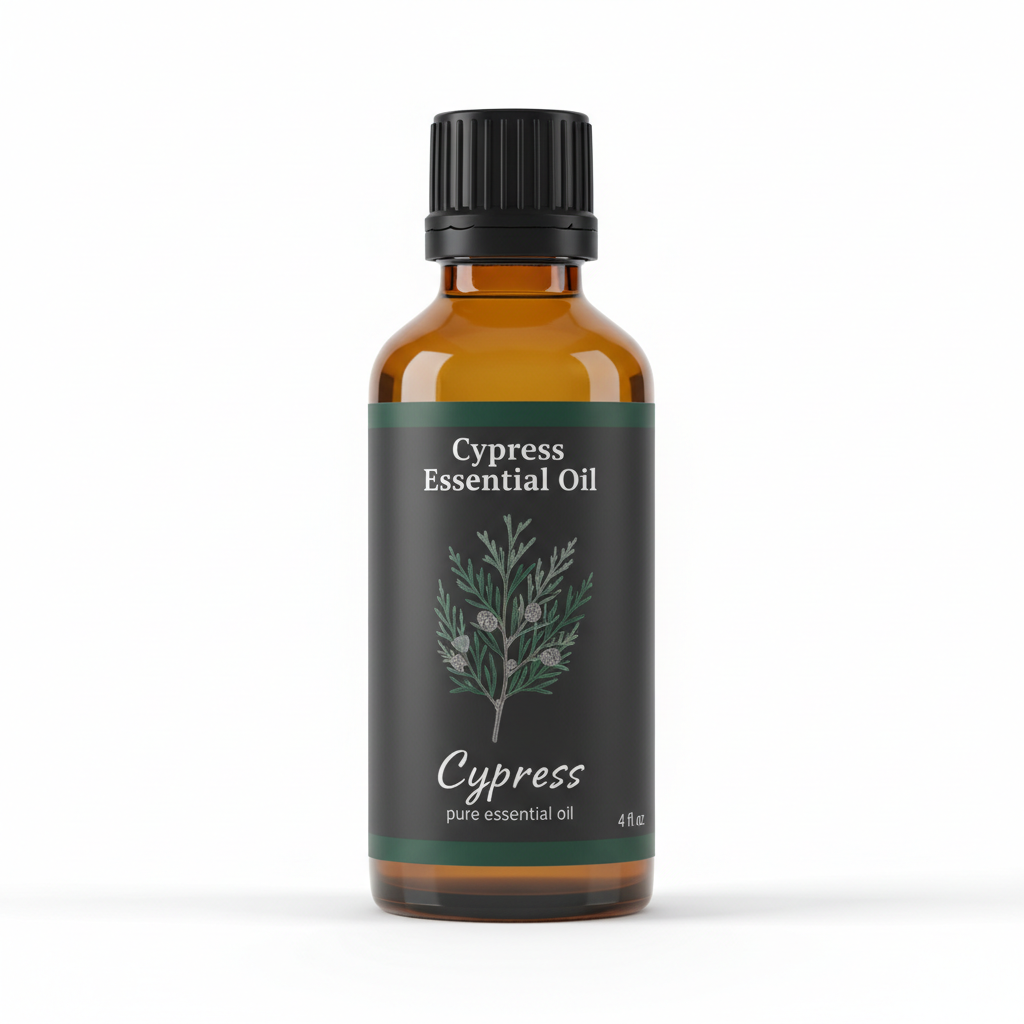
Cypress Essential Oil
Our own Cypress Essential Oil, in sizes from 0.5 oz to bulk.
From $10.99
Shop Now →Most people do this in reverse. They buy a bottle because a cosmetic label or a social post mentioned cypress oil for skin, and the first place they put it is their face. The face is the least forgiving place to learn. This guide walks the other way round: what the oil genuinely gives a routine, who should skip it, how to dilute it, how to patch test properly, and how to build up to facial use.
What cypress genuinely offers a skin routine
Three things, and they are modest.
A dry, clean scent. Cypress oil (Cupressus sempervirens) is steam-distilled from the foliage and small cones. Its aroma is mostly built from monoterpenes such as alpha-pinene and delta-3-carene, which read as woody, needle-green and slightly smoky rather than sweet or floral. In a body oil it smells like a forest path after rain, not like perfume. That is why it turns up in cologne and beard oil recipes as well as in simple skin blends.
A well-mannered aromatic. Used at the low dilutions below, in a plain carrier, cypress is not a demanding ingredient. It has no heavy fixative qualities, it does not turn a blend sticky, and it sits comfortably next to lavender, cedarwood, frankincense or a touch of bergamot-free citrus notes.
Ritual pleasure. Routines survive when they feel good. A two-minute arm-and-shoulder massage with a lightly scented oil after a shower is a routine people actually repeat. Some people report that a green, woodsy scent helps them slow down at the end of the day. That is a preference, not a promise.
Here is what it does not offer. No essential oil rewrites how skin renews itself, how much oil your glands produce, or how it ages. Claims that an oil will reshape skin tissue, change hair growth or rebuild the barrier belong in the myth pile. If a product page says otherwise, be skeptical of the whole page. Cypress oil in cosmetics is a fragrance and a ritual ingredient. The carrier oil and your basic care habits do the actual work of keeping skin comfortable.
The order most people get wrong
Buying cypress oil for the face first is the common mistake, and the reasoning is simple.
Facial skin is thinner, sits closer to the eyes and nose, and shows every reaction in public. Body skin (forearms, shoulders, calves, the backs of the hands) is thicker, easier to observe and easier to wash off. Using a diluted cypress blend on your body for a couple of weeks teaches you three things before you risk anything on your face: whether you tolerate the scent, whether your skin tolerates the oil, and whether the carrier you chose suits you.
Think of face use as a graduation, not an entry point. If you have not yet read how cypress behaves outside skin care, the complete guide to cypress oil uses at home and on skin gives the wider picture before you commit to a routine.
Skin-type suitability at a glance
| Skin type | Suitability | How to approach it |
|---|---|---|
| Oily | Fine at low dilution | Use a light, fast-absorbing carrier such as jojoba or squalane, stay at the low end of the range, and keep the blend to a few drops on a cotton pad or fingertip. Do not assume more oil means better results. |
| Dry | Fine in richer carriers | Blend into a heavier carrier such as sweet almond, marula or a little shea butter softened in oil. The carrier carries the comfort; cypress contributes scent. |
| Normal or combination | Fine | Follow the standard dilutions below. Use a different carrier for face and body if your T-zone and cheeks behave differently. |
| Sensitive or reactive | Approach with caution, or skip | Patch test twice, on separate days, and stay at 0.5 percent or less. If your skin reacts to scented products in general, an unscented carrier on its own is a reasonable and perfectly respectable choice. |
| Broken or freshly shaved skin | Skip | Wait until skin is fully intact. Essential oils absorb differently through damaged skin and are more likely to sting. |
If your skin runs oily and you want a full routine rather than a single blend, the cypress-focused oily-skin pieces on this site pair well with the dilutions here. The principle is the same: carrier first, scent second.
Face versus body dilution, with numbers
Dilution is the percentage of essential oil in the finished blend. Robert Tisserand and Rodney Young, in Essential Oil Safety (2nd edition), treat dilution and oxidation state as the main levers for keeping skin exposure sensible. Cypress is a comparatively gentle oil by their framework, but it is still a concentrated plant extract and still needs a carrier.
- Face: 0.5 to 1 percent.
- Body: 1 to 2 percent.
Roughly 20 drops make up one milliliter, though drop size varies by bottle. Use these as starting points:
| Dilution | Per 10 ml (about 2 tsp) | Per 30 ml (1 fl oz) |
|---|---|---|
| 0.5 percent (face, cautious) | 1 drop | 3 drops |
| 1 percent (face, standard; body, gentle) | 2 drops | 6 drops |
| 2 percent (body, upper limit) | 4 drops | 12 drops |
Resist the temptation to go higher because a blend smells faint. Cypress is a quiet scent on skin. If you want more aroma, add it to a diffuser instead; the Evergreen Stillness diffuser blend gives the room the volume your skin does not need.
What you need
- Pure cypress essential oil with the botanical name (Cupressus sempervirens) and a batch or distillation date on the label. If you want a single in-text pointer, our cypress oil range lists the botanical name and origin for every bottle.
- A carrier oil: jojoba, squalane, sweet almond or fractionated coconut.
- A 30 ml dark glass bottle with a dropper, washed and fully dry.
- Unscented soap and a clean towel.
- An adhesive bandage or a small square of gauze.
- A pen and a label, so you know the dilution later.
The 24-hour patch test, step by step
A patch test checks how your own skin responds to your actual blend before it goes anywhere visible. Do it with the real carrier at the real dilution you plan to use, not with the undiluted oil.
- Mix the blend you intend to use. For a first body blend, that is 6 drops of cypress in 30 ml of carrier (1 percent). Label the bottle with the date and the percentage.
- Prepare the spot. Wash a patch of inner forearm, roughly the size of a postage stamp, with unscented soap. Rinse and pat dry. The inner forearm has thin, protected skin, so it is a more useful test site than the back of the hand.
- Apply a small amount. Use a dab about the size of a lentil. Spread it thinly over the patch.
- Leave it alone for 24 hours. You can cover it with a bandage so clothing does not rub it off. Do not wash that spot. Do not apply anything else to it.
- Remove it at once if anything feels wrong. Itching, burning, warmth or visible redness means stop. Rinse first with plain carrier oil to dilute the blend, then wash gently with soap and water.
- Check at 24 hours. Look in daylight. Clear skin with no change in how it feels is a pass.
- Check again at 48 hours. Reactions to aromatic ingredients can show up late. If skin is still unchanged, the test is complete.
- Repeat when anything changes. A new bottle, a new carrier or a higher dilution is a new test.
If you take regular medication, are pregnant or nursing, or have a diagnosed skin concern, check with a qualified health professional before starting any new aromatic routine.
Building the routine: body first, face later
- Weeks one and two: body only. Apply the 1 percent blend to forearms or shoulders once a day, after a shower, while skin is slightly damp. Use about a teaspoon for both arms. Notice the scent, the feel of the carrier and whether your skin stays comfortable.
- Week three: widen the area. Add calves or the backs of the hands. If you want to step up to 2 percent for body use, mix a fresh bottle and patch test it again.
- Week four onward: decide about the face. If every earlier step went quietly, make a separate 0.5 percent bottle for the face (3 drops in 30 ml of carrier). Patch test it behind the ear or along the jawline edge for 24 hours.
- Apply to the face sparingly. Two or three drops of finished blend, warmed between fingertips and pressed on cheeks and forehead. Stay clear of the eyelids, lips and the skin directly beside the nostrils.
- Keep it occasional at first. Every second or third evening is plenty. A cypress oil face blend is an indulgence for the end of the day, not something your skin needs daily.
The phototoxicity question, answered once
Some essential oils make skin more reactive to sunlight. These are mainly expressed (cold-pressed) citrus oils such as bergamot, lemon and grapefruit, which contain furanocoumarins, compounds that absorb ultraviolet light on the skin. Steam-distilled oils generally leave those molecules behind. Cypress is steam-distilled and is not known as a phototoxic oil, and Tisserand and Young do not list it among the phototoxic ones. That distinction is why cypress is easier to place in a daytime routine than a bergamot oil would be.
It does not remove the need for ordinary sun habits, and a blend containing cypress plus a cold-pressed citrus oil would inherit the citrus oil's rules. Read every ingredient on a blend, not just the star.
Common mistakes
- Using it neat. Undiluted essential oil on skin is how most bad first experiences begin. Always blend.
- Skipping the patch test because the oil is "natural." Natural describes origin, not tolerance. Pine-family monoterpenes can be sensitizing once oxidized.
- Ignoring oxidation. Alpha-pinene and delta-3-carene react with oxygen on air contact, so a half-empty bottle ages faster than a full one. Oxidized oil is more likely to bother skin, and Tisserand and Young discuss this in their treatment of monoterpene-rich oils. Keep the cap tight, store it dark and cool, and replace an old bottle that smells sharp or turpentine-like rather than soft and green.
- Starting at the face. Covered above. It is the mistake this guide exists to prevent.
- Chasing stronger scent with more drops. The ratio is the safeguard. Use less carrier waste, not more oil.
- Using it on shaved or broken skin. Wait.
Who this is not for
If your skin reacts to most scented products, an unscented carrier oil is a better use of your money. If you want visible, measurable changes in how your skin behaves, a single essential oil is the wrong tool and no honest seller will tell you otherwise. And if you are looking for a daily-use staple, cypress is better as an occasional aromatic accent than as a foundation.
What to expect
Realistically, you may enjoy a clean, green aroma while you apply a carrier oil you were going to use anyway. Some people report that the scent helps them associate the end of the day with a slower pace. Some research suggests that scent can influence mood and routine, though results vary and cypress oil skin benefits are not established the way the benefits of a good carrier oil and consistent basic care are. What you should not expect is any change in how your skin works.
If the patch test passes, the body routine feels pleasant and the facial blend stays comfortable, you have a quiet, woodsy ritual that costs a few drops a week. That is a perfectly good reason to keep a bottle of cypress on the shelf.