
Cypress Essential Oil Benefits: What the Evidence Does and Does Not Show
What is cypress oil good for? Mostly its scent: a dry, green, conifer note that works in perfumery, grooming products, room scenting and massage blends. The research record is thin, made up of laboratory work on single compounds and a few small aromatherapy studies. The honest list of benefits is short, aesthetic, and still worth the bottle.
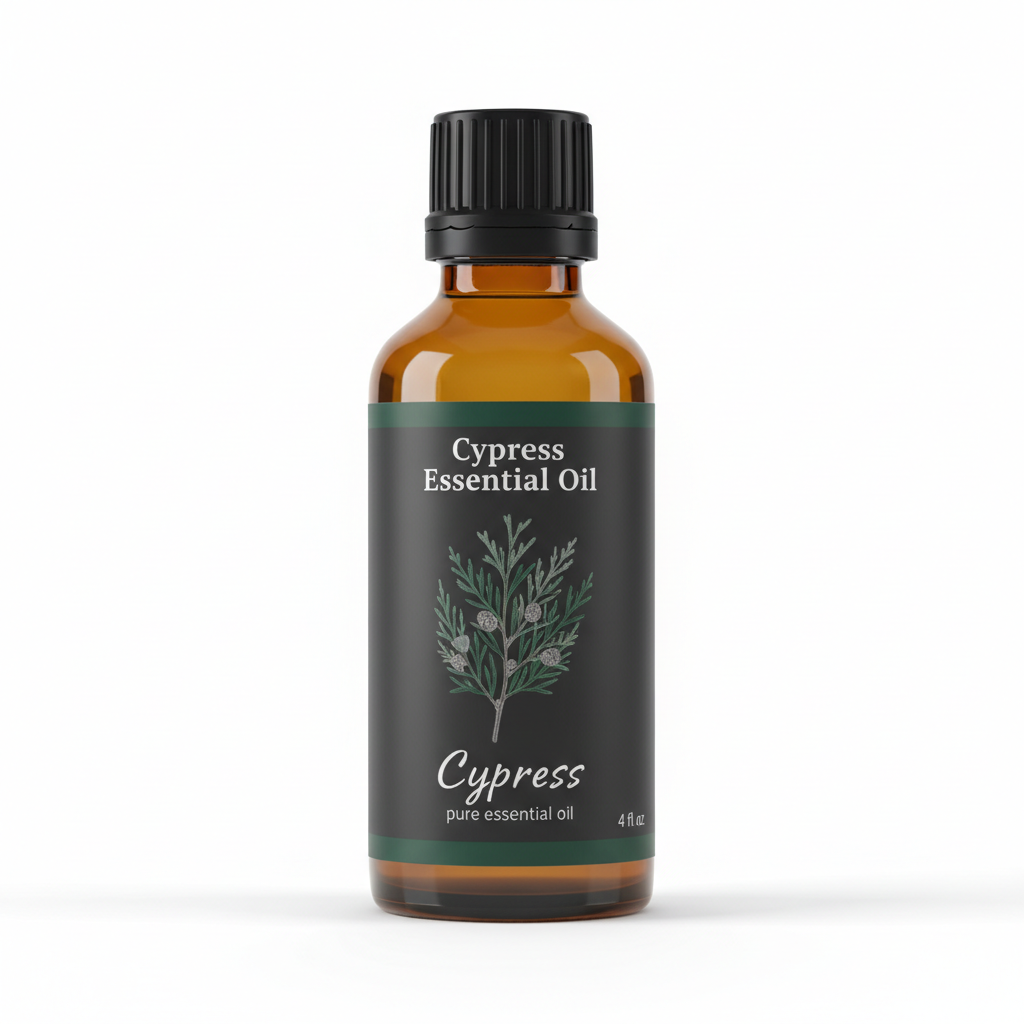
Cypress Essential Oil
Our own Cypress Essential Oil, in sizes from 0.5 oz to bulk.
From $10.99
Shop Now →Search for cypress oil benefits and you will find lists of fifteen or twenty. Read enough of them and a pattern shows up: the same sentences, lightly reworded, stacked up to make a product feel more important than a scent can be. We would rather give you the short version and show our working.
This article sorts what we can say into three tiers. First, what cypress oil is demonstrably good at. Second, what the research record actually consists of. Third, the claims you should ignore, wherever you see them. After that come safety and sourcing, because an honest evidence review is no use if the bottle you buy is old, mislabeled or misused.
Tier one: what cypress oil is genuinely good at
These benefits are aesthetic. They are also real, repeatable, and something you can check with your own nose in under a minute.
A distinctive dry green scent
Cypress oil is steam distilled from the needles and twigs of Cupressus sempervirens, the tall Mediterranean cypress. The result smells like a conifer, but a drier and quieter one than pine or fir: resinous, green, faintly smoky, with a woody tail that lingers after the sharper top has gone. Our guide to what cypress essential oil smells like walks through the stages of the scent in detail.
That character is the single most useful thing about it. Most of the oil is made of light, fast-evaporating monoterpenes, so it tends to sit in the top of a blend and lift it, while the minor heavier components leave a dry woody finish. Reasoning from that chemistry, it makes sense that cypress keeps sweet florals and vanilla-leaning bases from turning cloying.
Behaves well in perfumery and grooming products
Perfumers and small-batch makers reach for cypress because a little of it supplies structure. In beard oils, balms, bar soaps and solid colognes, it provides the green, outdoorsy backbone that other materials can sit against. It also tends to pair comfortably with citrus peels, juniper, cedarwood, bergamot and lavender, which makes it forgiving for anyone building a first blend.
A room-scenting note that reads as outdoors and stillness
In a diffuser, cypress reads as a walk under tall evergreens, not a bakery or a spa. A few drops in a hallway, a bathroom or a quiet reading corner give the room a clean, resinous, slightly stern atmosphere. That is a matter of association and taste, not a physiological claim. If you like the smell of conifers, you will likely like this. If you do not, no research will change that.
A pleasant massage-blend component
Diluted in a carrier such as sweet almond or jojoba, cypress adds a dry, green note to a massage blend, and the scent can be part of why a ritual feels like a pause in the day. The pleasure is in the aroma and the unhurried touch. Dilution rules matter here, and we cover them in our guide to cypress oil safety, dilution and patch testing.
Scent, perfumery, room atmosphere and a pleasant blend component. That is tier one, and it is enough.
What is actually in the bottle
Before the research, the chemistry, because every laboratory finding discussed below is about a compound, not about a bottle of oil.
PubChem, the open chemistry database run by the US National Library of Medicine, describes alpha-pinene and delta-3-carene as bicyclic monoterpenes, both with the formula C10H16. They are close structural relatives, volatile and aromatic, and they are the molecules most responsible for the piney, resinous character of cypress. Our deeper piece on alpha-pinene and delta-3-carene covers how each one smells and behaves.
| Compound | Class | Aroma contribution |
|---|---|---|
| Alpha-pinene | Bicyclic monoterpene | Fresh, resinous, pine-like |
| Delta-3-carene | Bicyclic monoterpene | Sweet, earthy, slightly sharp |
| Limonene | Monocyclic monoterpene | Bright, citrus-peel lift |
| Myrcene | Acyclic monoterpene | Green, herbal |
| Terpinolene | Monocyclic monoterpene | Fresh, piney-sweet |
| Cedrol | Sesquiterpene alcohol | Dry, woody tail (minor) |
Two cautions on that table. First, proportions vary with the growing region, the season, which part of the plant was distilled, and how the distillation was run, so no honest source can give you one fixed recipe for cypress oil. Second, a minor component is not a throwaway one. A small share of a heavier molecule can shape how long a scent lasts on a blotter.
The practical consequence: the only way to know what is in your bottle is a batch-specific gas chromatography report, which we return to in the sourcing section.
Tier two: what the research record actually consists of
This is where most benefit lists get slippery. They take a finding about a molecule in a dish and describe it as a property of a bottle on your shelf. Here is what the record is made of, in plain terms.
Constituent-level laboratory work
Laboratory studies have examined monoterpenes such as alpha-pinene in cell cultures and other controlled systems, observing how isolated compounds behave under defined conditions. That is real science, and it is how chemists learn what a molecule does. But it answers a narrow question. A purified compound at a set concentration in a dish is not the same thing as a diluted whole oil on skin, and it is certainly not the same as a few drops in the air of a living room.
Reasoning from the chemistry, the amount of any single compound reaching you from a diffuser is small and varies with room size, ventilation and how long the device runs. Concentrations used in laboratory work are chosen for the experiment, not to mimic a bedroom.
So when you read that cypress oil 'contains alpha-pinene, which has been studied,' both halves of the sentence can be true while the implied conclusion remains unsupported.
Small aromatherapy studies with real limitations
Small studies have also explored how people respond to inhaled or massaged aromas, sometimes including cypress alone or inside a blend. These are worth knowing about and worth reading with care, because aromatherapy research faces problems that are hard to engineer away:
- Blinding is difficult. Participants can smell what they are given, so expectation can shape what they report.
- Samples are small. A handful of participants can produce a result that does not repeat.
- Blends blur the picture. When several oils are used together, nothing can be credited to one of them.
- Outcomes are self-reported. Feelings are real, but they are hard to separate from the setting, the attention and the ritual.
- Materials are inconsistent. Studies often do not publish the composition of the oil used, which makes comparison difficult.
The National Center for Complementary and Integrative Health (NCCIH), part of the US National Institutes of Health, characterizes aromatherapy research overall as limited. That is the most useful single sentence to carry into any conversation about cypress oil, because it comes from a public body with no product to sell.
What is missing
As far as we can responsibly point to, there are essentially no large clinical trials behind the popular online claims about cypress oil. The gap matters. A large, well-designed trial is what it takes to move a statement from 'an interesting observation' to 'something we can reasonably expect.' Without that, the careful phrasing is the accurate phrasing: some laboratory work has looked at the compounds, some small studies have explored aromas, and the overall picture remains open.
Tier three: claims to ignore
Any page that promises cypress oil will fix a specific medical problem is overstating the evidence. Full stop. There is no study we know of that supports such a promise, and the phrasing of the claim usually gives it away: confident verbs, no named source, no mention of limits.
There is also a legal point worth stating plainly. In the US, a product sold as a cosmetic cannot legally make those claims at all. Once a seller says a product will change how the body functions or resolve a medical problem, regulators consider it a drug, with all the obligations that follow. A seller who makes such claims about an essential oil is either unaware of the rule or hoping you are.
A few signs that a page is reading marketing back to you:
- It lists twenty or more benefits for a single oil, with no sources for any of them.
- It says 'studies show' without naming a study, a population or a limitation.
- It treats a finding about one compound as a finding about the whole oil.
- It suggests the oil can stand in for care from a professional.
- It recommends swallowing the oil or applying it undiluted.
We hold ourselves to the same standard. If a benefit cannot be checked by your nose or defended by a named source, it does not go on our list.
Safety: who should go slowly or skip it
The standard reference here is Robert Tisserand and Rodney Young, Essential Oil Safety (2nd edition). It is the book we point people to, and its guidance is more conservative and more specific than most websites.
- Skin: Always dilute in a carrier before applying, and patch test first: a small dab of the diluted blend on the inner forearm, left for a full day. Keep it away from eyes and mucous membranes. Our safety guide gives the dilution details.
- Oxidation matters: Alpha-pinene and delta-3-carene react readily with oxygen. Tisserand and Young discuss how oxidized monoterpene oils are more likely to irritate skin than fresh ones. Because the reaction starts on air contact, a half-empty bottle ages faster than a full one. That is reasoning from chemistry, not a measurement from our shelf, but it is a good reason to buy smaller bottles and cap them tightly.
- Swallowing: Essential oils are not for internal use. If a child or an adult swallows any, call US Poison Control at 1-800-222-1222 right away.
- Pets: The ASPCA Animal Poison Control Center advises caution with essential oils around animals, and cats are widely considered especially sensitive. Never apply cypress oil to an animal. If you diffuse, ventilate the room, keep sessions short and make sure the animal can leave. Ask your veterinarian if you are unsure.
- Special circumstances: If you are pregnant or nursing, using oils with young children, or under the care of a clinician, ask a qualified professional before using any essential oil.
Sourcing and quality indicators
Because the scent is the whole benefit, quality is the whole game. Here is what a careful buyer can check.
- The botanical name on the label. Look for Cupressus sempervirens. 'Cypress' alone is vague. Other plants share the common name, and 'blue cypress' is a different oil from a different tree entirely.
- The plant part and the method. Needles and twigs, steam distilled, is the usual description. A seller who cannot tell you is not paying attention.
- A batch-specific GC/MS report. Gas chromatography with mass spectrometry lists what is in the oil. You are looking for alpha-pinene and delta-3-carene near the top of the list, alongside the minor compounds in the table above. A generic report with no batch number tells you little.
- Price that makes sense. A bottle that costs far less than its peers invites a reasonable question: has it been stretched with other conifer oils or isolated pinene? We cannot know from outside the bottle, but we can ask.
- Packaging. Dark glass, a proper cap, and a dropper insert protect the oil from light and air.
- Your nose. Fresh cypress oil smells dry, green and resinous. A harsh, solvent-like or turpentine edge suggests age or oxidation.
If you are ready to compare, our shop lists the oils we carry with their botanical names and batch details.
Who this is not for
Cypress oil is the wrong purchase if you want a fix for a medical problem. It will not be one, and the right move there is a conversation with a qualified clinician. It is also the wrong purchase if you are after a sweet, floral or gourmand scent, because cypress is resolutely dry and green. And it is a poor fit for anyone who plans to diffuse around cats in a small closed room.
What commonly goes wrong is predictable: putting the oil on skin undiluted, leaving the cap loose so the bottle oxidizes, buying something labeled only 'cypress' and hoping for the best, and expecting a diffuser to do more than scent a room. Each is avoidable.
The short list, stated plainly
Cypress essential oil offers a distinctive dry green scent, a useful structural note in perfumery and grooming products, an outdoorsy atmosphere for a room, and a pleasant component in a diluted massage blend. Those are the benefits. The research record around the oil is limited, which is why we describe it with care, and why you should be wary of anyone who does not. For a fuller picture of how people use it day to day, read our complete guide to cypress oil uses, and for the basics of the plant itself, start with what cypress essential oil is.
A short, honest list is still worth a bottle. If you have questions about whether an oil suits your circumstances, ask a qualified clinician before you buy.