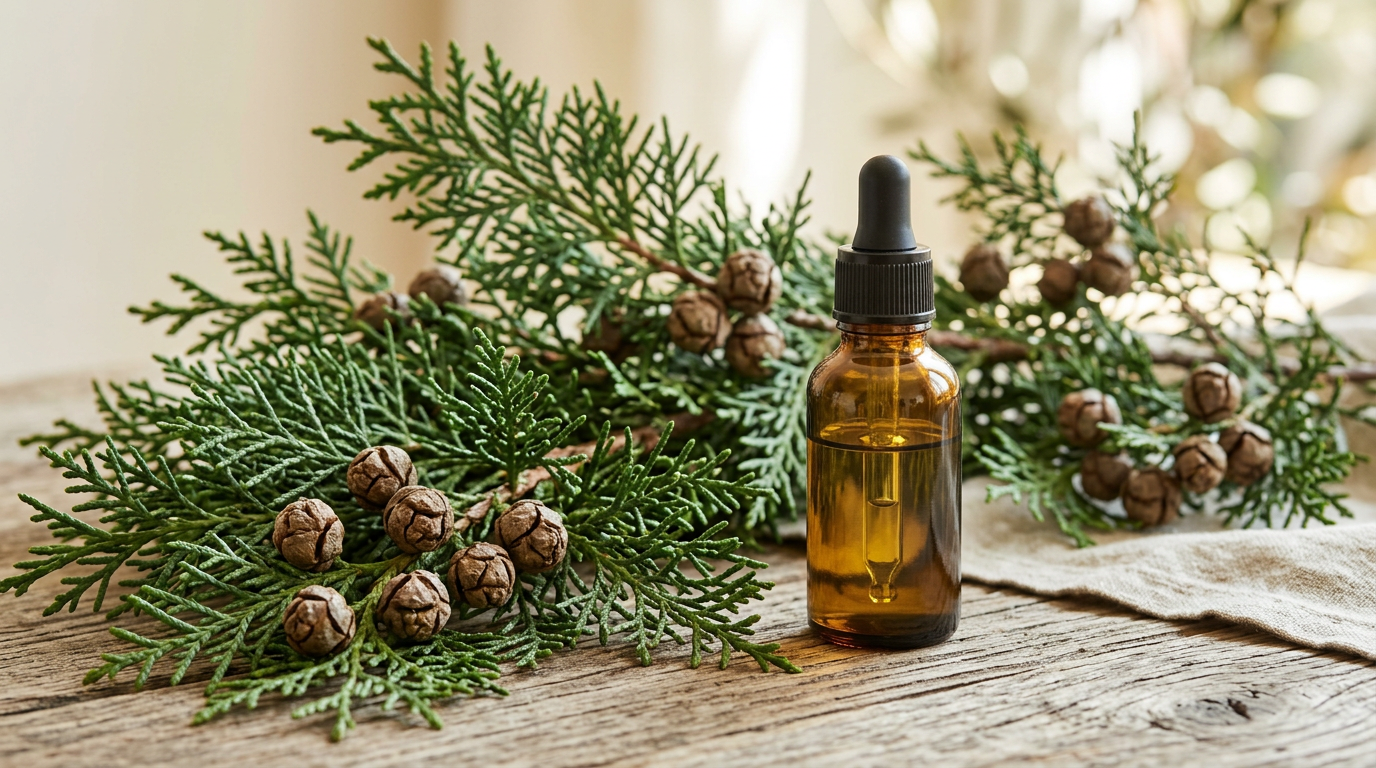
Alpha-Pinene and Delta-3-Carene: The Molecules Behind Cypress Oil
Cypress essential oil smells the way it does because of a short list of small molecules. Alpha-pinene gives the bright, dry, pine-fresh opening. Delta-3-carene adds a sweet resinous dryness. Limonene lifts the top with a citrus edge, and cedrol lingers as a soft woody trace. Most of what you read about cypress oil chemistry beyond that is decoration.
Cypress Essential Oil
Our own Cypress Essential Oil, in sizes from 0.5 oz to bulk.
From $10.99
Shop Now →The one-paragraph version for a buyer
Product pages tend to recite constituent lists the way people recite incantations: alpha-pinene, delta-3-carene, limonene, cedrol, a few more Latin-sounding names, and an implied promise that the list proves quality. It does not. A list of names tells you what molecules exist in cypress oil in general, not what is in the bottle you are holding.
Two facts are worth your attention when you buy:
- Is the chemical fingerprint consistent with genuine cypress? That is a question about the overall pattern of compounds, not about any single number.
- How fresh is this batch? Cypress oil is dominated by molecules that react with air, so age and storage change what is in the bottle.
Everything below explains why those two questions carry the weight, and why the rest is numerology.
What is in cypress oil, in plain terms
Cypress essential oil is most often steam-distilled from the foliage and twigs, and sometimes the small cones, of Cupressus sempervirens, the tall, narrow Mediterranean cypress. Distillation captures the plant's volatile aromatic molecules. Those molecules fall mostly into two families:
- Monoterpenes are built from ten carbon atoms (C10H16 for the hydrocarbon types). They are light, evaporate quickly, and make up most of the oil's top and middle notes. Alpha-pinene, delta-3-carene, and limonene belong here.
- Sesquiterpenes and their oxygenated cousins have fifteen carbons. They are heavier and slower to evaporate, and they shape the dry-down. Cedrol, a sesquiterpene alcohol (C15H26O), belongs here.
PubChem, the open chemistry database run by the US National Library of Medicine, is the cleanest place to confirm what each of these compounds is. Its entries give structures, formulas, and physical properties, so you can check any name on a label or lab report against a neutral reference instead of taking a seller's word.
One honest caveat before the profiles. Published analyses of cypress oil show ranges that differ by growing region, harvest timing, plant part, and distillation conditions. Even within one producer, batches vary. For that reason this article gives no percentages for any compound. A tidy number in a blog post would be false precision. The honest source of batch numbers is the GC/MS report for the specific lot, and there is a section on reading one further down.
The principal constituents, one at a time
Alpha-pinene: the dominant note
In published analyses of Cupressus sempervirens oil, alpha-pinene is generally reported as the leading constituent. If you search for alpha pinene cypress oil, this is the molecule that dominates the results, and it dominates the aroma too. Its smell is bright, dry, and pine-fresh, the first thing you register when you open the bottle.
Alpha-pinene is a bicyclic monoterpene, and it is volatile: its boiling point sits around 155 degrees Celsius, which is why it leads the opening and fades first on a scent strip. It also occurs in rosemary, juniper, pine needles, and the resin of many conifers, so it is common across the plant world. That matters for a reason covered below: pinene is easy to find and cheap, so a high pinene reading cannot prove an oil is cypress.
Alpha-pinene also exists as two mirror-image forms, often written (+) and (-). Their ratio varies by plant species and origin, and some analysts look at it as part of a fingerprint. For most buyers this is an advanced detail. It is worth knowing only because it explains why two oils with similar pinene numbers can still smell slightly different.
Delta-3-carene: the signature dryness
Delta-3-carene (often written 3-carene) is the compound that most separates cypress from a generic pine scent. It is sweet and resinous, with a dry, faintly earthy edge. Alongside alpha-pinene it forms the backbone of cypress's characteristic dry, woody-green profile.
Carene is one reason cypress smells drier and less sharp than a pure pinene oil would. It is also a useful marker. In published analyses of genuine cypress, carene is typically one of the leading constituents, usually reported second to alpha-pinene. An oil with a strong pinene signal and a missing or tiny carene signal is a pattern worth questioning.
Carene is also part of the safety story. Robert Tisserand and Rodney Young, in Essential Oil Safety (2nd edition), discuss delta-3-carene as a compound whose oxidation products are linked to skin sensitization. This is the chemistry that connects scent, shelf life, and skin comfort, and it gets its own section below.
Limonene: a citrus-edged lift
Limonene is the molecule most people already know, from citrus peel. In cypress oil it appears in a smaller role than in an orange or lemon oil, but it still contributes. It adds a faint citrus-edged lift to the top of the scent and softens the severity of the pinene.
Limonene has a higher boiling point than alpha-pinene (roughly 176 degrees Celsius), so it hangs on a little longer. It is also prone to oxidation, and oxidized limonene is among the better-documented skin sensitizers in essential oil safety literature. A fresh cypress oil with a faint lemony brightness is behaving as expected. One that smells flat, sharp, or like turpentine is hinting that these molecules have been reacting with air.
Cedrol: the quiet woody presence
Cedrol is a crystalline sesquiterpene alcohol, solid at room temperature, which also appears in cedarwood oils. In cypress oil it is a minor player in volume, but it earns a place in the conversation because of what it does to the dry-down. As the light monoterpenes evaporate, the scent that remains is softer, woodier, and warmer, and cedrol is one of the molecules that holds that base together.
Reported cedrol levels in cypress oil differ more between analyses than the headline monoterpenes do. Some distillations and plant parts carry noticeably more of the heavier fraction than others. Treat cedrol as a clue about the oil's lower register rather than a number to chase.
The supporting cast
Published analyses of cypress oil also commonly list terpinolene, alpha-terpinyl acetate, germacrene D, and other sesquiterpenes, among others. Their presence and proportions vary, which is part of why a complete GC/MS table looks different from lot to lot. These compounds shape nuance. They are rarely the reason to buy or reject a bottle.
A quick reference table
| Compound | Type | What it contributes to the aroma | Where it sits in the scent |
|---|---|---|---|
| Alpha-pinene | Monoterpene (C10H16) | Bright, dry, pine-fresh | Opening and heart |
| Delta-3-carene | Monoterpene (C10H16) | Sweet, resinous dryness | Heart |
| Limonene | Monoterpene (C10H16) | Citrus-edged lift | Top note |
| Cedrol | Sesquiterpene alcohol (C15H26O) | Soft, woody warmth | Dry-down |
The table has no percentage column on purpose. Anyone who gives you a single fixed percentage for each compound in cypress oil is describing one sample at best, and a guess at worst.
Why a constituent list proves less than it appears to
This is the common misconception worth correcting. A marketing page that lists alpha-pinene, delta-3-carene, limonene, and cedrol looks like evidence of authenticity. It is only evidence that the writer knows what cypress oil is supposed to contain.
Consider how little a name list can tell you:
- Alpha-pinene is abundant in many cheaper conifer oils and in turpentine fractions. A pinene-heavy result fits genuine cypress and fits a cheaper stand-in equally well.
- Because the major compounds are shared across several conifer oils, authenticity rests on the full pattern: which compounds appear, in what rough relationship, and which minor markers show up alongside them.
- A list with no batch, date, or lab attached describes the species in general. It does not describe the contents of the bottle.
The position of this guide is simple. Ignore constituent numerology, the habit of treating each percentage as a score to maximize. Cypress oil is not better because one compound is higher. It is better when the whole fingerprint fits cypress and the oil has not degraded.
Fact one: does the fingerprint fit genuine cypress?
A GC/MS report (gas chromatography with mass spectrometry) is the document that answers this. The instrument separates the oil into its component compounds and identifies each one, producing a table of names, retention times, and relative amounts for that specific lot.
You do not need to be a chemist to scan one sensibly. A few practical checks:
- Look for the pattern, not a single peak. Alpha-pinene should be prominent, delta-3-carene should be clearly present, and limonene and terpinolene-type compounds should appear in supporting roles. Cedrol and other sesquiterpenes should appear toward the later part of the table.
- Match the lot. The report should carry a batch or lot identifier that matches the one on your bottle, along with a date. A generic report for the product line is a species profile, not a quality check.
- Check the botanical name and part. The report should name Cupressus sempervirens and ideally the plant part and origin. Vague reports often accompany vague sourcing.
- Watch for an unusual dominant compound. A heavy reading for something that is not a normal cypress constituent suggests blending or substitution.
- Treat missing detail as information. A report that lists only the top two or three compounds hides most of the fingerprint.
One trade-off to state plainly: GC/MS shows what is present and in what proportion. It does not say whether the plant was grown with care, whether the distillation was gentle, or whether the seller is honest about origin. It is strong evidence about identity and weak evidence about everything else. Reputable producers pair the report with transparent sourcing details such as country, plant part, and distillation date.
Fact two: how fresh is the batch?
This is where cypress chemistry has a practical consequence. The molecules that define cypress's scent are monoterpenes, and monoterpenes react with oxygen.
What oxidation does, at reader level
When alpha-pinene, delta-3-carene, and limonene meet air, light, and warmth over time, they undergo autoxidation. They gradually pick up oxygen and convert into new compounds. For pinene, those products include pinene hydroperoxides. Oxidized limonene and oxidized carene form comparable hydroperoxide products.
Two things change as a result:
- The scent. The bright, clean pine-fresh opening gives way to something harsher, closer to turpentine or old varnish. The dryness turns sharp rather than smooth.
- The skin profile. Tisserand and Young's Essential Oil Safety documents oxidized monoterpenes, including oxidized pinene, carene, and limonene, as skin sensitizers. Fresh oil and aged oil are not the same material for skin contact.
This is the reason that storage advice is not fussiness. If you keep cypress oil in clear glass on a sunny shelf with the cap loose, you are speeding the very reaction that damages the scent and raises the sensitization concern. Dark glass, a tightly closed cap, and a cool, steady location slow it down.
The half-empty bottle problem
Here is reasoning from the chemistry, not an observation: the air trapped inside a bottle is a supply of oxygen. A nearly full bottle has little headspace, while a bottle that is mostly empty has a lot. Because alpha-pinene oxidizes readily on air contact, a half-empty bottle should age faster than a full one. Buying a size you will actually finish, or decanting the remainder into a smaller dark bottle, follows directly from that logic.
Reading freshness from the evidence you have
- Dates. Look for a distillation or batch date on the report and the bottle. Treat an undated oil as an unknown.
- Smell. Fresh cypress is dry and clean with a citrus-edged top. A harsh, solvent-like, or stale note suggests degradation. Smell is a screening tool, not proof, so combine it with the dates.
- Peroxide testing. Some suppliers report a peroxide value, which is a direct measure of early oxidation products. It is not universal, but when it is offered, it speaks to freshness better than a constituent list can.
- Packaging. Dark glass with a tight closure is the minimum. Clear or plastic containers are a poor sign for an oil rich in reactive monoterpenes.
Safety profile and who should be careful
Cypress oil is concentrated plant material, and its main constituents are the kind that can irritate skin or sensitize it, especially when oxidized. Some sensible habits follow from that.
- Dilute before it touches skin. Use a carrier oil and follow the dilution guidance in a reference such as Tisserand and Young's Essential Oil Safety. Never apply undiluted oil.
- Patch test first. Apply a small amount of the diluted blend to a small area, such as the inner forearm, and wait a full day before wider use. Stop at any sign of irritation.
- Use fresh oil for skin. Because oxidation products are the documented concern, an old bottle with a harsh smell is better used as a room scent or retired than applied to skin.
- Keep it out of the mouth. This guide covers aromatic and cosmetic use only. Do not swallow essential oils.
- Be careful around children and pets. Cats and dogs process aromatic compounds differently from people. The ASPCA Animal Poison Control Center and US Poison Control both publish guidance, and a call to them is the right step if an animal or child has contact with undiluted oil. Keep bottles and diffusers out of reach.
- Ask a qualified professional if your situation is not routine. If you are pregnant, nursing, taking medication, or under a clinician's care, consult a qualified health professional before using any essential oil. Nothing here replaces that advice.
What research can and cannot tell you deserves a plain statement as well. Some laboratory studies have examined the aromatic constituents of cypress oil and its main monoterpenes, and some research suggests these compounds are active in test-tube settings. Those results do not translate into claims about what a bottle of oil does for a person at home, and this guide makes none. The chemistry here is offered to help you judge scent, identity, and freshness.
Sourcing and quality indicators that actually mean something
Once the chemistry is clear, a good sourcing page is easy to recognize because it contains specifics a casual seller would not bother to supply.
- Full botanical name. Cupressus sempervirens, not just "cypress." Several unrelated trees carry the common name.
- Country or region of origin and plant part. Foliage and twigs are typical. Vagueness here usually means the seller does not know.
- Method. Steam distillation is the standard for this oil. Any additions, dilution, or fragrance blending should be stated, not hidden.
- A lot-specific GC/MS report. Matching the batch number on the bottle, dated, and showing the full constituent table.
- Dark glass and a closure meant to be tight.
- Realistic pricing. Cypress is not among the most expensive oils, so a bargain price is not by itself alarming. An unusually low price paired with a missing report is.
The trade-off is real: lot-specific testing costs a producer money, and small distillers may not always publish a full report. If a report is missing, ask for one. A seller who can answer questions about origin, distillation date, and constituents in plain language is giving you a signal, and one who deflects with adjectives is giving you a different one.
Who this approach is not for
If you want a single score that ranks cypress oils from best to worst, the chemistry will disappoint you. No one compound's percentage makes an oil superior, and ranking bottles by their alpha-pinene figure is exactly the numerology this guide argues against. If you want an oil to make claims about the body, this is also the wrong place, because chemistry observations are not benefit statements.
The approach suits people who enjoy knowing why a bottle smells the way it does, who want to read a lab report without being intimidated by it, and who would rather buy a fresh, honestly sourced oil than a famous one.
Common mistakes
- Treating a constituent list as a certificate. A list of names is a description of the species, not proof of the batch.
- Chasing the highest pinene number. Pinene is abundant in cheaper conifer oils, so a high figure is not a mark of cypress.
- Ignoring the date. A flawless report for a batch distilled years ago says little about what the oil is today.
- Storing in the wrong place. The bathroom shelf and the sunny windowsill are both hard on monoterpenes.
- Using old oil on skin. A harsh, stale smell is a reason to retire a bottle from skin use.
Putting the chemistry to use
Next time you look at a cypress oil listing, run a two-question check. Does the report, with its batch number and date, show a fingerprint where alpha-pinene leads, delta-3-carene sits clearly alongside it, and limonene and cedrol appear in their quieter roles? Then: how old is this lot, and how has it been stored? If both answers are clear, the rest of the molecule trivia can stay trivia.
The scent itself is the reward. Bright pine-fresh pinene, a sweet resinous carene backbone, a citrus-edged lift from limonene, and a soft woody trace of cedrol: that is cypress oil as the chemistry describes it. A bottle that matches that description and has been kept well will smell like it.