
French vs Mediterranean Cypress Oil: How Origin Shapes Quality
French cypress oil carries a reputation for finesse, Spanish and Moroccan oils for supply and value, and all three come from the same species, Cupressus sempervirens. Origin nudges the chemistry batch by batch, but it does not guarantee it. A careful Moroccan distillation beats a careless French one every time.
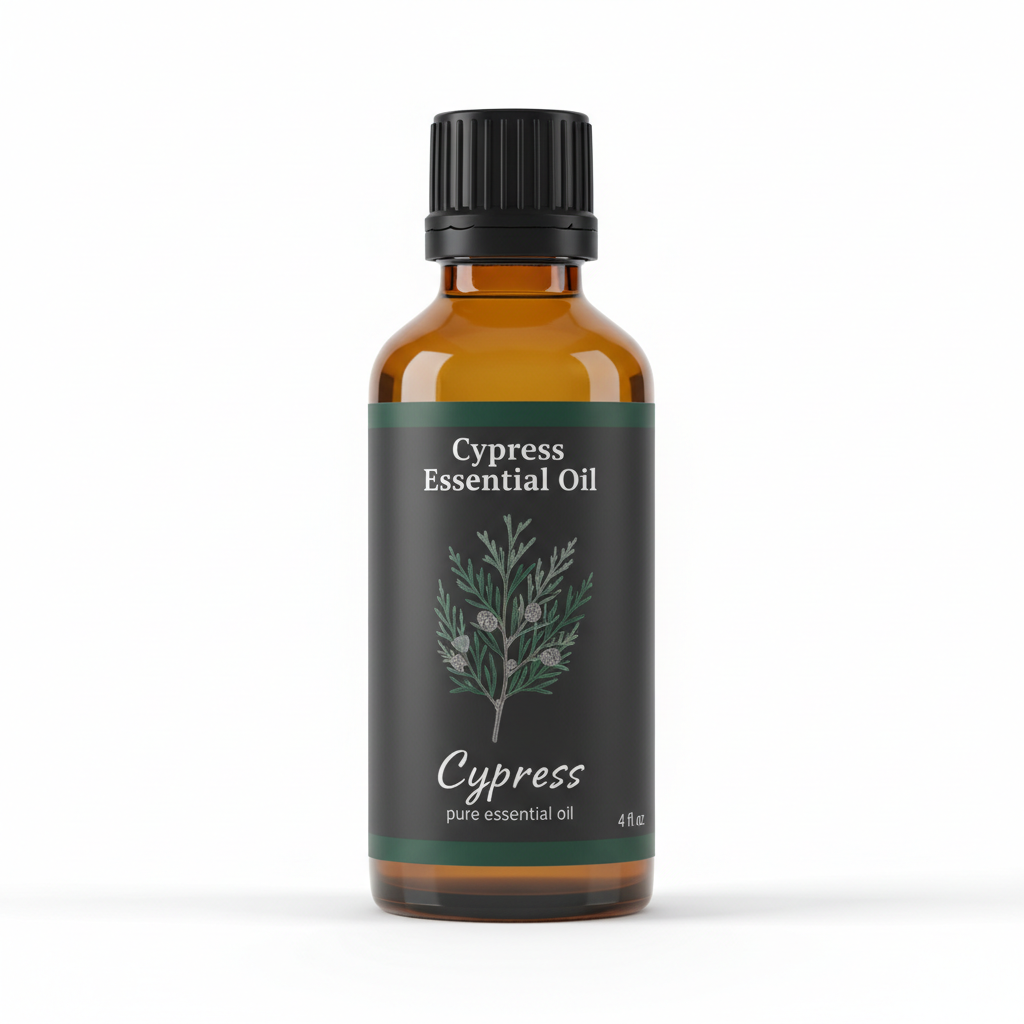
Cypress Essential Oil
Our own Cypress Essential Oil, in sizes from 0.5 oz to bulk.
From $10.99
Shop Now →Where does cypress oil come from?
Almost all commercial cypress essential oil is steam-distilled from the foliage, twigs and sometimes the small cones of Cupressus sempervirens, the tall, narrow Mediterranean cypress. The tree is native to the eastern Mediterranean and has been planted for centuries as a windbreak, a boundary marker and a cemetery tree across the whole basin. That planting history is why the oil has no single home.
Three origins appear on bottles most often:
- France: the south, including Provence and the Mediterranean coast, where cypress hedges and small distilleries sit close together.
- Spain: the origin behind much of the Spanish cypress oil sold in bulk, drawn from plantings and managed stands.
- Morocco: a steady source of Moroccan cypress oil, often supplied through larger regional distillers.
Smaller lots come from elsewhere around the basin, Crete among them. Treat any of these as a place of harvest, not a quality grade. A country name tells you where the foliage was cut. It says very little about how it was handled afterward.
What origin actually changes (and what it does not)
Here is the widespread misconception: that a country of origin fixes an oil's character. It does not. Cypress oil is led by monoterpenes, mainly alpha-pinene and delta-3-carene, with smaller amounts of compounds such as cedrol, limonene, terpinolene and myrcene. The balance among them shifts for four documented reasons.
- Climate and season. Heat, rainfall and the year's growing conditions influence how much volatile material the foliage holds when it is cut.
- Altitude and site. Trees on a dry coastal slope and trees in a sheltered inland valley are not growing under the same stresses.
- Harvest window. Fresh twigs distilled within a day behave differently from foliage that sat in a pile for a week. Cutting early or late in the season can also move the balance.
- Still practice. Steam pressure, run time and how the charge is packed affect which fractions come over and how much heat they see.
Notice that three of the four are about people, not geography. Even the first two vary between neighbouring hillsides. So the honest summary is that regional tendencies exist, they are real, and they are smaller and less consistent than origin marketing suggests. Where a seller quotes a neat percentage gap between French and Moroccan oil, be skeptical. No such fixed gap exists to quote.
French vs Spanish vs Moroccan cypress oil at a glance
This table describes trade reputation and typical buying conditions. It is a starting point for questions, not a prediction of any bottle.
| Attribute | French cypress oil | Spanish cypress oil | Moroccan cypress oil |
|---|---|---|---|
| Trade reputation | Prized by aromatherapy buyers for a fresh, green-woody profile | Dependable workhorse for general use and blending | Common in value-oriented lines |
| Scale of supply | Smaller lots, more variable year to year | Larger and steadier | Larger and steadier |
| Typical price position | Usually highest | Mid-range | Usually lowest to mid |
| Traceability | Often a named distillery or estate | Varies: single distiller or aggregated lots | Varies: often aggregated lots |
| Batch consistency | Can swing with the season | Tends to be steadier across batches | Tends to be steadier across batches |
| Difference in scent | Small and inconsistent. Batch and distillation matter more than country. | ||
French cypress oil: pros and cons
Searches for "cypress french essential oil" usually come from buyers who have been told French is the standard. Sometimes that is justified.
Pros
- Smaller producers often name the distillery, the commune or the harvest year, which gives you something to verify.
- Short supply chains mean less time between cutting and distilling.
- Many aromatherapy buyers prefer its cleaner, greener top note, though that is a preference and not a measured rule.
Cons
- Price. Small lots and French labour costs show up on the shelf.
- Availability swings with the harvest, so a favourite batch may not return.
- "French" is sometimes applied loosely. A bottle packed or labelled in France is not necessarily grown or distilled there.
Spanish and Moroccan cypress oil: pros and cons
Pros
- Larger volumes give more stable supply, so a brand can offer the same oil for years.
- Lower prices make them practical for diffusion blends, room sprays and body-care formulas where you use a lot.
- Established distilling infrastructure means well-run producers can document their lots thoroughly.
Cons
- Aggregated lots from several distillers are common, which blurs the harvest story.
- At the cheapest end, rushed distillation and stretched stock are a bigger risk, and the country name will not warn you.
- Some buyers find the aroma a touch flatter or more resinous. That is anecdotal, and it flips from batch to batch.
Why origin still matters in practice
If origin only nudges chemistry, why care? Because it works as an operational signal, even where it is a weak aromatic one.
- Traceability. A specific country lets a seller point to a supplier, and a supplier can be questioned. "Mediterranean" cannot be audited by anyone.
- Harvest practice. Knowing the region tells you the cutting season and typical lead time to the still, which are the variables that do move the oil.
- Supply stability. A brand sourcing from Spain or Morocco can usually restock the same oil. A brand tied to one French estate may sell out and substitute.
Origin is an input into your decision, not the verdict. The verdict comes from documents.
What a trustworthy origin claim looks like on a label
Compare these two lines:
- Weak: "Mediterranean-inspired cypress blend." This describes a mood, not a source.
- Strong: "Cupressus sempervirens, foliage, steam-distilled, Spain, distilled March 2026, batch 26-031."
The strong version has the botanical name, plant part, method, a specific country, a date and a batch number you can match to paperwork. Anything less specific should raise questions. Wording such as "French-style" or "Provençal blend" is also not an origin claim.
The paperwork is where quality is actually decided. A certificate of analysis with a GC/MS report shows the real constituent profile of that batch, which no origin story can. Our complete cypress buyer's guide explains how to read one, and the first-order checklist lists what to ask a seller before you pay. If a seller names a country but cannot produce a batch report, you are buying a story.
Freshness matters as much as geography
This is reasoning from chemistry, not a bench result. Alpha-pinene oxidizes readily on contact with air, so a half-empty bottle ages faster than a full one, and an oil that sat in warm storage for a year can drift from its original profile whatever its origin. Oxidized oils are more likely to irritate skin, a point Robert Tisserand and Rodney Young discuss in Essential Oil Safety (2nd edition). A fresh Moroccan oil in a tightly capped dark bottle is a better buy than an aged French one in a clear bottle on a sunny shelf.
Best for: matching origin to use
- Fragrance-led blending and personal perfume: French oil from a named distillery with a recent date, if the budget allows. You are paying for traceability and a fresh profile.
- Everyday diffusing: Spanish or Moroccan oil with a batch report. You will use more of it, and consistency is worth more than a small aromatic edge.
- Body-care and bath formulas, diluted: Spanish or Moroccan oil. Dilution blunts small differences in aroma, so price and documentation are better deciding factors.
- Comparing cypress to other conifers: any well-documented origin. If you are still choosing between them, cypress vs pine vs fir will help more than country of origin will.
Who this comparison is not for
If you want a single country to trust blindly, it will not give you one. If a bottle lacks a batch number, a distillation date and a named botanical, no origin on the label can rescue it. Common mistakes include paying a premium for "French" without asking for documents, and assuming a low price automatically means Moroccan or Spanish quality is poor. Both assumptions skip the actual evidence.
Safety basics before you use any origin
Cypress oil is for aromatic and cosmetic use only. Dilute it well in a carrier oil before it touches skin, patch test on a small area first, and stop if irritation appears. Keep it out of reach of children and away from pets. The ASPCA Animal Poison Control Center and US Poison Control both offer guidance if a bottle is swallowed or spilled. If you are under a healthcare provider's care or use any medication, check with a qualified professional before adding new aromatic products to your routine.
The verdict
Choose by batch, not by flag. A French oil earns its premium only when it comes with a named distillery, a date and a GC/MS report. A Spanish or Moroccan oil earns your trust with the same paperwork and rewards you with steadier supply and a fairer price. For most home aromatic and diluted body-care uses, a documented Spanish or Moroccan oil is the sensible default. Reserve French lots for occasions when the traceability itself is the point. When you are ready to compare specific bottles, browse the cypress oils in the shop and read the batch details before the origin line.