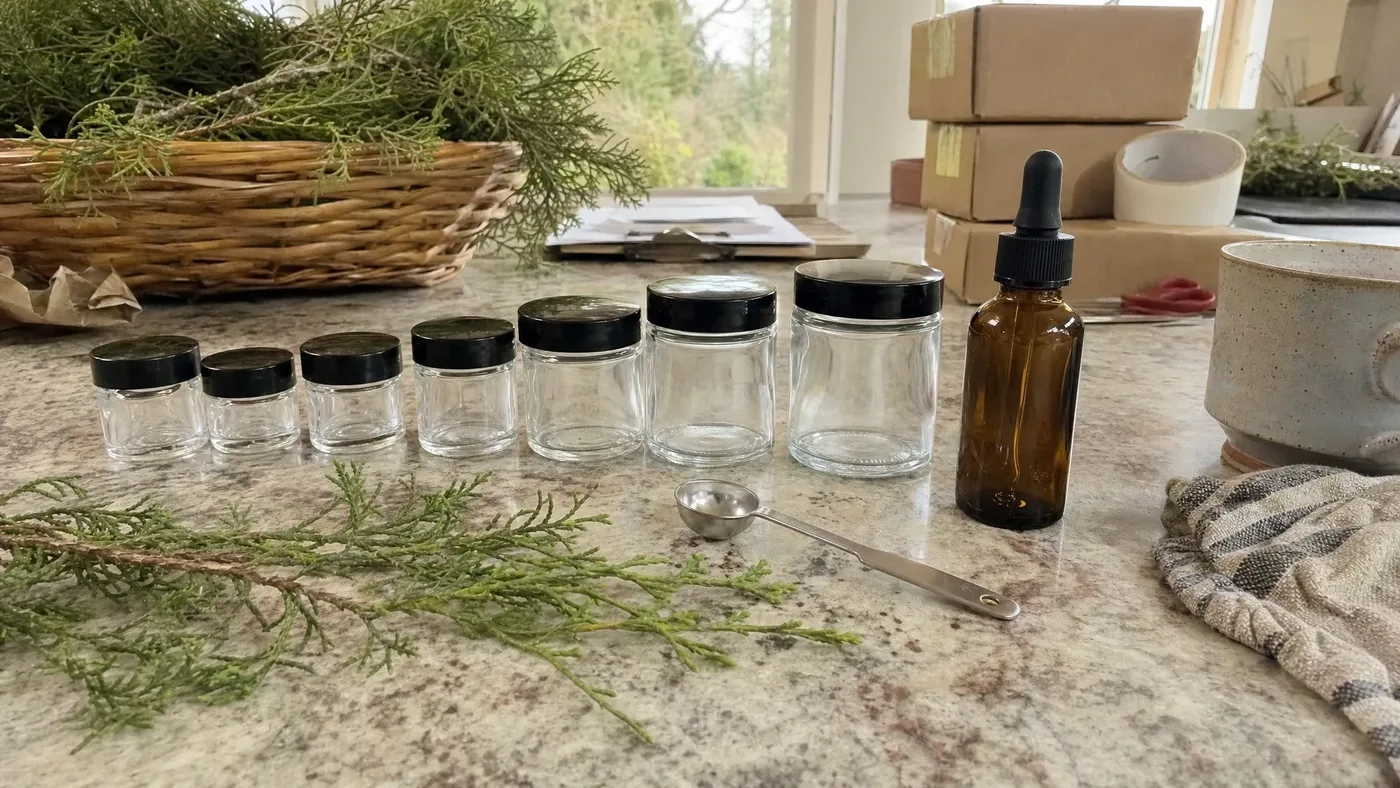
Cypress Oil Dilution Chart: How Many Drops per Carrier, by Use
For a 1 percent blend, use about 9 drops of cypress oil per 30 ml (1 oz) of carrier oil. For 2 percent, use about 18. For 0.5 percent, use 4 to 5. In a 10 ml roller bottle, 1 percent is 3 drops and 2 percent is 6. Start at the low end.
Cypress Essential Oil
Our own Cypress Essential Oil, in sizes from 0.5 oz to bulk.
From $10.99
Shop Now →| Dilution | Per 30 ml (1 oz) carrier | Per 10 ml roller | Typical use |
|---|---|---|---|
| 0.5% | 4 to 5 drops | 1 to 2 drops | Face, first-time use |
| 1% | about 9 drops | 3 drops | Face (upper end), everyday body oil |
| 2% | about 18 drops | 6 drops | Short-term body massage blends |
Bookmark that table if you like, but read the next section before you trust it. Every dilution chart on the internet rests on an assumption that rarely gets stated, and knowing it will change how you use this one.
The assumption behind every drops chart
A drop is not a unit of measurement. It is whatever falls out of the bottle. Standard orifice reducers deliver roughly 20 to 30 drops per ml, and the number moves with the bottle's opening, the angle you hold it at, and the oil's viscosity. Cypress is a thin, mobile oil, so it tends to fall faster and smaller than a thick resin or absolabsolute would.
Here is what that spread does to the math. One percent of 30 ml is 0.3 ml. If your bottle gives 30 drops per ml, 9 drops is 0.3 ml, which is exactly 1 percent. If your bottle gives 20 drops per ml, those same 9 drops are 0.45 ml, or 1.5 percent. The chart's 18-drop "2 percent" can land anywhere from 2 to 3 percent in the same way.
So these numbers are calibrated guidance, not pharmacy math. That is exactly why conservative percentages make the right default. A chart that can drift 50 percent high needs a starting point with room to drift. If you are unsure which way your bottle runs, count the drops that fill 1 ml (use a small syringe or a graduated dropper) once, and keep the number on a label.
What you need
- Cypress essential oil (Cupressus sempervirens) in a bottle with an orifice reducer
- A carrier oil such as fractionated coconut, jojoba, or sweet almond
- A dark glass bottle sized to what you will use in a few weeks: 10 ml roller, 30 ml dropper, or a pump bottle
- A small funnel, or a clean dropper for transferring
- A waterproof label and pen for the percentage and the date
- A cotton swab or clean fingertip for the patch test
If you are still choosing a bottle, the shop lists cypress oil in sizes that suit small-batch blending.
How to make a cypress blend, step by step
- Choose the percentage first, not the drops. Decide whether this blend is for the face, the body, or a roller, then pick the percentage from the table. If you have never used cypress on your skin, pick the lower figure for that use.
- Measure the carrier. Pour the carrier oil into the bottle before adding any essential oil. Adding essential oil to an empty bottle and then topping up wastes drops and makes the final strength harder to judge.
- Count drops slowly. Hold the bottle upright, tilt gently, and let each drop fall on its own. Rushing produces a stream of two or three drops at once. If the count goes wrong, pour out and start over rather than guessing.
- Cap and roll. Close the bottle and roll it between your palms for 20 to 30 seconds. Shaking works for a spray but whips air into oils, and air is what ages them.
- Label it. Write the oil, the percentage, and the date. A blend with no label is a blend you will eventually apply at the wrong strength.
- Patch test before the first full use. Instructions follow below.
- Store it cool and dark. A drawer works better than a bathroom shelf.
Dilution by use
Body massage: 1 to 2 percent
Robert Tisserand and Rodney Young's Essential Oil Safety (2nd edition) is the standard professional reference on dermal use, and its general guidance for adults leans on percentages in this low range for leave-on, whole-body products. Use 1 percent (about 9 drops per ounce) for a full-body oil that will go on large areas of skin. Reserve 2 percent (about 18 drops) for a smaller area and a short stretch of use, such as a calf or shoulder rub on a weekend. Because the oil's own composition affects how much is appropriate, check the cypress entry in the book for the current figure rather than assuming a chart covers it.
More is not better here. A bigger area at a higher percentage means more total oil on skin, which is the opposite of the conservative approach.
Facial skin: 0.5 to 1 percent
Facial skin is thinner and tends to react sooner than skin on the arms or legs, so the figures drop. Use 0.5 percent (4 to 5 drops per ounce) as your first face blend, and move to 1 percent only if the lower strength has been comfortable for a few weeks. Keep blends away from the eyes and the lips.
Roller bottles: do the math per 10 ml
Rollers are where dilution errors happen most, because the bottle is small and each drop is a big share of the total. At 1 percent a 10 ml roller needs 3 drops. At 2 percent it needs 6. Four drops is already close to 1.3 to 2 percent depending on the bottle, so count carefully. Rollers are for small areas such as wrists or shoulders, not the whole body.
Baths: never loose drops in the water
Essential oil does not dissolve in water. Drops added straight to a bath float on the surface as neat oil, and skin meets that undiluted layer at full strength as you sit down and move. The fix is to disperse the oil first, either in a spoonful of carrier oil or in a proper solubilizer, and then add the mix to the water. The cypress sea salt bath soak walks through a version of this, with the oil carried in the salt blend rather than dropped in loose.
Room sprays: different logic
A room spray is not a skin product, so skin percentages do not apply. The logic is solubility. Oil and water separate, so the usual base is high-proof alcohol, with the essential oil added to the alcohol first and water second. Label the bottle "shake to use" because even a well-made blend settles. Spray into the air, away from skin, fabrics you care about, finished wood, and any space where a pet cannot leave the room. The ASPCA Animal Poison Control Center is the right call if a pet is exposed to essential oils and seems unwell.
The patch test protocol
A patch test shows how your skin responds to a specific blend before you commit a larger area to it. It is not a guarantee, but it is a cheap check.
- Make a small amount of the blend at the strength you plan to use.
- Apply a dime-sized amount to the inner forearm.
- Leave it uncovered and do not wash it off for 24 hours, unless it feels uncomfortable, in which case wash with soap and water and skip the blend.
- If the spot stays calm after 24 hours, the blend is a reasonable candidate. If you see redness, itching, or a rash, do not use it.
For a longer discussion of who should patch test, and what to do with unfamiliar skin, see the guide on cypress oil safety, dilution, and patch testing. If sun exposure is part of your routine, the piece on whether cypress oil is phototoxic covers that question directly.
Common mistakes
Adding drops because you stopped smelling the blend
This is the most common error, and it comes from a misreading. After a few minutes, your nose adapts to a scent and the signal fades. That is olfactory fatigue, not a weak blend. The oil on the bottle is exactly as strong as it was. Step out of the room, breathe fresh air, and smell it again before you reach for the dropper.
Treating drop counts as exact
As shown above, "9 drops" can be 1 percent or 1.5 percent depending on your bottle. If you keep a recipe you like, record the percentage and the bottle's drops-per-ml, not just the drop count. When you change bottles, recheck.
Mixing a week's worth, or a month's, in one bottle
Cypress oil is rich in monoterpenes such as alpha-pinene and delta-3-carene, and compounds of that type oxidize readily on contact with air. Tisserand and Young discuss oxidation as a reason to store these oils carefully and use them while fresh. This is reasoning from chemistry, not a measurement on your bottle: a half-empty bottle has more air in it, so it ages faster than a full one. Make small batches, in a bottle sized to the blend, and discard anything that smells sharp, flat, or rancid.
Using the "2 percent" row as the starting row
The top row of a chart is a ceiling for a short stretch of use, not a baseline. Starting at the bottom and moving up only if you want to is the more careful route.
Reusing an old chart for a new oil
The numbers in this article are for cypress. Different oils have different recommended limits. A figure that suits one oil may be too high for another.
Who this chart is not for
Do not use this chart for babies or young children, for anyone who is pregnant or nursing, or for anyone with a medical condition or skin that reacts easily, unless a qualified professional has cleared it. Check with your doctor or pharmacist first, particularly if you take regular medication. Essential oils are not a replacement for professional care, and nothing here is meant to be.
If you want a fully worked recipe at a fixed percentage, the cypress cologne and beard oil recipes show how the percentage logic carries into a finished grooming product.
What to expect
A well-diluted cypress blend has a clean, woody, slightly resinous scent. People report that it feels fresh and grounding in a morning or after-outdoors ritual, and some describe it as part of a calm evening routine. Those are descriptions of atmosphere, not outcomes you should count on. A correctly diluted blend should leave skin feeling like the carrier oil alone: soft, lightly scented, and unremarkable. Anything that stings, tingles, or turns skin red is a sign to stop and wash the area with soap and water.
Keep this chart for reference, but let your own bottle set the real numbers. Count drops per ml once, write it on the label, and choose the lowest percentage that does what you want for the use you have in mind.