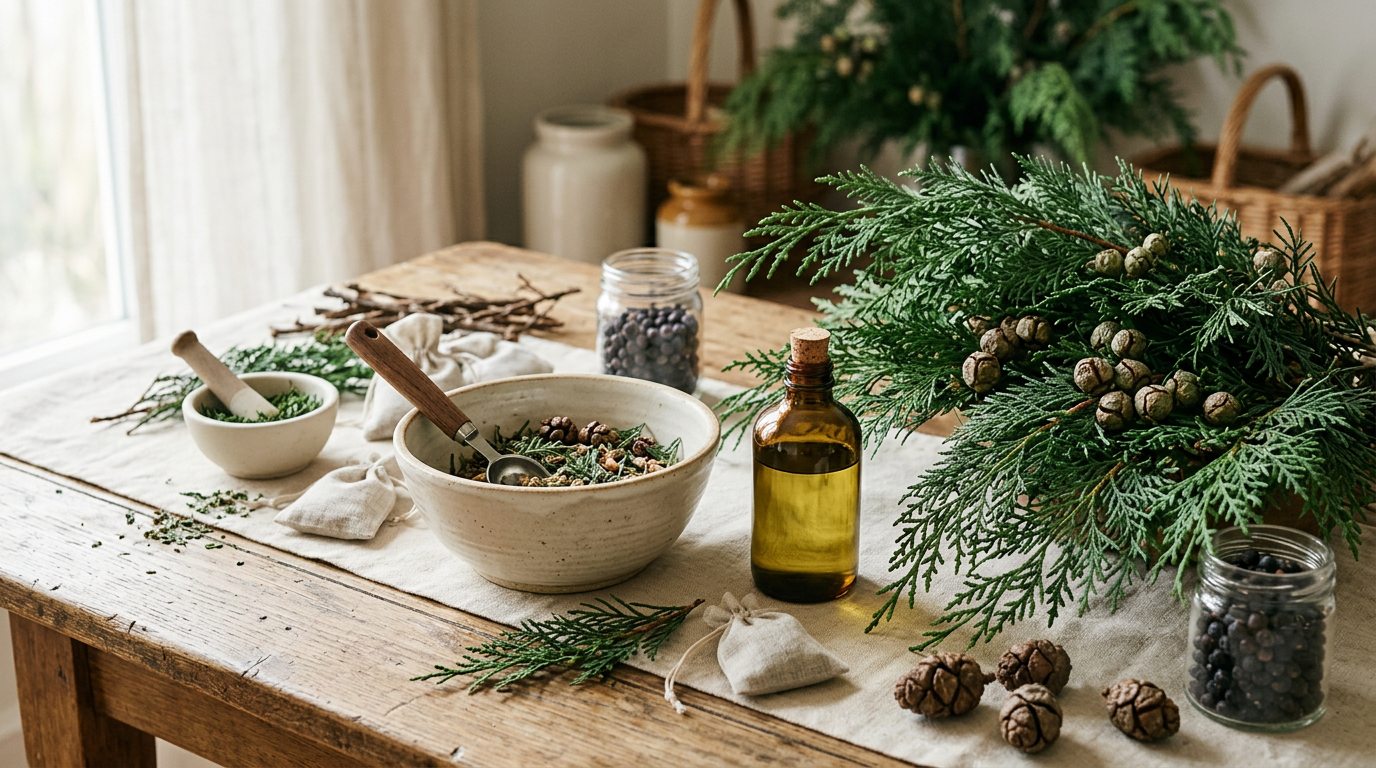
DIY Cypress Sea Salt Bath Soak for After a Day Outdoors
Before the recipe, one correction. Drops of essential oil do not disperse in bathwater. They float on the surface as a thin film, and that film meets your skin at full strength exactly where you sit. Salt does not fix this. Salt dissolves into the water, and the oil stays on top. The safe method is to blend the oil into a carrier oil or a proper solubilizer first, then into the salt, then into the bath. Everything below is built around that order.
Cypress Essential Oil
Our own Cypress Essential Oil, in sizes from 0.5 oz to bulk.
From $10.99
Shop Now →Why drops in the tub are the mistake to skip
Essential oils are lipophilic, which is a technical way of saying they mix with fats and not with water. Pour ten drops into a full tub and they gather into floating droplets and a surface sheen. When you lower yourself in, the skin along the waterline, and anywhere you shift or turn, passes straight through that layer. Neat essential oil on skin is the situation dilution guidance exists to avoid.
Robert Tisserand and Rodney Young cover this in Essential Oil Safety (2nd edition). Their guidance on bathing points the same way: essential oils should be dispersed before they go into bathwater, and adding them undiluted is discouraged. This is why a reputable essential oil bath soak recipe always has a middle step, and why that step is where most online recipes fall short.
The popular shortcut is to drop the oil onto the salt and call it done. That does help you portion the oil, but it is not dispersal. The salt crystals dissolve in seconds, and the oil they were carrying has nowhere to go but the surface. Salt is a convenient vehicle for the scent. It is not a dispersant.
The two ways to disperse oil properly
Option one: a carrier oil
Jojoba or fractionated coconut oil gives the essential oil something to dissolve into. The blend still floats, but it floats as a diluted oil layer and not as a concentrated one. That is a real improvement, and it also leaves a slight conditioning feel on the skin. This is the method used in the recipe below.
Option two: a solubilizer
A bath dispersant essential oil product, such as polysorbate 20 or a cosmetic-grade solubilizer sold for this purpose, does what a carrier cannot: it lets the oil spread through the water in tiny droplets so nothing pools on top. Ratios vary by product, so follow the supplier's instructions, and mix the essential oil into the solubilizer before it ever touches water. The water-mixable result suits people who dislike an oily tub. Milk and honey are often suggested as dispersants, but they are not reliable ones, so do not lean on them for safety.
If you want zero guesswork, the solubilizer route is the more complete one. If you want a short ingredient list and a skin-feel bonus, use the carrier. Either beats loose drops every time.
About the cypress itself
Cypress oil is steam-distilled from the foliage and twigs of the tree. Its scent is dry, green, and resinous, with a woody backbone that reads like a walk under conifers. Alpha-pinene and delta-3-carene are among its main aroma constituents, and you can verify the composition of both on PubChem. That terpene profile is what makes the oil smell like a forest, and it is also why it behaves the way it does: terpenes are volatile, which means heat carries the scent quickly.
For a cypress oil bath, that volatility matters. Hot water pushes fragrance into the air fast, and in a small bathroom the effect can swing from pleasant to overwhelming within a minute or two. Keep the water warm, not hot. You get a calmer, longer-lasting scent and you avoid a steamy room that is too strong to enjoy.
The recipe
Difficulty: easy. Prep time: about 10 minutes. Makes: roughly 4 to 6 baths. This is a diy cypress bath salts recipe built for scent and skin comfort, with the dispersal step done in the right order.
Ingredients
| Ingredient | Amount | Role |
|---|---|---|
| Coarse sea salt or Epsom salt | 1 cup | Base that carries the blend |
| Jojoba oil or fractionated coconut oil | 1 tablespoon | Carrier for the essential oils |
| Cypress essential oil | 6 drops | Woody, green forest scent |
| Lavender essential oil | 3 drops | Soft floral rounding note |
You will also need a small glass bowl, a spoon (not metal if your salt is damp), and a clean, dry glass jar with a tight lid.
Method
- Measure the carrier first. Pour 1 tablespoon of jojoba or fractionated coconut oil into the glass bowl.
- Add the essential oils to the carrier. Drop in 6 drops of cypress and 3 drops of lavender. Stir for about 30 seconds so the blend is even. This is the step that replaces loose drops in the tub.
- Pour the oil blend over the salt. Add the salt to the bowl, then stir thoroughly, folding from the bottom, until the salt looks evenly damp and no oily pools remain.
- Jar it. Spoon the mixture into the dry glass jar, seal, and shake gently. Let it sit overnight so the scent settles.
- Use a measured amount. For each bath, stir 1/4 cup of the blend into a tub of warm water. Do not go above 1/2 cup per bath, regardless of how much you like the scent.
At 1/4 cup per bath, you are adding roughly two drops of essential oil to a full tub. That figure is deliberate. A bath is the use where your whole body is in contact at once, and it is the setting with the least room for the "a bit extra won't hurt" instinct. If the scent seems faint when you first get in, give it a few minutes before reaching for more. Warm water carries aroma, and your nose adapts quickly.
Variations and substitutions
Post-hike version with fir
For a deeper conifer note, swap the lavender for fir. Use 5 drops of cypress and 4 drops of fir needle (balsam or Siberian), with the same 1 tablespoon of carrier and 1 cup of salt. The scent leans crisper and more like a cut tree. Fir oils are rich in terpenes that oxidize readily when exposed to air, so use a fresh bottle, and note that Tisserand and Young advise against using oxidized oils on skin. If your fir oil smells sharp or turpentine-like instead of fresh, leave it out.
Unscented-carrier version for sensitive skin
Skip the essential oils altogether and make the same blend with just salt and 1 tablespoon of carrier. You get the conditioning feel and a plain, clean soak with no fragrance at all. It is also a good way to learn how your skin responds to the salt and carrier before you add anything aromatic. If you do want a trace of scent later, begin with 2 drops of cypress in the full 1 cup batch and work up slowly.
Switching the salt
- Epsom salt: dissolves quickly and feels slightly slick in the water.
- Coarse sea salt: dissolves more slowly, looks better in the jar, and has a more mineral feel.
- Half and half: a practical middle ground if you want both qualities.
Switching the carrier
Jojoba is a liquid wax and is very stable on the shelf. Fractionated coconut oil stays liquid, is nearly odorless, and is also slow to go off. Sweet almond oil works, though it is a nut oil and so not suitable for anyone who needs to avoid nuts, and it tends to age faster. Avoid heavy butters here, since they leave a stubborn film.
Using a solubilizer instead
To skip the oily feel, replace the carrier with a cosmetic solubilizer, blend the essential oils into it according to the supplier's ratio, and then mix into the salt as above. Because solubilizers are concentrated surfactants, stay conservative with the amount and rinse well afterward.
Safety: read this before you run the bath
- Dilute first, always. Never add essential oil drops directly to bathwater. Blend into carrier oil or solubilizer first, as described above.
- Patch test. Mix a pinch of the finished salt blend with a little warm water and carrier, dab on the inside of your forearm, cover, and wait 24 hours. If you notice redness or irritation, do not use the blend.
- Keep it warm, not hot. Hot water amplifies scent intensity and can leave skin feeling tight. Ventilate the room.
- Mind the slippery surface. Oiled tubs are slick. Use a mat, take care climbing in and out, and rinse the tub after draining. A film left behind is a hazard for the next person.
- Rinse your skin. A quick shower rinse after the soak removes salt and any remaining oil film.
- Avoid sensitive areas. Keep the water away from your eyes, and do not use the blend on broken or irritated skin.
- Who this is not for. Skip the essential-oil version if you are pregnant or nursing, bathing a baby or young child, or under a doctor's care, unless your doctor has said it is fine. If you take any medication or have questions about your situation, consult your doctor or another qualified professional first. Essential oils never replace medical advice.
- Pets. Cats and dogs can react badly to essential oils in the air and on surfaces. The ASPCA Animal Poison Control Center is the place to call if a pet is exposed. Keep animals out of the bathroom while you soak and ventilate afterward.
- Keep out of reach. Store the jar and the essential oil bottles where children cannot get to them. If anyone swallows essential oil, contact US Poison Control at 1-800-222-1222.
What commonly goes wrong
The most frequent error is the one we started with: loose drops in the tub. The second is doubling the oil because the first bath smelled faint. Scent perception fades within minutes, so a recipe that seems weak at the start is often right by the end. The third is storing the finished salt in a jar that is not fully dry, which leads to clumping and, in time, a musty smell.
A less obvious problem is expecting too much from a soak. This is a forest-scented bath, a quiet ritual after a long day on a trail or in the garden. That is plenty, and it is all this recipe is meant to be.
Storage and shelf life
Keep the finished blend in an airtight glass jar with a tight lid, away from heat and direct light. Scoop with a dry spoon every time, since moisture is the enemy of any salt blend. Because the oils are a small fraction of the mix and the carriers named here are slow to turn, a good working shelf life is about three months. This is a conservative estimate based on how the ingredients behave, not a tested figure. Alpha-pinene oxidizes readily on air contact, so a half-empty bottle of cypress ages faster than a full one. Buy smaller bottles, cap them promptly, and discard any blend that smells flat, rancid, or sharp.
If you make the solubilizer version, treat the shelf life the same way and label the jar with the date you mixed it.
Putting it together
A good cypress soak is a short process done in the right order: oil into carrier, carrier into salt, salt into warm water. Do those three steps and you have a safe, scented bath that smells like the woods you just walked out of. Skip the first step and you have a tub with oil floating on top. Measure carefully, keep the water warm, rinse afterward, and give the scent a few minutes to settle before adding anything more.