Cypress at the Desk: A Workday Diffusing Routine for Deep-Work Blocks
No essential oil has been shown to make anyone smarter or more productive, and this article will not pretend cypress oil is the exception. What a consistent scent can do is simpler and more useful: act as a cue, the olfactory equivalent of hitting play on the same five songs before a run. Pair cypress and sweet orange with one specific block of work, every time, and the smell itself starts to mark the edge between "starting" and "everything else."
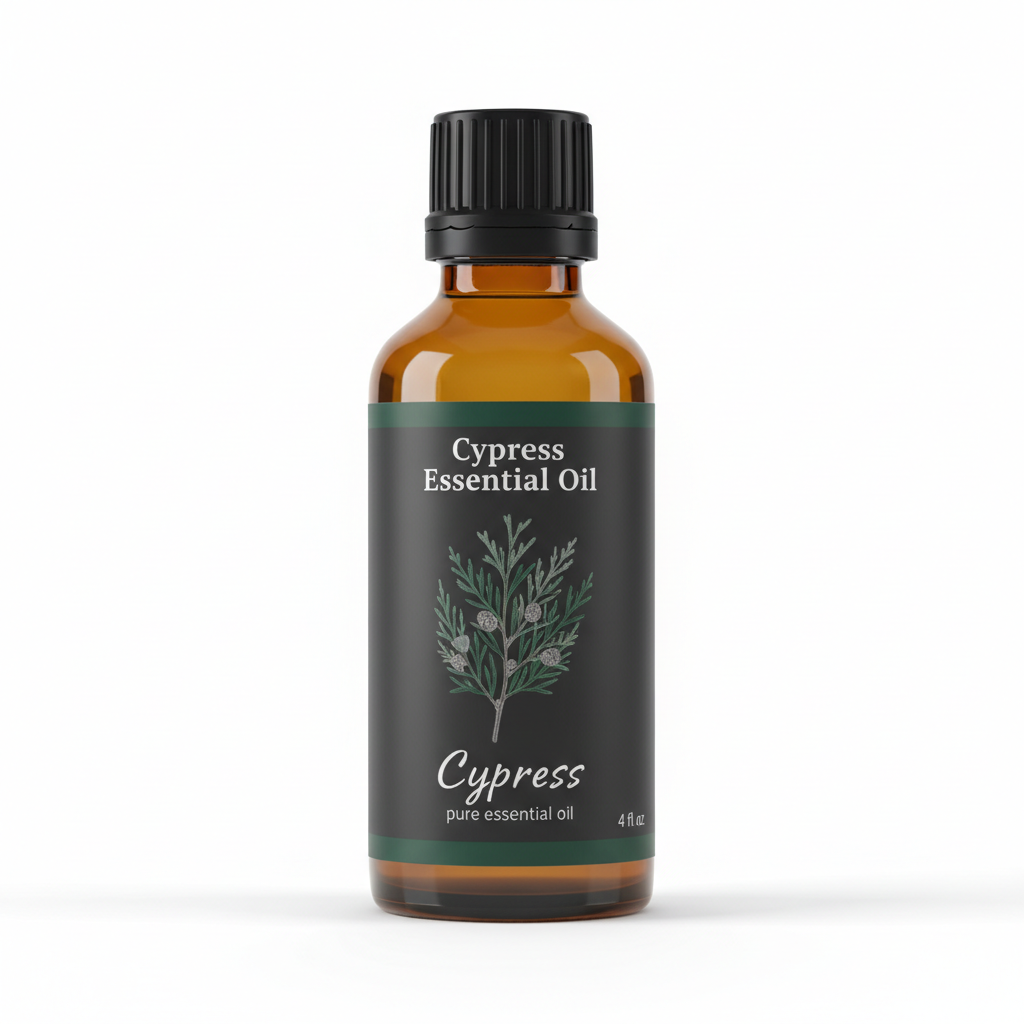
Cypress Essential Oil
Our own Cypress Essential Oil, in sizes from 0.5 oz to bulk.
From $10.99
Shop Now →What a Desk Diffusing Routine Can and Can't Do
Searches for cypress oil for focus are common, but no research shows any oil sharpens attention directly. The oil's actual job here is smaller and more mechanical: acting as a cue. Cypress oil (Cupressus sempervirens) is mostly alpha-pinene and other monoterpenes, the same class of molecule responsible for the smell of a freshly cut pine branch. Sweet orange is almost entirely limonene. Neither compound has a documented effect on attention or memory. What they do reliably have is a smell distinct enough from the rest of a normal office day (coffee, hand soap, the particular blend of carpet and printer toner) to work as a sensory bookmark.
That is the whole mechanism behind a work diffuser routine: distinctiveness plus repetition plus restriction to one context. The same principle is why a runner's warm-up playlist stops feeling like a warm-up once it gets used for everything else, including laundry and commuting. Scarcity is what keeps a cue meaningful, which is also why this routine asks you to turn the diffuser off after 30 minutes rather than let it run all day.
What You'll Need
The materials for a desk diffuser essential oil routine are deliberately minimal:
- A small personal diffuser sized for a desk, not a room (optional; see the no-gadget version below). If you're shopping for one, the shop carries cypress oil sized for exactly this kind of daily, small-dose use.
- Cypress essential oil
- Sweet orange essential oil
- A timer or phone alarm, set for 30 minutes
- For the no-gadget version: a cotton pad and a small dish or saucer
- For shared spaces: a personal inhaler tube, or a carrier oil for a 1 percent wrist dilution (see below)
The Routine, Step by Step
- Pick one blend and reserve it for this block only. Two drops cypress, two drops sweet orange, in a small desk diffuser filled to its marked water line. This exact ratio and this exact use case are what make it a cue instead of just a nice smell. Don't reuse the blend in the evening or on weekends; save other combinations, including the fifteen seasonal options in this blends roundup, for contexts that aren't trying to signal "start work."
- Start the diffuser at the exact moment the block begins, not five minutes before as a way of easing in. The timing is the trigger. If you sit down, open the document, and then start the diffuser, the sequence teaches your nose the wrong order.
- Set a 30-minute timer and let it run. Thirty minutes is long enough for the scent to register as present without running so long that it stops registering at all. Olfactory receptors adapt to a constant signal within minutes; this is the same reason you stop smelling your own kitchen after you've been home an hour. Thirty minutes keeps the cue inside the window where it's still noticeable.
- Turn it off at the timer, even mid-task. This is the step people skip, and it's the one that matters most. The diffuser's job was to mark the start; it has no job for the next ninety minutes. Leaving it running doesn't extend any benefit, because there's no cognitive benefit to extend in the first place. It just spends down the scarcity that made the cue work.
- No-gadget version: use a cotton pad instead. One drop cypress, one drop sweet orange on a cotton pad, set in a small dish at the corner of the desk. Pull the pad and put it in a drawer when the 30 minutes are up. This version is also the right call in a shared office, which gets its own section below.
- Repeat the next day with the identical blend, ratio, and timing. Consistency is the entire mechanism. A routine that changes its scent each day is just an air freshener with a ritual-sounding origin story.
Tips and Common Mistakes
- Don't double the drops to make the cue "stronger." More oil doesn't deepen the signal, it just shortens how long before your nose adapts and stops noticing it.
- Don't let the blend drift. Swapping in a third oil because the bottle was open, or switching to cedarwood on a whim, breaks the association you're trying to build.
- Store both bottles away from heat and light. Alpha-pinene and limonene oxidize on contact with air, which is why a bottle that's been opened and left half-full for months smells sharper and less pleasant than a fresh one. Keep caps tight and store in a cool, dark drawer rather than on a sunny windowsill.
- Don't diffuse into an empty room expecting carryover. A small desk diffuser scents a desk, not a floor. If you can't smell it from your chair within a minute of starting it, add water or move it closer rather than adding more drops.
- Keep the blend out of evening use entirely. If part of your day already includes a wind-down ritual, such as the one described in this cypress bedtime routine, use a different blend for it. One scent, one context, is the rule that makes either routine work.
The Shared-Office Rule
Running a diffuser in a shared office without asking everyone nearby is rude, and that stays true no matter how mild the blend is. Scent is involuntary. A person at the next desk can't opt out of smelling what you're diffusing the way they could decline a snack you offered them, and some of them may have a scent sensitivity, or simply a strong dislike of citrus that they're too polite to mention. Default to personal-scale methods at a shared desk: a cotton pad tucked at the edge of your own keyboard, a personal inhaler tube you can cap and pocket, or a single drop of a 1 percent dilution (about one drop of essential oil in a teaspoon of carrier oil) applied to the inside of your wrist. Robert Tisserand and Rodney Young's reference text, Essential Oil Safety, 2nd edition, uses dilutions in roughly this range for everyday skin contact, which is a reasonable ceiling for something you're wearing near your face for hours. As with any diluted application, patch test on a small area of skin first and discontinue use if irritation occurs. Save the actual diffuser, the one that scents the air for everyone in the room, for a space you control: a private office, a home desk, a studio with a door that closes.
If the Cue Stops Working
The routine tends to degrade in one predictable way: the blend leaks into non-work time. Maybe the diffuser got left running through a lunch call, or the same two oils ended up in a bath blend over the weekend, or a trip made the cotton pad version feel like just a nice travel scent rather than a work signal. Once cypress and sweet orange stop meaning "this is the start of a deep-work block" and start meaning "pleasant smell in general," the cue is gone, and no amount of drops brings it back on its own.
The fix is to re-fence it. Stop using the blend anywhere else for a week or two, including in other rooms, other times of day, or other combinations. Let the association reset through disuse before reintroducing it strictly at the start of work blocks. If you also keep an evening grounding ritual, like the approach in this guide to cypress for quiet evening moments, keep its oils and timing distinct from the desk blend so the two don't bleed into each other.
What You Can Reasonably Expect
Used this way, consistently and without scope creep, some people report that the scent becomes a reliable marker for "I'm in it now," the way a particular chair or a closed door already might be for other parts of a routine. That's an anecdotal, individual effect tied to habit and association, not a property of the oil itself. Nothing about cypress or sweet orange has been shown to improve focus, memory, or output, and framing the routine as anything more than a scent-based habit cue would be overselling two very ordinary conifer and citrus oils. The honest version is smaller than that, and also more durable: a cue that costs two drops and thirty minutes, and that keeps working precisely because you don't ask it to do more.