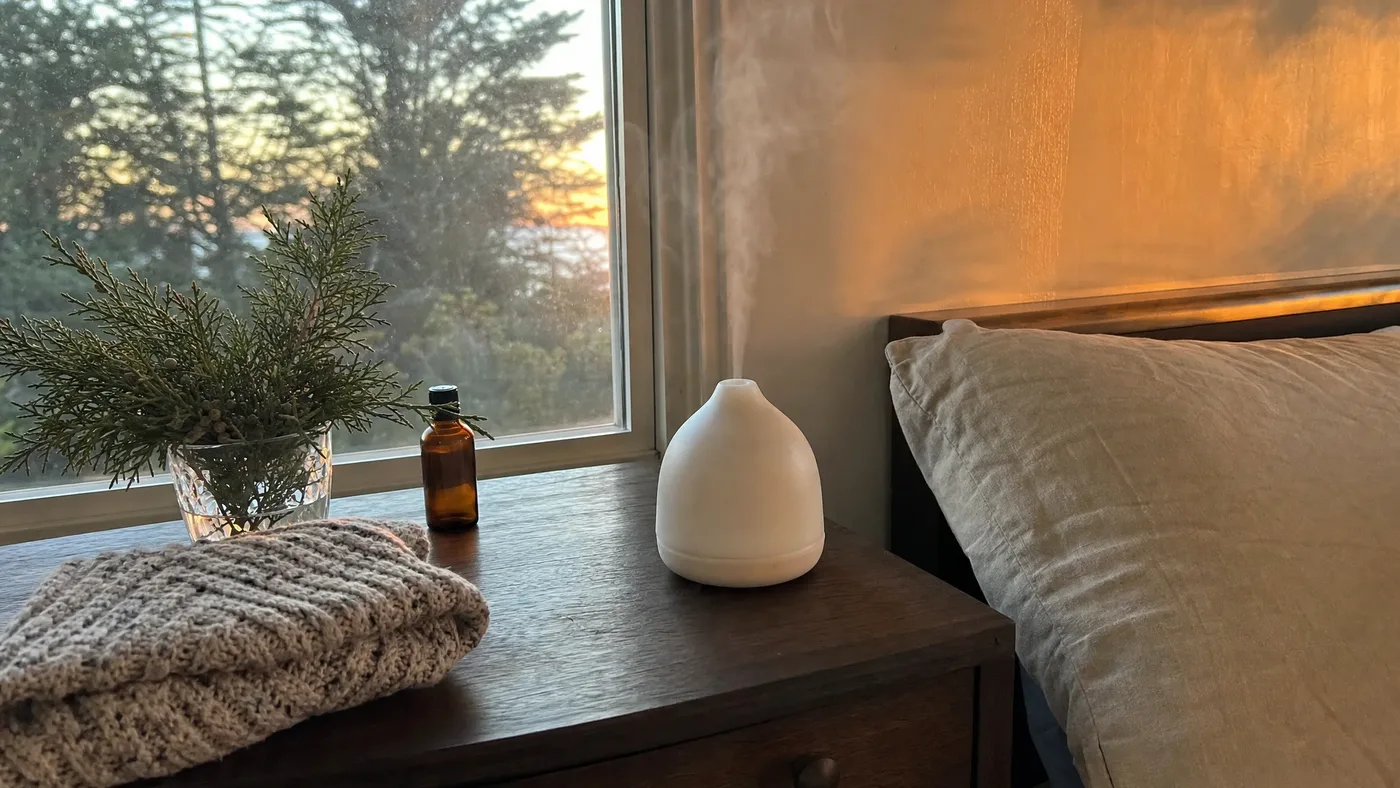
A Cypress Bedtime Wind-Down: Diffusion Timing for Calm Evenings
Run the diffuser for 30 to 60 minutes before lights-out, with the bedroom door open, and switch it off when you get into bed. That is the whole practice. Most advice about cypress oil at bedtime covers which oil to use. Almost none covers when to start and when to stop, and the timing is where a diffuser before bed either earns its place in your evening or becomes background haze.

Cypress Essential Oil
Our own Cypress Essential Oil, in sizes from 0.5 oz to bulk.
From $10.99
Shop Now →This guide walks through the timing first, then three blends with exact drop counts for a 100 ml ultrasonic diffuser, then a pillow-mist alternative. It ends with an honest ranking of what matters most in an evening routine. Spoiler: the scent is not at the top.
The misconception: longer diffusion is better
The common assumption is that a diffuser should run all night, so the scent is there whenever you want it. The reasoning behind that assumption does not hold up well, for three reasons.
- Odor fatigue. Your nose adapts to a steady smell and stops reporting it. This is ordinary olfactory adaptation, and it happens within minutes for most aromatic materials. After the first stretch, you are no longer perceiving the scent at all.
- Vapor with no sensory payoff. An ultrasonic diffuser running in a closed room keeps adding fine mist and volatile compounds to air that is barely moving. Since you stopped noticing the scent long ago, you are paying for output you cannot perceive.
- The cue works before bed, not during. A scent you pair with the same pre-bed routine night after night becomes a signal that the evening is winding down. That association forms while you are awake and doing the routine. It does not need to keep running while you are unconscious.
So the position of this article is simple: the diffuser is a prelude, not an all-night fixture. If you currently diffuse until morning and like it, nothing here is an emergency. But you are likely getting the same benefit, whatever it is for you, from the first hour.
What you need
- A 100 ml ultrasonic diffuser with an auto shut-off and a timer if possible
- Cypress essential oil (see below for what to look for)
- One or more companion oils: lavender, cedarwood, sweet orange
- Cool tap or filtered water
- For the pillow mist: a 30 ml glass spray bottle, 15 ml high-proof drinking alcohol or perfumer's alcohol, 15 ml distilled water
A note on the cypress itself. Its fresh, resinous, slightly woody character comes largely from monoterpenes such as alpha-pinene, which oxidize readily on contact with air. A bottle that is mostly empty has more air in it and tends to smell flatter and sharper over time. Keep the cap tight, store it away from heat, and use a nearly empty bottle first.
Step-by-step: the 45-minute routine
Step 1: Pick a start time and keep it
Choose a time 30 to 60 minutes before you want the lights out. If lights-out is 10:30 pm, start at 9:45 pm. Consistency matters more than the exact minute. The point is that the scent arrives at roughly the same place in your evening each night, so it can act as a marker.
Step 2: Fill the diffuser and add your drops
Fill the tank to the max line with cool water. Add your drops (blend recipes below). Do not add more than the recipe says. In a 100 ml tank, a handful of drops is already plenty for a bedroom, and a heavier hand mostly shortens how long the scent feels pleasant before it feels crowded.
Step 3: Start it in the bedroom with the door open
Run it in the room where you will actually wind down, not in the hallway. Leave the door open. This is a small but deliberate choice: an open door keeps the room from becoming a sealed pocket of concentrated vapor, and it lets the scent drift into the space you are moving through while you brush your teeth or set out tomorrow's clothes. Place the diffuser on a stable surface a few feet from where your head will be, never on fabric or directly beside the pillow.
Step 4: Use the diffusing window for the rest of your routine
This is the window to dim the lights, put the phone on its charger across the room, and read something on paper. The scent is the backdrop. If you want a quieter companion piece, this evening grounding guide covers ways to build a slow, unhurried hour around cypress.
Step 5: Switch it off when you get into bed
When you climb into bed, turn the diffuser off. If your unit has a timer, set it to 30 to 60 minutes at the start so the shut-off is automatic. By now your nose has adapted anyway, and the room still holds the scent in the air and on soft surfaces. Leave the door as it was.
Step 6: Empty and dry the tank
In the morning, pour out any leftover water and wipe the tank dry. Standing water with oil film does not age well, and a clean tank gives you a cleaner scent next time.
Three bedroom blends for a 100 ml diffuser
Each blend uses a small total drop count. Essential oils are described in fragrance work as top, middle, and base notes, based on how quickly they evaporate. A blend with one note from each layer tends to feel rounded. Cypress sits mostly in the top-to-middle range, so pairing it with a base note keeps the scent from thinning out as the evening goes on. For more pairings beyond these, see what blends well with cypress essential oil.
Blend 1: Cypress 2 + lavender 3
Note structure: Cypress supplies a crisp, green, woody top; lavender fills the floral middle and softens the sharper edges. This is the gentlest of the three and the easiest starting point.
Blend 2: Cypress 3 + cedarwood 2
Note structure: Two woody, resinous oils, with cedarwood acting as the base that lingers after the cypress top fades. This blend reads drier and more forest-like, with no floral element at all.
Blend 3: Cypress 2 + sweet orange 2 + cedarwood 1
Note structure: Sweet orange adds a bright citrus top, cypress bridges the middle, and one drop of cedarwood anchors the base. The citrus fades fastest, so this blend changes character over the window, ending up woodier than it began. Keep your sweet orange fresh: citrus oils are rich in limonene, which oxidizes with age, and oxidized citrus oils are more likely to irritate skin. Tisserand and Young discuss this in Essential Oil Safety (2nd edition).
| Blend | Drops (100 ml tank) | Character |
|---|---|---|
| Cypress + lavender | 2 + 3 | Soft, green, floral |
| Cypress + cedarwood | 3 + 2 | Dry, woody, resinous |
| Cypress + sweet orange + cedarwood | 2 + 2 + 1 | Bright opening, woody finish |
The alternative: a pillow mist, done carefully
Some people dislike running a device in the bedroom. A mist is a fair alternative, but the method matters.
- Build it on an alcohol base. Essential oils do not dissolve in water. In a 30 ml glass bottle, combine 15 ml high-proof drinking alcohol (or perfumer's alcohol) with 6 drops of oil, for example cypress 2 + lavender 3 + cedarwood 1. That is roughly a 1 percent concentration. Swirl, then add 15 ml distilled water.
- Shake before every use. Even with alcohol, the oils drift apart as the bottle sits.
- Mist the air above the pillow, not the pillow. Hold the bottle at arm's length, spray once or twice into the air above the bed, and let it settle for a minute. Do not soak the fabric your face will rest against.
The reason for that third step is exposure. Spraying fabric and then pressing skin against it for hours means prolonged direct contact with the oil and its oxidation products. That is an unnecessary exposure when misting the air gives you the scent without it. The same logic applies to bedding generally. If you want a scented linen routine, this cypress linen and closet spray recipe is designed for closets and linen storage, where fabric is not in contact with your face overnight.
Alcohol-based sprays are flammable. Keep the bottle away from candles and open flame, and mist once rather than saturating the room.
Common mistakes to avoid
- Adding more drops when the scent fades. It faded because your nose adapted, not because the oil ran out. More drops will not bring it back.
- Closing the door and running the diffuser overnight. This is the setup with the least sensory benefit and the most accumulated vapor.
- Placing the diffuser at the head of the bed. Distance gives you a gentler scent and avoids mist landing on bedding.
- Using cypress that has sat half-empty for a year. Fresh oil smells cleaner. If it has gone sharp or sour, replace it.
- Skipping the dry-out. Residue builds up in the tank and muddies the scent.
Who this routine is not for
Diffusing is not suited to every household. If you share a space with a cat, a bird, or another small pet, check with your vet and the ASPCA Animal Poison Control Center before diffusing at all, since animals process aromatic compounds differently than people do. Keep diffusers out of infants' and young children's rooms. If you are pregnant or nursing, or you take any medication, ask your doctor or pharmacist before adding essential oils to your routine. And if you simply dislike scent in your bedroom, skip it: the rest of this article still works without it.
Stop using any blend that gives you a headache, an irritated nose, or a sense of heaviness, and air the room out. For general guidance on what to do after a significant exposure or accident, US Poison Control (1-800-222-1222) is the starting point.
What you might reasonably expect
Some people report that a consistent scent paired with a consistent routine helps the evening feel more distinct from the workday. Some research suggests that familiar scents can become associated with settings and habits, which is the logic behind using one at the same time each night. That is a modest, plausible claim, and it is all this routine offers. It is not a promise about how you will sleep, and the scent will not do the work for you.
Fresh, well-stored oil matters because you will be smelling it closely for a short window each night. If you are replacing a bottle, the cypress essential oil in our shop is one place to start.
The meal and the garnish
Here is the honest ranking. The routine around the scent is the meal: a consistent bedtime, dim light, screens put away, and a cool room. Those four things do the heavy lifting, and you can have all of them without a single drop of oil.
The scent is the garnish. A good garnish is a pleasure, and it can make a plate feel finished. But nobody confuses it with dinner. Use the diffuser for 30 to 60 minutes, turn it off when you get into bed, and put your real effort into the lamp, the phone across the room, and the open window.