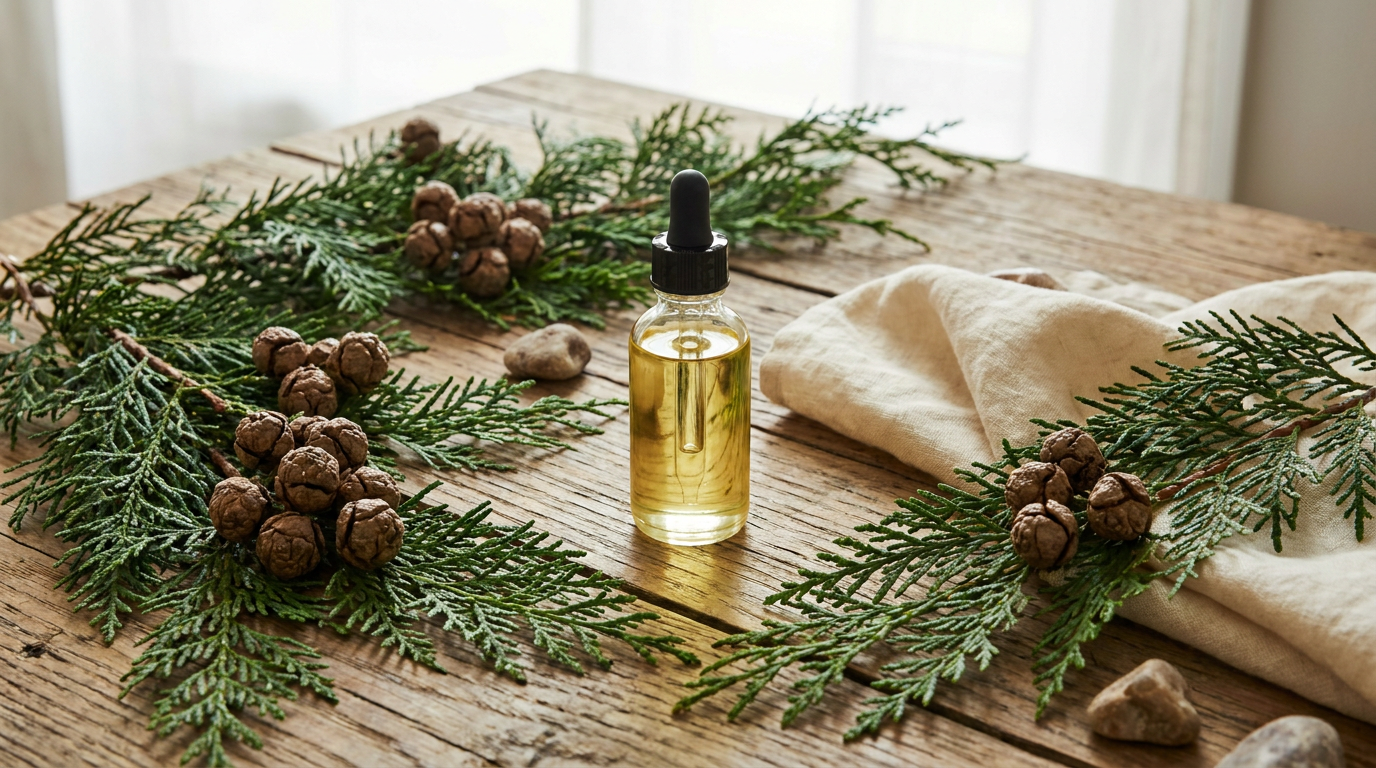
Organic and Wild-Harvested Cypress Oil: What the Label Really Means
USDA Organic on a cypress oil certifies how the plant material was grown or gathered and how it was handled afterward. It does not certify purity, potency, or scent. "Wild-harvested" is not regulated at all. Judge a bottle by its Latin name, batch documents, and freshness date first, and by its seal fourth.
Cypress Essential Oil
Our own Cypress Essential Oil, in sizes from 0.5 oz to bulk.
From $10.99
Shop Now →That ordering will annoy some sellers, because the seal is the part of the label that looks most official. It is also the part most often asked to do work it was never built to do. A certified organic cypress oil can be carelessly distilled, stored warm for a year, and still carry the seal. A conventional one from a small distillery with excellent batch records can smell better and be better documented. Saying so plainly is the position of this guide.
What follows is the walk-through a good shopkeeper would give at the counter: what each label phrase structurally covers, what it leaves out, when the organic premium is worth paying, and how to compare bottles when price is the deciding factor.
What USDA Organic Actually Certifies on an Essential Oil
The USDA National Organic Program (NOP) sets rules under 7 CFR Part 205 for agricultural products. An essential oil qualifies because it is distilled from a plant, which makes it an agricultural product in the eyes of the program. The certification attaches to two things.
- The plant material. The land or wild area must have been free of prohibited substances (most synthetic pesticides and fertilizers) for a set period before harvest, and the grower must follow an approved organic system plan.
- The handling chain. The distiller, bottler, and any intermediary who takes the product must also be certified by an accredited certifying agent, so that organic material is not mixed with conventional material or contaminated along the way.
That is the full scope. The seal tells you something about farming practice and about record-keeping from field to bottle. It is a statement about inputs and traceability.
What the seal does not cover
The NOP does not set a chemical profile for cypress oil. It does not require a minimum alpha-pinene or delta-3-carene content, does not inspect for adulteration with cheaper conifer oils the way a laboratory would, and does not check that the oil smells fresh and green rather than flat and resinous. It does not regulate distillation time, temperature, or the condition of the still. It does not tell you when the oil was distilled or how it has been stored since.
So an organic cypress oil can be a poor one, and a conventional cypress oil can be superb. Both statements follow directly from what the program was designed to do. The seal answers "how was this grown and who handled it?" It was never built to answer "is this a good oil?"
The wording on the front of the bottle matters
Under NOP labeling rules, "100% organic" means every ingredient is organic. "Organic" means at least 95 percent of the ingredients are. "Made with organic ingredients" covers a lower tier and cannot carry the seal. For a single-ingredient cypress oil, you should see either "100% organic" or "organic" alongside the certifier's name. If a bottle says "organically grown" or "grown without pesticides" with no certifier named, that is a marketing statement. It may be true. You have no way to check it from the bottle.
Look for the name of the certifying agent printed near the seal. A genuine certified product carries it, and it gives you something concrete to look up.
What "Wild-Harvested" Means (and Why It Often Means Nothing)
No agency defines "wild-harvested" for essential oils. There is no inspection, no required documentation, and no penalty for using the phrase loosely. On one label it may describe material gathered from a real, identifiable stand of trees. On another it is romance copy that evokes mountainsides while the actual plant material came from a plantation.
Cypress makes this especially worth questioning. Cupressus sempervirens, the Mediterranean cypress, is planted widely as a windbreak, a boundary tree, and an ornamental. Material from managed or planted trees is common in the trade. A bottle that pictures a rugged hillside is not evidence of where the branches were cut.
The three details that earn the claim
"Wild-harvested" becomes believable only when it comes with specifics a seller can state without hedging:
- Where. A named region or country of origin, not "the Mediterranean" as a mood.
- By whom. A named distillery, cooperative, or collector, so there is someone accountable for the claim.
- Under what limits. Some account of how much may be taken, how often, and how the stand is left. Cypress oil is typically distilled from foliage and twigs, so a responsible harvest takes limited material from a tree rather than felling it.
A seller who can answer all three has probably thought about the supply chain. A seller who answers with adjectives has not.
Wild and organic are not opposites
A common misconception is that "wild-harvested" and "organic" compete, so you must pick one. They do not. The NOP rules include a provision for wild crops: gathered material can be certified when the harvest area has been free of prohibited substances for the required period and the gathering does not damage the environment. So the strongest version of a wild claim is one that is also certified, because a third party has looked at the harvest area and the records. The weakest version is a wild claim standing alone with nothing behind it.
The Honest Hierarchy for Judging Any Bottle
When you pick up a bottle of cypress oil, work through these four questions in order. Each one narrows the field before you reach the seal.
1. Latin name
Start here because "cypress" is not one plant. The oil most buyers expect is Cupressus sempervirens. But "blue cypress" is typically Callitris intratropica, an Australian tree with a very different aroma, and other bottles labeled cypress may come from different Cupressus or Chamaecyparis species, or may be a blend. A label that says only "cypress oil" with no botanical name leaves you guessing which tree you are buying. No seal, organic or otherwise, fixes that. If the Latin name is missing, move on.
2. Batch documents
A certificate of analysis (COA) tied to a specific batch number is the closest thing a buyer has to a statement of what is in the bottle. The most useful form includes a gas chromatography and mass spectrometry (GC/MS) report, which lists the individual aromatic compounds the lab detected and their relative amounts. For a Cupressus sempervirens oil, you would expect a profile led by monoterpenes such as alpha-pinene and delta-3-carene, with smaller amounts of compounds like cedrol. PubChem is a free, reliable reference for checking what any compound on a report actually is.
What to confirm on the document:
- The batch or lot number matches the number on your bottle.
- The species named on the report matches the label.
- The report comes from an identifiable lab and carries a date.
- The profile looks like cypress rather than a generic conifer mix. A report that is a screenshot with no lab name, or one reused across every product in a catalog, tells you very little.
Here the trade-off becomes clear. A COA describes composition. The organic seal describes farming and handling. Only one of those tells you whether the oil in your hand matches its name.
3. Freshness date
Cypress oil is rich in monoterpenes, the compound family that reacts readily with oxygen. Robert Tisserand and Rodney Young discuss oxidation and shelf life in Essential Oil Safety (2nd edition), and the practical point for a buyer is straightforward: oxidized oils lose their bright, green, slightly woody top note and can become more likely to bother skin.
Reasoning from that chemistry, a few things follow. Because alpha-pinene oxidizes readily on air contact, a half-empty bottle ages faster than a full one, since more air sits above the oil. Heat and light speed the process, which is why dark glass and cool storage matter. And a bottle with no distillation date or best-by date gives you no way to estimate any of this. Look for a distillation date, a bottling date, or a clear best-by date. A bottle with none of them is asking you to trust it blindly.
4. Certifications
Only now does the seal come into the picture. By this point you know the species, you have seen a batch-specific report, and you know roughly how old the oil is. The seal becomes a useful tie-breaker or a values choice, and it stops being a stand-in for quality. That is its proper job.
When the Organic Premium Is Worth Paying
Certified organic oils generally cost more, because certification involves fees, record-keeping, and a smaller pool of qualifying growers. Whether that premium is rational depends on what you are buying the oil for.
It makes sense when
- Supporting certified agricultural practice matters to you. If you want your purchases to reward growers who follow NOP rules, the seal is the only reliable way to verify that, and the extra cost is the point.
- The oil goes into a leave-on skin product. In a body oil, balm, or lotion that stays on the skin, some buyers want every variable managed they reasonably can. A certified chain of custody removes one variable: how the plant was grown. It does not replace proper dilution or a patch test.
It makes less sense when
- The oil is for a diffuser and you chose it for scent. Here the aroma is the entire purpose. Batch freshness and documentation predict how a cypress oil will smell far better than the seal does. A recently distilled conventional oil with a matching GC/MS report will often outperform an older organic oil that has been sitting in a warm warehouse.
- The premium comes at the expense of documentation. If the organic option has no batch report and the conventional one does, the conventional one is the more informed purchase.
This guide is not for the buyer who wants the seal to settle the question for them. It will not. It is for the buyer who wants to know what each marker covers and spend accordingly.
Key Features to Compare Side by Side
When two or three bottles are on the table, a short comparison keeps the decision grounded in things you can verify.
| Feature | What a strong answer looks like | What a weak answer looks like |
|---|---|---|
| Botanical name | Cupressus sempervirens printed on the label | "Cypress oil" or "cypress blend" only |
| Plant part and method | Foliage and twigs, steam distilled | No method stated, or "fragrance oil" wording |
| Batch document | Lot-specific GC/MS from a named lab | A generic report or none at all |
| Date information | Distillation, bottling, or best-by date | No date of any kind |
| Organic claim | Seal plus the certifying agent's name | "Organically grown" with no certifier |
| Wild claim | Named region, named collector, stated harvest limits | Scenic language with no specifics |
| Container | Dark glass with a dropper or orifice reducer | Clear glass or plastic |
Choosing at Different Price Points
Rather than name brands, which would go stale and which this guide cannot vouch for from firsthand testing, here is what to prioritize at each budget level. Prices vary by region and season, so think in terms of what the money should buy.
Entry level: documentation over certification
If you are spending the least, skip the premium for the seal and put your effort into the first three questions. A conventional Cupressus sempervirens oil with a named species, a lot-specific GC/MS report, and a date will serve a diffuser better than a sealed oil with no paperwork. Buy a small bottle so that it is used up while fresh.
Mid range: the certified, documented oil
This is where a certified organic oil with the certifier named, a batch report, and a date all appear on the same product. If you are blending leave-on skin products or want to support certified farming, this tier covers both with fewer compromises. Confirm that the report matches the lot on the bottle rather than assuming it does.
Premium: provenance you can trace
At the top, the price should buy specifics: a named origin, a named distiller, stated harvest practice for any wild claim, and ideally a certified wild crop. If a premium bottle offers a beautiful story and the same thin documentation as a cheaper one, you are paying for the story.
Red Flags to Avoid
- No Latin name. You cannot know which tree you are buying.
- An organic seal with no certifier's name. The claim is unverifiable from the bottle.
- "Wild-harvested" used as the only quality claim. The phrase is unregulated, so it proves nothing without where, by whom, and under what limits.
- A COA that is the same for every product, has no batch number, or comes with no lab name.
- No date anywhere. Freshness drives scent and stability, and you cannot judge it blind.
- Large bottles of a monoterpene-rich oil for occasional use. Air in the headspace speeds oxidation, so a big bottle opened a few times a month ages in storage.
- An unusually low price paired with an organic or wild claim. Certification and careful harvest cost money, and a price that ignores that deserves a question.
- Language that drifts into medical territory. A reputable seller describes aroma, origin, and handling. If a label or page promises effects on the body, that is a reason to distrust the seller's judgment generally.
Where to Buy
The best source is whichever one lets you see the documents before you pay. In practice that means a few kinds of seller.
- Specialist essential oil retailers that publish batch reports on the product page or send them on request, and that name the species and origin.
- Distillers and cooperatives selling directly, who can speak to harvest practice and distillation date firsthand.
- Plant-focused shops whose product pages state the plant part, the method, and the certifier. You can browse our cypress oil selection with the same checklist in hand.
Be more cautious with marketplace listings where several sellers share one product page, because the batch you receive may differ from the batch in the photos. Whichever route you take, ask for the lot-specific report before purchase. A seller worth buying from answers that quickly.
Using Cypress Oil Safely
Quality and safety are separate questions, and an organic seal does not answer the second one. Essential oils are concentrated. For skin use, dilute well in a carrier oil, and follow the dilution guidance in Tisserand and Young's Essential Oil Safety (2nd edition) rather than a rule of thumb from a product page. Do a patch test on a small area and wait before wider use. Keep oils away from the eyes, do not ingest them, and store them out of reach of children. If you share your home with pets, contact your veterinarian or the ASPCA Animal Poison Control Center with questions before diffusing or applying anything near them. If you are pregnant, nursing, or under a clinician's care, check with a physician or other qualified clinician before using essential oils. Essential oils are for aromatic and cosmetic use, and they are not a substitute for professional advice.
The Short Version at the Counter
Read the Latin name. Ask for the batch report and match the lot number. Find the date. Then look at the seal, and decide whether certified agricultural practice is something you want to pay for. For a diffuser oil chosen on scent, put your money toward freshness and paperwork. For a leave-on skin product, or if supporting certified farming matters to you, the organic premium is a sound purchase. And if a bottle leans on "wild-harvested" without telling you where, by whom, and within what limits, treat that phrase as decoration and let the documents do the talking.