How to Make a Cypress Room Spray: Dilution Ratios and Mixing Steps
To make a cypress room spray that stays mixed, dissolve about 40 drops of cypress essential oil (roughly 2 percent) in 60 ml of high-proof neutral spirit first, swirl until clear, then add 40 ml of distilled water. Oil and water alone will separate, so the alcohol (or a solubilizer) is not optional.
Cypress Essential Oil
Our own Cypress Essential Oil, in sizes from 0.5 oz to bulk.
From $10.99
Shop Now →The Misconception Worth Clearing Up First
Search for a room spray recipe and you will find the same instruction repeated everywhere: fill a bottle with water, add some drops of essential oil, shake. It looks harmless. It also does not work.
Essential oils are hydrophobic. Cypress oil is built largely from terpene hydrocarbons such as alpha-pinene and delta-3-carene (you can look up the composition of the major constituents on PubChem), and molecules like these do not dissolve in water. What happens inside the bottle is plain physics. The oil breaks into droplets when you shake it, then rises and gathers as a film on the surface within minutes.
Now think about where the sprayer's dip tube sits: at the bottom of the bottle. The first several pumps draw up almost pure water, so the room smells like nothing. As the bottle empties, the oil layer drops toward the tube, and the last pumps deliver a concentrated mist of oil. That is a lopsided result, and a stronger concentration than you intended is landing on your furniture.
There is a second problem. Oil sitting at the surface of a water-based mixture is in constant contact with the air in the bottle's headspace. Alpha-pinene oxidizes readily on air contact, so a thin, exposed oil film ages faster than oil kept in solution. The scent can drift from fresh and green toward flat and sharp.
A working room spray needs something that can hold the oil in solution. There are two practical choices: a high-proof alcohol base, or a solubilizer. This article builds the main recipe on alcohol, then explains the solubilizer alternative and its trade-offs honestly.
What You Need
Ingredients
- 60 ml high-proof neutral spirit. A food-grade grain spirit at 190 proof (95 percent alcohol by volume) is ideal. Perfumer's alcohol (often sold as SD alcohol 40-B) also works. Ordinary 80-proof vodka is only 40 percent alcohol and carries a lot of water, so it holds oil poorly at this ratio and may turn cloudy.
- 40 ml distilled water. Tap water carries minerals that can cloud the mixture and microbes that shorten its life.
- 40 drops cypress essential oil. That is about 2 ml in a 100 ml batch, or roughly 2 percent, using the common rule of thumb of about 20 drops per milliliter. Drop sizes vary with the bottle's orifice reducer, so treat this as an approximation.
- Optional: 10 drops cedarwood essential oil. This adds about 0.5 ml, bringing the total fragrance load to roughly 2.5 percent. Cedarwood rounds out cypress's green, resinous character with a drier, pencil-shaving warmth.
Equipment
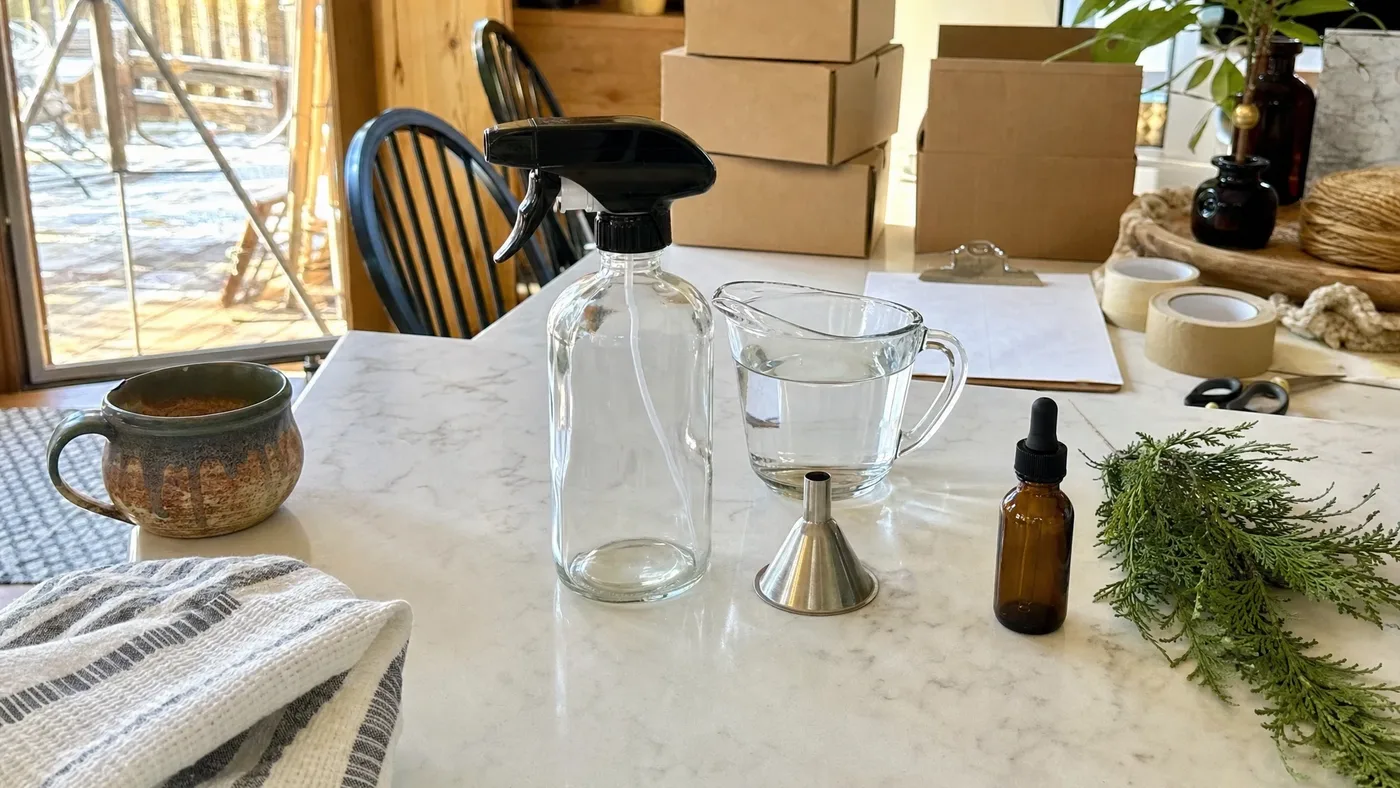
- A 100 ml (or slightly larger) glass bottle with a fine-mist sprayer. Amber or cobalt glass slows light-driven aging. Glass is also the safer choice because concentrated essential oils can soften or cloud some plastics.
- A small glass measuring cup or beaker with a pouring lip, plus a glass stirring rod or clean chopstick.
- A funnel, if your bottle has a narrow neck.
- A label and pen for the batch date.
If you want a quality cypress oil for this, our shop lists the oils we carry, with botanical names and country of origin noted so you know exactly which species you are buying. Look for Cupressus sempervirens on the label; the Latin name tells you more than a marketing name does.
The Recipe at a Glance
| Component | Amount | Role |
|---|---|---|
| High-proof neutral spirit | 60 ml | Dissolves the oil, carries the scent into the air |
| Distilled water | 40 ml | Dilutes the alcohol, softens the mist |
| Cypress essential oil | 40 drops (about 2%) | Main fragrance |
| Cedarwood essential oil (optional) | 10 drops (about 0.5%) | Warm, dry base note |
How to Make Cypress Room Spray: Step by Step
-
Set up a clean, ventilated workspace, away from flame. High-proof alcohol is flammable, and 190-proof spirit more so than most people expect. No candles, no stovetop burners, no one smoking nearby while you mix. Wash and fully dry your bottle, cup, and stirring rod, because water droplets left inside will change the ratios slightly and any residue can shorten shelf life.
-
Pour 60 ml of the spirit into the measuring cup. Measure by volume, not by eye. A kitchen measuring cup with milliliter markings is accurate enough for a small batch.
-
Add the cypress oil to the alcohol, not to the water. Count out 40 drops directly into the spirit. If you are using cedarwood, add its 10 drops now. This is the step that decides whether the spray works, and the reason is solubility. Alcohol is a solvent that can hold terpenes in solution, because it is partly oil-friendly and partly water-friendly. Water cannot hold them at all. If the oil goes into water first, it forms droplets and a surface film right away, and adding alcohol afterward has to rescue a mixture that has already separated. Put the oil in the solvent that can accept it.
-
Swirl until the liquid is completely clear. Stir gently with the glass rod or swirl the cup for 30 to 60 seconds. You are looking for a transparent liquid with no oil beads and no streaks bending the light. Hold it up to a window. If you can still see tiny oil ribbons, keep stirring.
-
Add 40 ml of distilled water slowly. Pour it in a thin stream while stirring. A faint haze at this stage is normal for some oils and usually clears as it mixes. If the liquid turns milky and stays that way, the alcohol was probably too weak (a lower-proof spirit) or the oil load too high. See the troubleshooting section below.
-
Transfer to the bottle and close it tightly. Use the funnel, screw the sprayer on firmly, and give the bottle a gentle swirl. Leave as little empty space as you can; a bottle that is nearly full keeps less air in contact with the liquid.
-
Label it and let it rest for 24 to 48 hours. Write the date and the formula on the label. Resting lets the scent settle and blend. Fresh cypress oil can smell sharply green and a bit camphor-like at first, and a day or two in the bottle tends to soften that edge.
Why the Ratio Is 2 Percent
Two percent is a room-spray figure, not a skin figure. A spray that lands in the air and on the nearby fabric does not need the strength of a perfume, and a higher load mostly makes the scent harder to control. In a 100 ml bottle, 40 drops is about 2 ml. If you would like a lighter result, drop to 25 or 30 drops. If you move to a larger bottle, scale everything in proportion: a 200 ml bottle takes 120 ml spirit, 80 ml water, and 80 drops.
Do not push past about 3 percent total fragrance on the assumption that more will smell better. In a room, the nose adapts to a scent quickly, and people respond by adding more and more. A sprayed film of concentrated oil on a shelf or tabletop is also harder to wipe off and more likely to mark a finish.
Robert Tisserand and Rodney Young, in Essential Oil Safety (2nd edition), treat dilution as the central safety variable for any aromatic product, and a room spray at this strength sits well inside the conservative range for air fragrance. Still, the book's broader point applies: more concentrated is not better, only more likely to cause a problem.
How to Use the Spray
Aim high and let it fall. Stand near the center of the room and mist two or three pumps upward at about head height or above, then walk out of the cloud. The fine droplets drift down slowly, and the alcohol evaporates on the way, which leaves the scent hanging in the air instead of soaking one patch of surface.
Avoid spraying directly at anything. A burst aimed at a sofa arm or a bookcase puts a wet, concentrated dose on one spot. Three short mists in the middle of the room give an even, light result.
Where not to spray
- Finished wood. Alcohol and concentrated oil can dull or cloud lacquer, varnish, and shellac. A piano, a polished table, or an antique cabinet should not be in the line of fire.
- Natural stone. Oil can darken porous marble, limestone, and unsealed granite, and it can leave a mark that is hard to remove. Keep the mist away from stone counters and hearths.
- Anywhere cats groom. Cats clean themselves by licking their coats and paws, so anything that settles on a cat's fur, a cat bed, or a favorite blanket ends up in their mouths. The ASPCA Animal Poison Control Center advises caution with essential oils around pets, and cats are generally considered more sensitive than dogs. If you share your home with a cat, skip this spray in the rooms where it sleeps and lounges, keep the bottle out of reach, and ask your veterinarian before using any fragrance product around animals.
Keep sprays away from eyes, and from faces generally. If you are pregnant or nursing, or a doctor has given you guidance about fragrance exposure, check with a qualified professional before adding aromatic products to your routine. Small children and anyone with sensitive airways are better off with an unscented room.
Shelf Life, Stated Honestly
The alcohol version keeps well. With a high-proof spirit as more than half the formula, the liquid resists spoilage, and the main thing that changes over time is the scent itself. Stored in a dark glass bottle, in a cool cupboard, away from sun and radiators, it should stay pleasant for a few months. After that, the top notes fade and the oils oxidize, and the smell becomes flatter. Because pinene-rich oils oxidize on air contact, a half-empty bottle will age faster than a full one, so it makes sense to mix a small batch rather than a large one you will use slowly.
Date the label. When the scent turns sharp, stale, or sour, make a fresh batch.
The Solubilizer Alternative, and What You Give Up
Some people dislike the sharp alcohol note, or they want to avoid flammable liquid in the house. A solubilizer is the other route. These are cosmetic ingredients, such as polysorbate 20, that coat oil droplets and let them disperse in water. A common approach is to blend the oil with the solubilizer first (suppliers often suggest somewhere between one and four parts solubilizer to one part oil, so follow your supplier's data sheet), then add distilled water.
The result is gentler smelling, because there is no alcohol lift, and it can feel softer in a closed room. The trade-offs are real, though:
- Shorter life. A mostly water formula supports microbial growth in a way a 57 percent alcohol formula does not. Without a preservative suited to water-based cosmetics, treat it as a two-to-three-week batch, keep it cool, and discard it if it clouds or smells off. If you want it to last longer, a broad-spectrum cosmetic preservative used exactly as its supplier directs is the usual route.
- Less scent throw. Alcohol evaporates quickly and carries fragrance into the air. A solubilizer-and-water mist is heavier, falls faster, and is more likely to leave droplets on surfaces.
- More fiddly mixing. The ratios depend on the specific solubilizer, and a wrong ratio gives a cloudy or separated bottle anyway.
For most people, the alcohol recipe is simpler and lasts longer.
The Shake-to-Use Compromise
If you have no spirit and no solubilizer, a plain water-and-oil bottle is a stopgap, and only a stopgap. Use distilled water, add a modest number of drops (15 to 20 in 100 ml, which is a lighter load), shake hard before every single pump, and make only what you will finish within about a week. Expect uneven delivery, and keep the mist away from wood and stone, where stray oil droplets do the most damage. This is an acceptable workaround for a weekend, not a recipe to keep.
Common Mistakes and Troubleshooting
- Adding oil to water first. It separates before the alcohol can catch it. Always oil into alcohol, then water.
- Using 80-proof vodka and expecting a clear result. The spirit already contains about 60 percent water, so the oil has little solvent to dissolve in. If you must use vodka, reduce the oil to 20 drops and expect some haze, or switch to a higher-proof spirit.
- Using tap water. Hard-water minerals can cloud the mixture and leave a residue on the nozzle. Distilled water costs very little.
- Making a double-strength batch. A milky, cloudy bottle at the end of mixing usually means the oil load is too high for the alcohol available. Add another 10 to 20 ml of spirit and swirl; the mixture often clears.
- Clogged sprayer. If the nozzle sputters, rinse it with warm water and a little spirit. Oils and resins can build up in the tip of a fine-mist pump.
- Leaving the bottle on a sunny windowsill. Heat and light speed oxidation. Store it in a cabinet.
- Storing it near a heat source. Alcohol plus a radiator, stove, or candle is a bad combination.
What to Expect from the Finished Spray
Cypress smells green, woody, and slightly resinous, with a clean, dry edge that sits somewhere between a pine forest and a freshly cut cedar chest. Within the room, it reads as crisp rather than sweet, and many people describe it as a clean-smelling, outdoorsy note. Some research suggests that inhaled woody and coniferous aromas may be experienced as pleasant and may help promote a sense of calm, though responses are personal and the evidence is limited. Anecdotal reports describe a spray like this as a pleasant cue for a bedtime wind-down or a tidy-up of the living room, which is the kind of modest, atmospheric effect worth expecting.
Do not expect a spray to change how a room is cleaned, to purify the air, or to stand in for ventilation. It is a fragrance product. The scent should fade over 30 to 60 minutes in an open room, faster with a window cracked.
Who This Recipe Is Not For
This spray is not for a home with a cat that roams every surface, a nursery, or a space shared with someone who reacts to fragrance. It is also a poor fit for a small bathroom with no ventilation, where a concentrated mist hangs around. And if you do not want to handle flammable alcohol at all, a diffuser may suit you better than a spray.
If you have any concern about how aromatic products might interact with your own circumstances, talk to a qualified medical professional before using them, and always patch test any new product on a small area of skin if you plan to touch the sprayed fabric or surfaces. Essential oils are for aromatic and cosmetic use only, and they are not a substitute for professional advice.
A Short Checklist Before You Mix
- Alcohol of at least 190 proof or a perfumer's alcohol, not 80-proof vodka.
- Distilled water, not tap.
- No flame anywhere near the workspace.
- Oils into alcohol first. Swirl until clear. Water last.
- Dark glass bottle, dated label.
- Mist high, step away, and keep it off finished wood, stone, and the places a cat sleeps.
The recipe takes ten minutes. The lesson behind it is the part that carries over: whenever a formula puts essential oil and water in the same bottle, ask what is holding them together. If the answer is nothing, the bottle will tell on you by the third spray.